


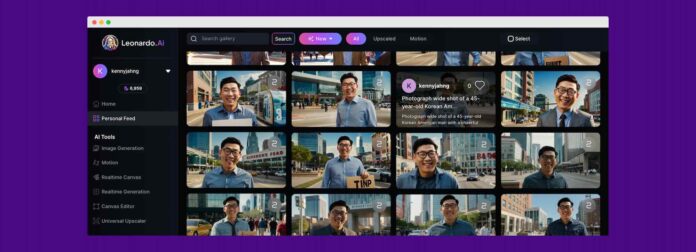
TL;DR Canva’s acquisition of Leonardo.ai promises to supercharge its design platform with generative AI, enabling church leaders to produce custom visuals faster and more creatively.
|
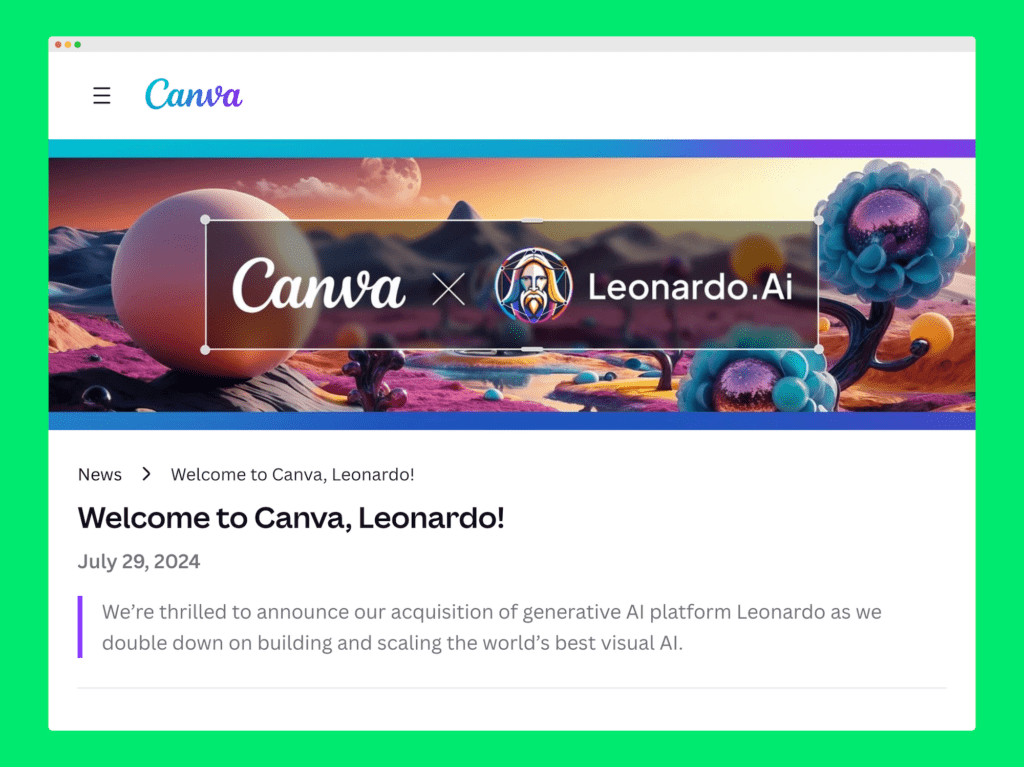
This week, Canva announced its acquisition of Leonardo.ai, a move set to enhance Canva’s AI capabilities significantly. This integration brings exciting opportunities for pastors and church staff who rely on Canva for creating visual content.
What is Canva?
Canva is a popular online design tool that allows users to create professional-quality graphics easily. It offers a wide range of templates, images, and design elements that can be customized for various purposes, including social media posts, presentations, flyers, and posters. Canva’s user-friendly interface and extensive library make it a go-to platform for many, especially churches looking to improve their visual communication game.
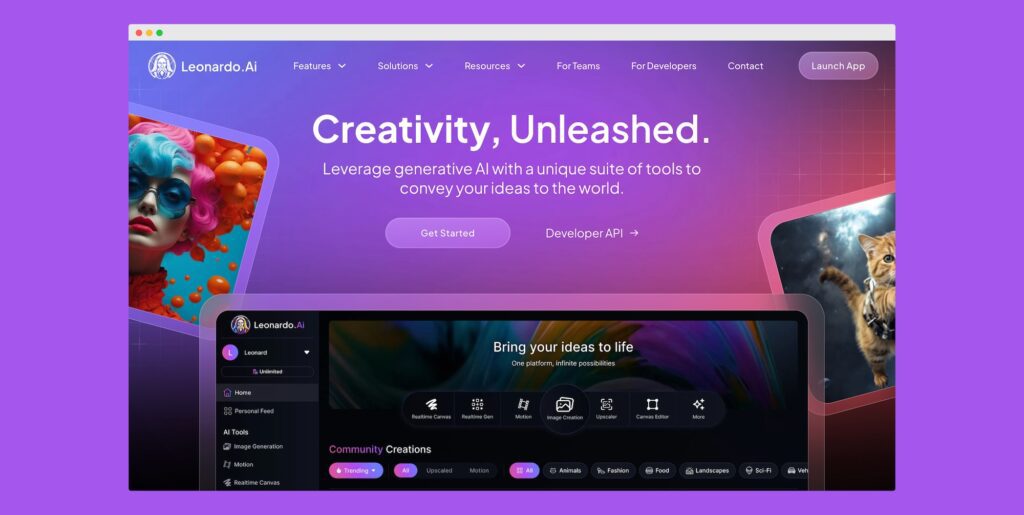
What is Leonardo.ai?
Leonardo.ai is an advanced artificial intelligence platform specializing in generative design. It leverages sophisticated algorithms to create customized graphics and design elements quickly and efficiently. Leonardo.ai is known for its ability to produce high-quality visuals, including illustrations, icons, backgrounds, and textures.
Practical Benefits and Uses for Pastors
The integration of Leonardo.ai into Canva would offer numerous practical benefits and applications for creating church-related visual content than ever before.
Pastors can use Leonardo.ai today to generate visually appealing sermon slides that highlight key points and scripture passages. The AI graphics tool can create custom backgrounds, icons, and illustrations, making sermon preparation more efficient and engaging.
Maintaining an active and engaging social media presence is crucial for modern churches. I’ve already been recommending to church leaders that Leonardo.ai can help them by generating custom graphics tailored to specific messages, events, or campaigns. This makes it easier to create consistent and compelling content for platforms like Facebook, Instagram, and Twitter.
Churches frequently organize events that require attractive promotional materials. Leonardo.ai can quickly produce professional-quality flyers and posters, helping to attract attention and increase attendance. The AI’s generative capabilities with text are better than ChatGPT + Dall-E. And as of now, Ideogram.ai is probably the other tool that does text within graphics as well. Being able to set reference images also increases the chances of getting outputs tailored to the program or event’s theme you already have.
For Bible studies, Sunday school classes, and other educational programs, pastors can use Leonardo.ai to create custom illustrations and diagrams that aid in teaching and enhance the learning experience. This makes complex biblical concepts more accessible and engaging for learners of all ages. Forget stock photo sites, this is a sweet spot for pastors who need better visual illustrations.
Additionally, Leonardo.ai can help in creating visually appealing graphics for sharing inspirational quotes on social media. These visuals can uplift and engage the community, enhancing the church’s online presence. What I love about Leonardo is that it can produce engaging backgrounds for worship lyrics and presentations vs. the generic abstract images you find in church services now. Finally, Leonardo.ai can create eye-catching visuals for church newsletters and bulletins whether you still use printed bulletins or are sending them via email.
Unique Strengths of Leonardo.ai
Leonardo.ai offers several unique features that set it apart from other AI image generators. Hopefully we’ll see some of these transfer over to Canva when it all gets integrated.
Collaborative Content Creation
Leonardo.ai enables a collaborative creation process between humans and the AI. Users can provide prompts, feedback, and direction to influence the creative output, allowing for a more interactive and tailored design process (DotCom Magazine).
Diverse Pre-Trained Models
Leonardo.ai offers a variety of pre-trained models spanning different styles, including photorealistic, artistic, and thematic designs. These models are optimized for detailed and high-quality outputs, making it easy to produce precise and remarkable visuals (Leonardo AI) (AI Parabellum).
Advanced Image Editing Tools
Leonardo.ai includes powerful image editing tools such as in-painting and out-painting, depth-to-image, edge-to-image, and pose-to-image controls. These tools allow users to make intricate adjustments and create complex, layered images with ease (Leonardo AI).
Custom Data Sets and Models
Users can upload their own photos to create custom data sets and models, allowing for highly personalized and tailored visual content. This feature ensures that the final product aligns closely with the user’s artistic vision (Leonardo AI).
Canva’s Acquisition Strategy
Canva has been on an acquisition spree to bolster its design capabilities. In addition to Leonardo.ai, Canva recently acquired Affinity, a professional creative software suite. Affinity’s core products—Affinity Designer, Affinity Photo, and Affinity Publisher—are renowned for their high performance and versatility. This acquisition allows Canva to offer tools tailored to professional designers and enhances its ability to compete with Adobe (Affinity) (Forbes Australia) (MacRumors).
Parallels and Predictions
Given Canva’s history with integrating acquired technologies, we can expect Leonardo.ai’s advanced features to be seamlessly incorporated into Canva’s platform. Similar to the Affinity acquisition, which brought professional-grade tools to Canva’s users, Leonardo.ai’s integration will likely enhance Canva’s generative design capabilities, making it easier for users to create sophisticated and personalized content. This integration may also lead to the development of new features and tools that leverage AI for more efficient and creative workflows.
Further Thoughts
Today’s announcement of Canva’s acquisition of Leonardo.ai is a super positive piece of news for pastors and church staff for creating visual content. (If your church isn’t using Canva already, you need to check it out!).
By integrating more AI tools into Canva, it will offer even more robust solutions for churches so that they don’t have to depend on multiple tools, they don’t have to learn complex tools like Photoshop, and they can really get more people involved because the learning curve isn’t steep.
Stay tuned to ChurchTechToday.com for more updates and insights on leveraging technology to support your ministry.