



|
TL;DR Saying “please” to AI isn’t about robots—it’s about how courtesy shapes us as Christ-followers. 1. Politeness may improve AI responses but also consumes energy. 2. Treating AI like humans risks blurring the human–machine line. 3. Habits with AI can carry into how we treat real neighbors. 4. Courtesy with AI can save time and energy for serving others. 5. Ultimately, love for God and neighbor should guide even digital interactions. |
A jerk is someone who doesn’t say “please” or “thank you.” And who wants to be a jerk, right? You add the obligatory niceties to your requests and responses, but do you really mean it? Sometimes you don’t even stop to ask that question. At times your words are sincere and at other times you are simply going through the motions. But what kind of world would we live in if we decided to give up on basic courtesy? We might be about to find out!
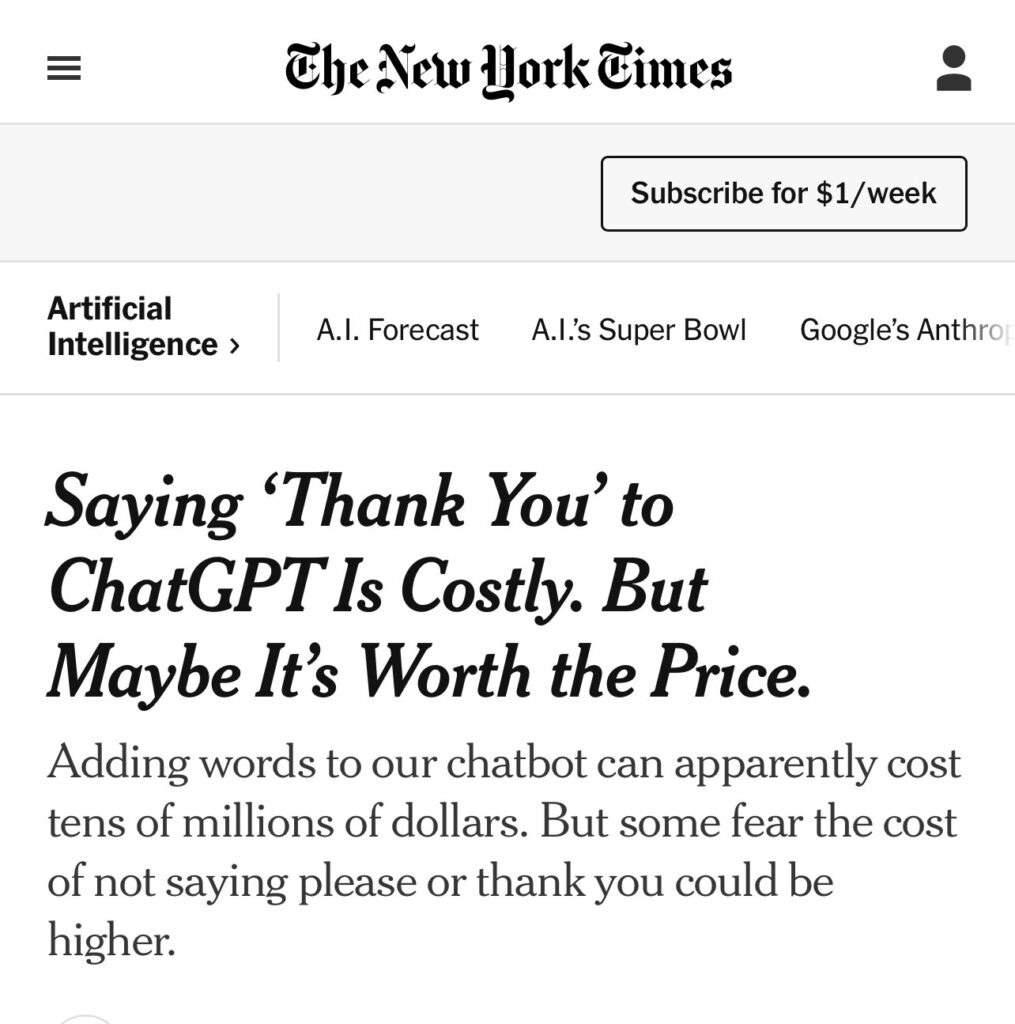
Recently Sam Altman shared a small detail on X that caused a flood of questions about courtesy and AI. He asked, “I wonder how much money OpenAI has lost in electricity costs from people saying “please” and “thank you” to their models.” He went on to answer his own question with a vague reference to “tens of millions of dollars well spent…You never know…” With this curious revelation, he opened a much bigger question, “Should humans treat AI machines that dialogue like humans with the same politeness we show a flesh-and-blood human?”
When I spent some time thinking about it and then asked people in my LinkedIn Network, I found some interesting reasons why people decide to be polite to their AI tools. Some claim that politeness increases the quality of the responses. There is research to back this up. One study found that “Polite language in human communications [with LLMs] often garners more compliance and effectiveness, while rudeness can cause aversion, impacting response quality.” In another study a full 70% of respondents said they were polite to AI when using it. I’m sure they had many reasons. Most people probably don’t even think about it. They simply use the same etiquette they would use for any other interaction. But 12% of those who were polite said they did it “in case of a future robot uprising”!
I must admit that I had thought about this even before Altman’s post. I remember a day when I was prompting one of the AI engines with a question and used a polite phrase that I would never have used with our family dog or my cell phone. It talked to me in such a natural and polite way that I returned the favor and responded without thinking about it.
In that moment, I got mad at myself for treating a machine with the same respect I treated a human. I vowed that day to not be polite to AI. Part of it was stubbornness and part was a desire to keep that line clear between machine and human.
While I was resolute, it wasn’t an easy commitment to keep. You try being kind and courteous out in the world and then being cold and demanding of your AI copilot. The contrast is jarring and hard to maintain.
As I think about that decision and how hard it is to implement, my mind goes to Jesus’ words in Matthew 22:39 about who we should love. The Jewish religious leaders are pressing him to clearly state the most important commandment. Jesus starts with the 1st commandment from the Law of Moses (to love God) and then adds to it a second one, which he says is just as important. That is to “Love your neighbor as yourself.” (NLT) The Jewish people would have interpreted it more narrowly to be fellow Jews, but we know from Jesus’ other teachings that He was speaking of anyone and everyone God has placed around us.
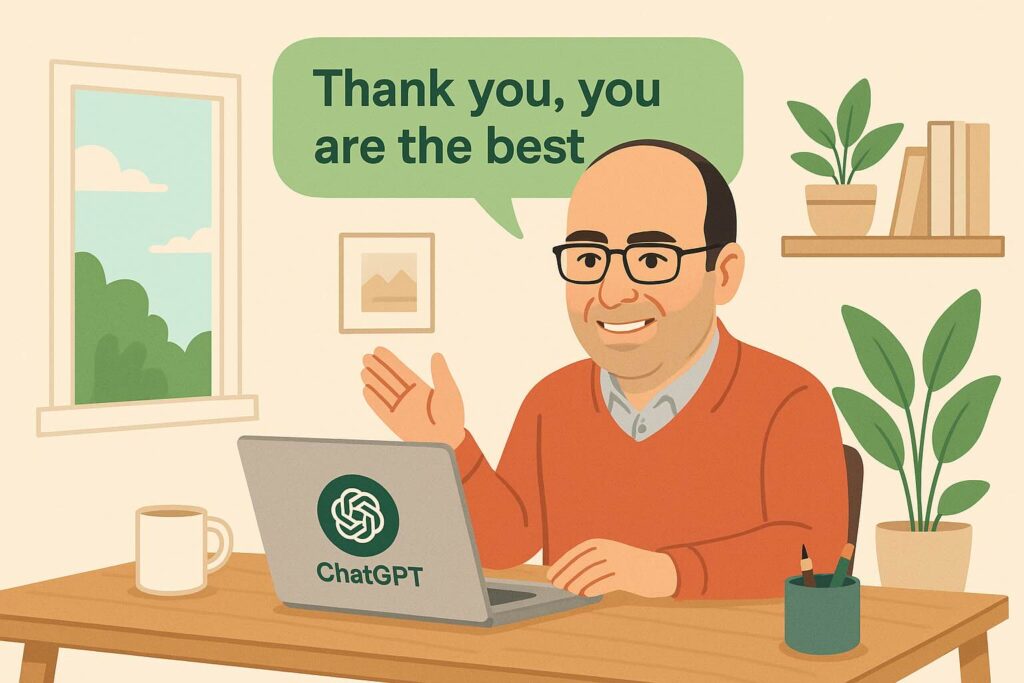
I begin to ask myself this follow-up question, “Does being polite to an AI tool make it more or less likely that I will love my neighbor?” My thoughts went in four very different directions:
- By being polite to AI and forcing AI to utilize precious compute power to respond politely, I am using up gigawatts of energy and millions of dollars that could be better spent making a difference in the lives of my neighbors through jobs, lighting and heating homes, and preserving God’s creation.
- By being polite to AI, I’m blurring the line between what is truly human and what is machine in a way that will potentially cause me to lose clarity about what it means to be human and elevate a machine over my neighbor.
- By being polite to AI, I’m practicing the kind of politeness I hope to show people when I meet them online or out in the world. It is possible that my cold treatment of AI will become the norm and will bleed over into how I treat service workers, co-workers, friends, and neighbors.
- By being polite to AI, I am potentially getting better results and can do my work more effectively, which is good stewardship of my time and energy. This could give me more time to love and honor my neighbor.
All of these are worthwhile questions to ask, and they could help me and anyone reading this article to discern whether it is appropriate to be polite to AI.
But in the end, I’m still drawn back to the first commandment. As my wife Mindy reminded me this weekend, to love God is to desire the fruit of His spirit that he mentions in Galatians 5. In this famous chapter, Paul describes the life that is possible through the power of the Holy Spirit. A life of “…love, joy, peace, patience, kindness, goodness, faithfulness, gentleness, and self-control.”
My life should be defined by this fruit. Not parts of my life, but my entire life. Which means my interactions with family, neighbors, and even talking machines should be seasoned with kindness and gentleness. My politeness reflects the power of the Holy Spirit in my life, not my dependence or admiration for the machine. I need to trust that the same Holy Spirit will help me discern that blurring line between human and machine.
Next time I ask an AI tool for help I may just say “please” and “thank you,” but it won’t be to get a better answer or get on the good side of future robot overlords. Instead, I hope my “please” reflects the Holy Spirit’s transforming power in my life.


I appreciate the heart behind desiring the fruit of the Spirit in our lives. But, in our desire of this fruit, I think we can be vulnerable to a “try harder” mentality – as if I am the one producing the fruit. It relies on my effort. It’s still good to be kind, polite, etc. But it’s the Spirit of God who produces the fruit, and we are to pursue Him. The results will follow.
I have appreciated Andy Crouch’s conversations about AI and the parallel to how the allure of so many technologies can be compared to the old pursuit of alchemy. We want effortless power (his definition of “magic”), and that is the promise of technology. But there are always ways that the promise is not kept, and humans pay the cost (like the energy cost of running AI that someone ends up paying). He uses the example of Jeff Bezos promising drones that will deliver all your packages, right to your door, in little to no time at all. In the end we have overworked Amazon truck drivers who have to behave like a machine in order to be on time and, at least in some instances, are not cared for well by their company.
Using AI for technical work, speeding up searches of large amounts of data, filling in code faster than we could, etc. seems the best use of AI. But when a growing number of people are looking to AI responses for counsel and almost therapy, it feels like we have crossed a line (and our souls are being shaped for the worse). Could it be that making AI more polite, even as it rewards you with better results when you are polite, is contributing to more people searching AI for “answers” that really should only be asked of people?
Interesting topic. I literally laughed out loud at “12% of those who were polite said they did it ‘in case of a future robot uprising’!” When my 18 year old daughter heard me and asked what was so funny, she said that’s why she’s nice to AI… in case it takes over the world. So, maybe not so funny now.