


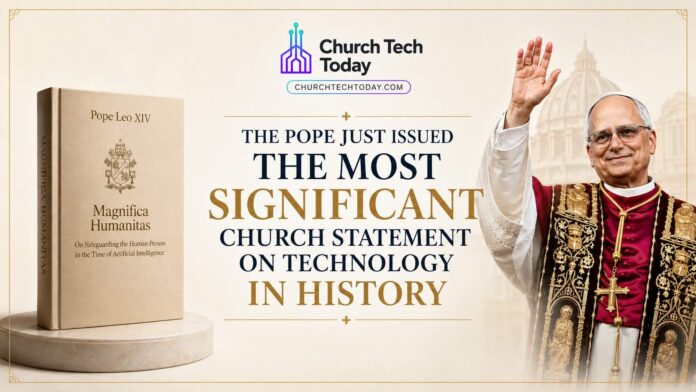
On May 25, 2026, the Catholic Church did something it has never done before. Pope Leo XIV issued a full papal encyclical on artificial intelligence.
Not a commission report. Not a working group recommendation. Not a footnote buried in a document about the environment. It is a complete encyclical, Magnifica Humanitas, addressed to the entire Church and to all people of goodwill, with AI and the human person as its only subject.
That distinction matters beyond Catholic circles. Papal encyclicals have shaped the moral conversation of Western civilization for over a century. Leo XIII’s Rerum Novarum in 1891 gave the world a theological foundation for engaging the industrial revolution that still shows up in labor law, social policy, and Christian ethics today. Leo XIV is doing the same thing for the digital age.
The question at the center of the encyclical is one every pastor should be sitting with: Are we building a Tower of Babel, or are we rebuilding Jerusalem?
What is an Encyclical Letter?
The category matters before the content. An encyclical carries the highest weight in ordinary papal teaching. Leo XIV issued this as a formal letter to bishops, clergy, religious communities, lay faithful, and all people of goodwill. At over 40,000 words, it is one of the longest social encyclicals the Church has produced. It runs five full chapters with 224 footnotes.
It is long, it is dense, and it is worth every paragraph.
The document was released on the 135th anniversary of Rerum Novarum, and that timing is deliberate. Leo XIV places AI in the category of “new things” of the present era, requiring the same structured social discernment that Leo XIII applied to capital, labor, and industrial transformation. The encyclical builds directly on Rerum Novarum and on every major social document issued in the 135 years since.
Two Bible Stories at the Center of It All
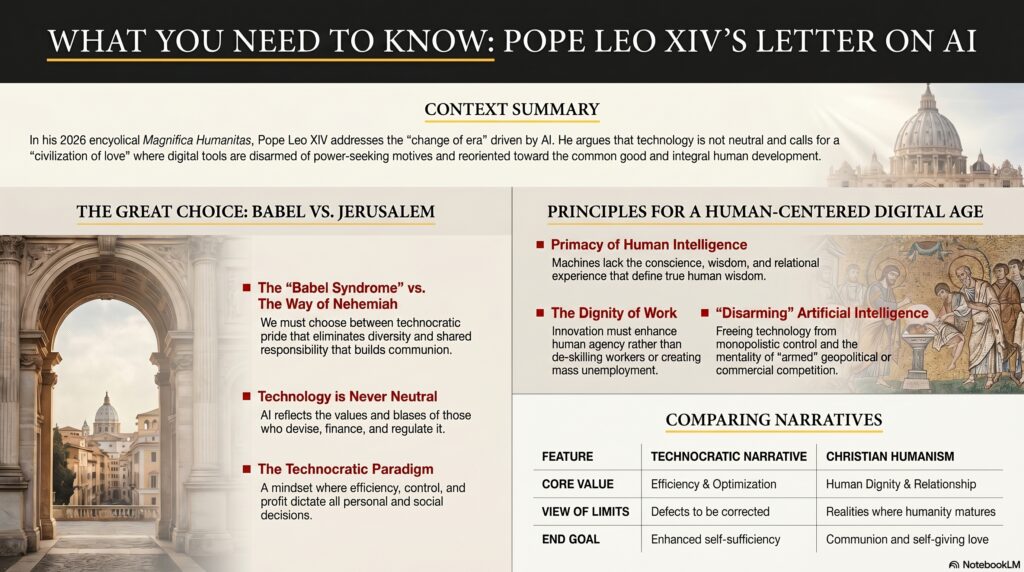
The two images that carry the entire document are the Tower of Babel from Genesis 11 and the rebuilding of Jerusalem’s walls from Nehemiah 2-6.
Babel represents AI built on pride, uniformity, and self-sufficiency. A project conceived without reference to God, where a single language and a single technology flatten diversity and sacrifice human dignity for efficiency. The result is not unity. It is dispersion.
Nehemiah is the other option. He prays before he acts. He surveys the damage before he proposes solutions. He convenes the people, assigns each family a section of the wall, listens to concerns, and coordinates without imposing. The city comes back through the shared responsibility of all. God stays at the center. Relationships get rebuilt before the stones do.
The Pope writes that technology is never neutral, because “it takes on the characteristics of those who devise, finance, regulate and use it.” The choice is yes or no to technology, yes, but more fundamentally it is a choice between these two building projects.
The Nehemiah narrative runs through all five chapters and gives any pastor a ready biblical anchor for conversations about AI with their congregation.
Chapter One: Why the Church gets to speak on this
The first chapter traces Catholic social doctrine from Leo XIII through John XXIII, Vatican II, Paul VI, John Paul II, Benedict XVI, and Francis. It makes the case that every major technological and economic shift in the last 135 years has called the Church to develop its social teaching, and that AI belongs in that same line.
Leo XIV’s argument is that Social Doctrine is a living process of discernment, born from the meeting of the Gospel and the real questions of each generation. AI belongs in that tradition and calls it to go further.
Chapter Two: The principles that apply to everything digital
This is the doctrinal core. Leo XIV takes five longstanding Social Doctrine principles and applies them directly to the AI age: the common good, the universal destination of goods, subsidiarity, solidarity, and social justice.
The most striking section covers the universal destination of goods. The Church has always taught that the earth’s resources belong, in a fundamental sense, to all of humanity. Leo XIV extends this to digital assets.
He writes that among the goods universally intended for everyone, we must now include patents, algorithms, digital platforms, technological infrastructure, and data. When those things stay concentrated in the hands of a few without adequate sharing and access, a new injustice contradicts a basic principle of Catholic teaching.
That is a direct doctrinal claim about algorithm ownership. It is a remarkable sentence.
On subsidiarity, he applies the principle to the biggest tech companies in the world, arguing that they already define conditions for access, rules of visibility, forms of interaction, and economic opportunity. That level of power must be directed toward the common good with transparency and accountability, including public checks on how algorithms work.
The chapter ends with a section the Church rarely says so plainly. Social Doctrine is a message to society, and it is an examination of conscience for the Church itself.
Chapter Three: What AI actually is, and what it will never be
This chapter gives pastors the most usable material in the entire document for conversations with their congregations.
Leo XIV draws a clear line. AI systems imitate certain functions of human intelligence. They do not have experiences, do not have a body, do not feel joy or pain, do not grow through relationships, and do not know from the inside what love, work, friendship, or responsibility mean. They have no moral conscience. They can simulate empathy, but they do not understand what they produce.
His description of AI learning is worth quoting directly: “Even when these tools are described as capable of ‘learning,’ their way of doing so is different from that of a human person. It is not the experience of those who allow themselves to be shaped by life and grow over time through choices, mistakes, forgiveness and fidelity. Rather, it is a form of statistical adaptation based on data and feedback.”
That single paragraph is a sermon illustration waiting to be used.
The chapter also addresses transhumanism and posthumanism, the philosophical movements that treat human limitations as problems to be fixed through technology. Leo XIV rejects that vision entirely. The authentic “more than human,” he argues, comes through grace in Christ. Weakness, limitation, and finitude are the conditions through which love, compassion, and genuine relationship become possible.
Chapter Four: Truth, work, and freedom
This is the longest chapter and the most practical. It covers three areas where AI is changing daily life.
On truth, Leo XIV calls for an “ecology of communication” and warns that AI-fueled disinformation is eating away at the foundations of democratic life. He quotes Hannah Arendt on totalitarianism and makes the case that when a society stops caring what is true, it loses its footing in a predictable way.
On work, he applies the Church’s longstanding teaching on labor directly to automation. He quotes the January 2025 Vatican note Antiqua et Nova on how AI can “paradoxically de-skill workers, subject them to automated surveillance and relegate them to rigid and repetitive tasks.” He calls for concrete, verifiable protections for workers whenever automation is introduced.
He spends significant time on children and screens, documenting real psychological harm from early and unsupervised device use and calling for a real alliance among governments, schools, and families. He supports age limits and wants service providers to carry accountability, not just parents.
On freedom, he names digital addiction and surveillance capitalism as new forms of slavery. He goes further, calling out the hidden workers who keep AI running, including data labelers, content moderators, and rare earth miners, as people whose exploitation demands the same moral response as historical slavery. He asks for forgiveness on behalf of the Church for how long it took to condemn slavery clearly, calling it a wound in Christian memory.
Chapter Five: Power, war, and the civilization of love
The final chapter addresses geopolitics and armed conflict. Leo XIV says it is not permissible to give lethal or irreversible decisions to automated systems. His line on this is direct: “No algorithm can make war morally acceptable.”
He also says the just war theory has become outdated, arguing that humanity has better tools available, including dialogue, diplomacy, and forgiveness.
He proposes what he calls the “civilization of love” as the answer to the culture of power, and offers five specific paths toward it: disarming words, building peace through justice, looking at conflict from the perspective of victims, cultivating healthy realism, and reviving dialogue and multilateralism.
How it ends
Leo XIV closes with Mary’s Magnificat as the song of hope for the AI age. He calls the Church to be weavers of hope, comparing the calling of every Christian in the digital era to Nehemiah’s: survey the ruins, pray before acting, assign the work, listen to concerns, rebuild brick by brick.
His final charge to church leaders is worth reading slowly. He writes that we are called to enter the construction sites of history, including research labs, tech companies, schools, media organizations, institutions, and local communities, to rebuild what has collapsed and protect what is threatened.
What pastors and ministry leaders should take from this
The Nehemiah narrative runs all the way through this document. It gives pastors a biblical anchor that connects directly to one of the oldest and most developed traditions of Christian social thought in the world.
The declaration that algorithms, data, and platforms fall under the universal destination of goods is a doctrinal claim with real-world stakes. Access to AI tools is a justice issue. Churches that grasp that are better positioned to serve vulnerable people in the digital transition and to explain to their congregations why equitable digital access is a ministry concern, not a technology preference.
The work section draws on the same research on AI’s labor market impact that the Church AI Roadmap Summit covered earlier this spring. Leo XIV places all of it inside Catholic social teaching, giving ministry leaders a theological grounding for those conversations.
The section on children and digital life is the most urgent for everyday local church ministry. Leo XIV is describing documented harm to minors and calling the Church to respond with the same seriousness it would bring to any other threat to children in the congregation.
Read the full document
Magnifica Humanitas is available in full at the Vatican’s official website in eight languages.
English: https://www.vatican.va/content/leo-xiv/en/encyclicals/documents/20260515-magnifica-humanitas.html
If you are short on time, start with the Introduction and Chapter Three. Then Chapter Four on work and children. Return to Chapters One and Two for the doctrinal foundations when you have more bandwidth. Chapter Five on war is important but the furthest from everyday parish ministry.
This is the most significant magisterial document on technology in the history of the Catholic Church. For leaders at the intersection of faith and technology, it is required reading.