


|
TL;DR The 2025 State of Church Tech Report shows pastors increasingly see technology as a way to deepen connection—not replace it. 1. 86% of pastors now say tech increases church connection. 2. Digital tools are reducing loneliness and personalizing care. 3. Recurring giving and digital generosity are rapidly growing. 4. Gen Z & Millennials are reshaping church engagement. 5. AI is entering church strategy, but pastors remain cautious with sermons. |
Episode Summary:
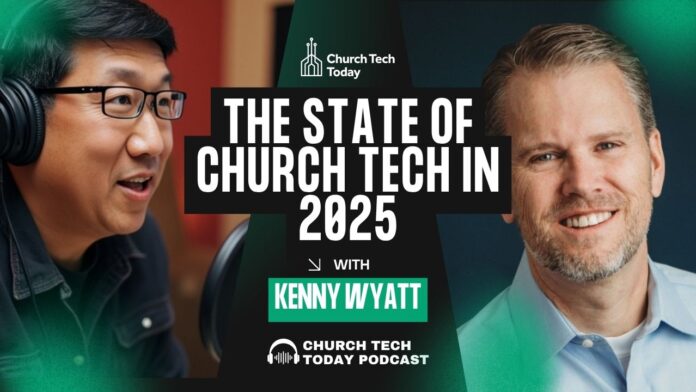
In this episode, Kenny Jahng sits down with Kenny Wyatt, CEO of Pushpay, to discuss the 2025 State of Church Tech Report and its surprising insights for ministry leaders. Discover how leading churches are leveraging technology not only for growth, but to meaningfully increase connection, generosity, and engagement—even across digital and in-person divides. Kenny Wyatt shares practical examples, the latest trends with AI in ministry, and actionable ideas for pastors who want to use tech as a true amplifier for their mission. Tune in for a grounded, energizing conversation that gives you the real data—and next steps—for thriving in today’s ministry landscape.
In This Episode, You’ll Learn:
Why 86% of pastors now see technology as a way to increase church connection, not replace it
How church tech can be used to actively reduce loneliness within your congregation
What growing churches do differently with data to personalize care and follow-up
Why digital giving and recurring gifts are rapidly increasing generosity across generations
How Gen Z and Millennials are changing the landscape of church engagement and tithing
Where AI fits into church strategy (and why most pastors still avoid using it for sermon content)
How Pushpay and its partners are building an integrated, secure ecosystem for holistic ministry impact
Key Quotes:
“Those churches that are growing and thriving oftentimes have high correlation to using technology, not as a replacement for connection, but actually as an amplifier for connection.” — Kenny Wyatt
“Data isn’t scary anymore. The data is actually providing insights… to understand what is the next connection point you should be making.” — Kenny Wyatt
“If you use technology strategically and with intention, it can actually deepen your faith.” — Kenny Jang
“The future of church tech is driving connections.” — Kenny Wyatt
Links & Resources Mentioned:
- Pushpay
- State of Church Technology Report 2025
Church Tech Today — https://churchtechtoday.com
Resi (Pushpay’s livestream/content platform)
Visitor Reach (Pushpay partner for digital outreach)
Pew Research Study on church trends (referenced, not directly linked)
About the Church Tech Today Podcast:
The Church Tech Today Podcast is here to help pastors, church staff, and ministry leaders navigate the intersection of faith and technology with confidence. Hosted by Kenny Jahng and brought to you by www.FrontDoor.church.
EPISODE TRANSCRIPT
Kenny Jahng [00:00:06]:
Hey, friends. It’s that time again. Kenny Jahng here with the ChurchTech Today podcast. And today, it’s gonna be a fun one because it’s someone I respect, but someone I like his name too. His name is Kenny Wyatt, and he is the CEO over at Pushpay. Now, Kenny and I and I have known each other for a while, and he spent a couple of decades, in the tech world, both in the church world and not. And this is where I love talking to leaders that have marketplace experiences like I do that help inform the church, and I think today’s conversation is gonna be interesting in that in that regard. And, again, I love his deep connection to ministry.
Kenny Jahng [00:00:47]:
Today, he’s leading Pushpay. And as you know, Pushpay, they have tens of thousands of ministries that they are helping grow and thrive and work on financial stewardship, and more. And, I’m just thrilled to be able to tap Kenny’s, insights here as a leader and also in terms of what Pushpay is doing for a lot of the churches and ministries out there. And one of the things that we’re gonna frame today’s conversation is Pushpay does this annual state of the church technology report. You can go back onto past articles we have at CTT and look at some of the insights. And every single year, there’s some new really good insights that I think that we can learn from. I think this year, there’s over 1,500 pastors that have been pulled in this thing. And so, Kenny, welcome, first of all.
Kenny Jahng [00:01:33]:
Thank you so much for being with us. I know you’re super busy. I really appreciate you dropping by today.
Kenny Wyatt [00:01:39]:
Kenny, great to see you again, and, look forward to the conversation for sure.
Kenny Jahng [00:01:42]:
Absolutely. So let’s get right to it. So the the new report for 02/2025, the state of the church technology report, one of the things I picked up there is that eighty six percent of pastors now say that technology increases connection. And this is, like, totally completely different than when I was a church online pastor where we were in the doghouse thinking that, oh, technology is gonna help ministry and connection. From your perspective, what do you think is the biggest mindset shift of growing churches that they’ve now seen technology that maybe others are still resisting, but these growing churches really understand what technology offers us?
Kenny Wyatt [00:02:21]:
Yeah. It’s a great question, Kenny. And by the way, I’ll I will do just do a very quick plug on, State of Church Tech. If you if you get a chance to download it Yes. It we believe it is, one of the best kind of guiding documents out there on what is happening inside of of churches and ministries today and how technology can be leveraged to make it make our ministries much more efficient and much more effective, over time. And so if you don’t have a chance to download it, please do. As Kenny mentioned, 1,700 pastors, all of whom were decision makers around technology or influenced technology decisions, were Kenny poured their heart and soul into this report. So, many thanks to those that participated this year.
Kenny Wyatt [00:03:01]:
Your question, 86% of pastors, now say technology does increase connection. We shouldn’t be surprised at this. Those churches that are growing and thriving oftentimes have high correlation to using technology, not as a replacement for connection, but actually as an amplifier for connection. Right? Those that we’re really seeing and you see this every single day, Kenny. Those that we’re seeing using technology in a in a mighty way for their ministries are using it to, create deeper outreach, create deeper connections. We know that a lot of ChurchStaq happening online today versus actually inside the four walls of the church. And so technology just enables more and more pastors to to create that personal connection in ways that have never been Kenny done before, in in ministry. Would love to unpack some of this as we go in, in in places like AI and other tools Yeah.
Kenny Wyatt [00:03:54]:
That are starting to emerge on the scene, for for for church technology. Yeah. I’d also say that many pastors are telling us through this report that data isn’t scary anymore. Right? The data is actually providing insights. Right? So you can start to make some connections and correlation with the right data, with the right platform in order to understand what is the next connection point you should be making. Who is that seeker that’s walking through the front door of the church? How they engage with your social content? How do you how do they wanna be Kenny communicated to and with, over the Kenny of their path of either evangelism or discipleship? And so, we’re seeing churches really thrive by by leveraging, these connections through data.
Kenny Jahng [00:04:39]:
I love it. Now here’s an interesting point that I picked up also that according to the report, churches now are, I think, four times more likely to say that church actually reduces loneliness. And I thought that to me stood out because I think many pastors today and a lot of people in general will say tech usage actually leads to the opposite outcome, that it’s actually promoting load loneliness. It’s compartmentalizing people’s lives. Why do you think the leaders from the survey are saying that it’s four times more likely now that tech reduces loneliness?
Kenny Wyatt [00:05:13]:
Yeah. I mean, I think I think your statement isn’t wrong. Right? That, I I do think we see in this world today that, in many cases, technology actually increases loneliness. And so I don’t think that that is necessarily wrong. I just think it’s incomplete. Right? So, as you think about churches leveraging technology, and they do it kind of if they leverage technology that’s intentionally designed for their community, it actually has the opposite effect. Right? So think about, for instance, a small group leader. So someone who maybe is leading a dozen or 15 different individuals or even couples as part of a small group on a regular basis.
Kenny Wyatt [00:05:51]:
Technology actually can help, reduce the loneliness that some of their small group members may feel. Right? So if you start to see a drop off in attendance, if you start to see measured engagement, reduction, That creates a trigger for an outreach. That that that creates a trigger to maybe deepen a relationship because of a life event that may have happened, that, therefore, technology can help come alongside that small group leader, in order to Kenny trigger them to say, hey. This person needs outreach. This person, maybe isn’t as engaged as they once were. And that that act alone could help reduce loneliness as one simple example that happens every single week at church.
Kenny Jahng [00:06:32]:
Yeah. I love that. I mean, those tools that you can now use in ChurchStaq, it’s practical. I think that that’s a practical use case of, like, how do you actually tackle the person who needs connection, needs empathy, needs support, and the church being the church. Right?
Kenny Wyatt [00:06:48]:
Exactly right. I think the other thing I’d mentioned is, you know, we in in part of the report, you saw this as well that, you know, a vast majority of churches are now using some sort of live streaming as part of the ministry. And that digital outreach, that that ability to take a ChurchStaq, for instance, a sermon to just about anywhere in the world of one of their members. It could they could be on a treadmill. They could be on a hike. They could be on an airplane watching watching the sermon. All of a sudden, the the gap, the gap closure for loneliness, starts to become much much smaller. Because now rather than having to sit in a Sunday service, they can feel connection with that same, kind of ecosystem of the pastor, preaching directly to them no matter where they are.
Kenny Wyatt [00:07:33]:
So, again, one other example around, where many kind of, pieces of technology are being able to use to kinda close this divide of loneliness that we’re experiencing in the world.
Kenny Jahng [00:07:43]:
Now there’s also a tension that I see, Kenny. Like, so nearly I think nearly half of pastors say that tech deepens faith, which is I totally see that that if you use it strategically and you have intention, the technology actually deepens your faith. Yet we do still see this continued decline in church attendance overall, right, in our culture today. What are your thoughts on that tension between those two points? Like, tech tech is accelerating, deepening, supporting faith, spiritual developments, and yet we’re seeing declines in church attendance. Like, how how do we how should the pastor listening in today think about this?
Kenny Wyatt [00:08:24]:
It’s a great point. So I I I’ll leave you maybe with a couple of different, angles on that that same question. One is we are seeing that decline starting to start to flatten just a bit. Right? So you you probably read the Pew Research study just recently that was, that was announced that, you know, 62% of Americans are identifying as Christians. That that’s encouraging. Right? And so, we are starting to see while we we have seen over the past few decades this decline in Christianity, we are starting to see those trends flatten out, here as of late, which to me is super encouraging and super hopeful, for the church. More importantly is we’re starting to see some trends while you while it is true overall decline, we are starting to see some trends by generation that are super encouraging.
Kenny Jahng [00:09:12]:
Yeah.
Kenny Wyatt [00:09:12]:
We’re starting to see engagement by the younger generation. I’m thinking millennials and Kenny z specifically that are are more engaged and and more deeply engaged in the church than, ever before in their own individual generations, but also relative to previous generations. And there’s a lot of reasons for that. Right? Churches that are embracing digital, they’re embracing technology tools or appealing to those generations. Right? The second is, we’re starting to see a lot more trends, for instance, that, is just take donate donations or giving, for example, that churches that are starting to connect real purpose and and reason for the gift and the giver, particularly for the younger generations, that that those those two those two items are starting to correlate even even more and more. So this appeal to younger generations, I think, is having an impact. And I predict, the the the the the data will have to bear it out over time. I predict that we start to see a revival, particularly in The US, as a result of some of these emerging trends, in the younger generations here as of late.
Kenny Jahng [00:10:20]:
Yeah. I know that even I think the stat I saw is that Kenny z, is responsible for something like 34% of church tithing and giving. So it’s like a third Yeah. Their total giving is a little bit lower due lower income, obviously, but their participation rate is notable, and it’s it’s rising, basically. Right? As church engagement rises, their giving
Kenny Wyatt [00:10:43]:
is rising. And imagine over time, Kenny, as the as those generations start to get into their earning years, not that the total donation volume is is kind of stat number one, but what it it what it does show, donation volume and total donation amounts are strongly correlated to engagement in the church. Right? So if you believe those two are highly correlated, imagine over the next several years as those, those generations start to hit their earning years, what the impact of engagement could be in the church over time.
Kenny Jahng [00:11:15]:
Yeah. And, again, I think it’s we’re talking about digitally native generations now. And I think of nearly nearly half or over half now of church leaders actually give, electronically, which I think just anecdotally, the the average pastor doesn’t that’s not something they would report on, a a survey, right, of themselves of perception that more than half of the church go goers are actually giving electronically, which I think is just something that we have to our perceptions have to catch up with reality in that that way. Right. Now the the again, the surveys I love this because the surveys saying the the pulse of the of the country is positive in in the in terms of digital, in terms of giving, in terms of generosity that the 70% of pastors and leaders are now saying that tech increases generosity. Now I I think that tech solutions like, Pushpay offer more options, for giving today versus five years, ten years ago. Right? But is it that is it just that there’s more surface area, more options, more places to give, more ways to give, or is it something else that you think is driving this increase of generosity because of the technology that we have available today?
Kenny Wyatt [00:12:31]:
It it is a great question. And by the way, this this statistic, the 70% say tech is increasing in generosity, actually doesn’t surprise, as push pay at all, because we we see it in our own data. Right? We see when customers move to push pay, the technology tools that are available now to that church Yeah. We see generosity increasing, to a point where, actually, you know, we we offer a guarantee of generosity.
Kenny Jahng [00:12:57]:
Yes.
Kenny Wyatt [00:12:59]:
Just by implementing the tools that that Pushpay, offers to churches. So this didn’t surprise us, but it is in my mind, it’s it’s more than just access. Yes. Of course, having more access to, giving tools and technology, will increase generosity, but it’s more than that. Right? So let me let me maybe leave we leave you with a a couple of different statistics. One is and this is to your access question. You know, we we’ve, we launched Apple Pay, I don’t know, several quarters, maybe a few years ago, before my time. But what we’re seeing in Apple Pay, for instance, is that 54% of first time donors will use Apple Pay.
Kenny Wyatt [00:13:40]:
Now that that’s an incredible statistic because what that tells you is those that are coming in, it somewhat goes back to the the Kenny and millennial comment on the earlier. Right? Those that are walking through the front door of your church for the very first time, more than half of them are going to use what is most common, what is most comfortable to them, and what’s easy for them to engage from a a donation perspective, and that’s Apple Pay, as well as other technologies. But that’s just one example of of many where we see that it increases generosity because we because access makes it so much easier. I could say that about ACH. I could say that about cards. I could say that about crypto, for instance. Having the the, to use your words, kind of the as many access options available to you, of course, is going to increase generosity, but it’s more than that. Right? What also has to come with it, is tying that donation, tying that, that gift, that tithe back to something that’s meaningful and purposeful to the donor.
Kenny Wyatt [00:14:39]:
We’re seeing more and more churches start to make this very, very strong correlation even from the pulpit about what the gift is actually driving. Right? And so in my mind, that’s the rest of the swing. Right? That’s the rest of what increases generosity. It’s not just having access to great technology tools like Pushpay, but actually kind of tying what the gift means to the broader impact of the community, to the broader impact of the kingdom, and finally to the broader impact of Kenny of the world around us. And so I think those two things in in conjunction with one another lead to this 70% say tech is increasing generosity.
Kenny Jahng [00:15:17]:
Yeah. And I think and, again, it is those tools that allow you to it’s not just the old offering plate where it’s like, oh, you only have one option. The money goes in here, and that’s it. There’s no designated. There’s no campaigns. There’s no the the options that we have available that tech gives us, is quite amazing, I think, in that regard.
Kenny Wyatt [00:15:34]:
Yeah. And what I what I would say came to that as well, and I’ve I’ve I had the opportunity to be in literally dozens, not hundreds of churches in a year. Right? Just customers. Oftentimes, I’ll go to a Wednesday night or a Thursday night service. I was in one last week in, in in Alabama. But the, the my point in all this is what I’m hearing a lot from the pulpit and from messages is this idea of a recurring gift. Yeah. Because it’s obedient.
Kenny Wyatt [00:16:03]:
Right? God’s God calls us, to to be obedient in our giving, and one way to show obedience is actually through a recurring gift. And that, that is the biggest driver that we’re seeing, in time Kenny of increased generosity and technology, is through the recurring gift. Many churches that we deal with that we kinda have the opportunity to serve today are reporting between 6080% of their gifts are now coming through recurring, which is, you know, obviously, nice and stable from a donation perspective, but it’s more than that. It’s also it it what it also means is that many of their congregants, that many of their members are being obedient to what God’s calling us to do on a regular basis.
Kenny Jahng [00:16:44]:
I love that. Wyatt if we shift gears a little bit? Because the new kid on the block, the popular kid in class is AI. And I wanna talk about AI a little bit here because this is important for the future, but it’s also here now and today. So and it seems like, most pastors now are watching and paying attention to AI in 2025. We just did a, state of AI in the church report here at ChurchStaq today, and, it’s super encouraging. Like, the majority of pastors are actually for the use of AI in ministry today. But there’s still a bunch of people that are hesitant, that are concerned, that are trying to be intentional and steward the technology in a right way. I would say from your perspective, what are some of the questions, from your point of view that church leaders should be asking about AI that aren’t even on their radar yet? Right? They they haven’t even thought about these questions.
Kenny Jahng [00:17:41]:
As a technologist on your side, what what’s one or two questions you might offer, that are wise questions that a pastor should start to ask about AI today?
Kenny Wyatt [00:17:51]:
Great question. A couple that come to mind. One is, if I’m a pastor of a church, I might be asking how can AI be used to foster genuine spiritual connection with the members of my church, with visitors of my church, with folks that maybe even be seeking my church, in in, you know, the ZIP codes that surround, for instance, the church. How can how can AI be used to foster genuine connection, with with with with those people? And I think there’s some really cool tools out there. I’ll talk maybe a little bit later about what push Pushpay is doing on the AI front. But that would be the very first question I would ask is, how can how can, AI help my job or my staff’s job be easier to make connections and therefore make outreach to those that are either seeking or that I’m trying to to disciple inside of my church? I do think your point of it being double a double edged sword is actually a good one. Right? I I do think that leaders should also be asking, you know, and considering what are the ethical implications of AI in my ministry. Right? How do I think about data security and data privacy, as I look to leverage AI driven insights, for instance, inside of my ChurchStaq so those are probably two, maybe, opposing questions I would be asking if I’m a if I’m a pastor today considering how I use AI.
Kenny Wyatt [00:19:15]:
What we’re seeing as far as very, very early trends, one is, you know, you probably saw in the in the, in the report, we we almost doubled actually, more than doubled the the number of pastors that are thinking about considering wanting to learn more about AI as part of their ministry. That’s a big step in a single year. It’s a it’s a it’s a material step, and we typically don’t see a jump in data like that year over year. So what it tells us is AI is, is on the forefront of everything we’re doing as a consumer, for instance, in our daily lives. It’s also on the minds of our pastors and about how they make their their their ministries that much more effective. And so I I would I would say start with those two questions. What we’re learning is, however, those that are adopting it early, those that are adopting a AI early are using it to augment and replace maybe, some more methodical kind of outreach, steps that that, that are made easier with AI. Right? Sending emails, sending communications, trying to correlate social engagement with content that I’m trying to figure out how I then use this outreach tools, for instance.
Kenny Wyatt [00:20:20]:
What we’re seeing what we’re seeing it not used at all, which I love this. I love the the, the discipline of pastors is we’re not seeing it used yet and maybe never for content creation. Right? We’re not seeing pastors use AI to go generate sermon, Kenny content. That that is still held Kenny of very protected as a way that I’m you know, I want to to breathe into the spiritual life of my church, and I’m gonna do that on my own versus using technology to drive it.
Kenny Jahng [00:20:49]:
Yeah. The figures that you guys had in the report mirrors the report that we did with the the state of AI and that currently, I think you said 45% of pastors are actually adopting AI usage right now today. And I think that to me is, I don’t know. I that’s encouraging to me because I think what you’re saying is that measured approach of, increased adoption is the thing that we need going forward. Now what about Pushpay’s products and services and offerings? Like, can you give us some, insights as to how you are thinking about AI across your platform and your offerings?
Kenny Wyatt [00:21:29]:
Yeah. For sure. I think about it across the the discipleship journey. Right? So and I’ll I’ll I’ll describe maybe a few things we’re thinking about, and actually deploying, today in our technology our technology platform. If you think about, for instance, evangelism, right, and how you use AI at your back with push pay in order to, increase the effectiveness of evangelism or getting news new seekers, new members of, of of your church through the four walls of the ChurchStaq. We’re, for instance, in in the process of developing with Resi, for instance, how do we leverage the content, all of the content that sits, inside of the library of a church of livestream? How do you leverage that, chop chop up that data, create social, Kenny of posts around it, and then use it as an outreach tool for evangelism. And do that in a way that, you know, AI can help kind of skip a ton of steps, if you will, in actually snipping that content, making it specific to some topics that maybe you wanna generate inside of a community, and then, therefore, create that social content for you. So that that’s one area of Kenny of leveraging literally hundreds, if not thousands, of hours that most churches have sitting on Resi of just content that could be leveraged for social outreach and evangelism.
Kenny Wyatt [00:22:51]:
So that’s that’s a that’s a positive use of AI that that Pushpay is helping to drive. On the flip side of the spectrum, you think about discipleship. Right? We’re we’re we have already and will continue to embed inside of our CHMS product, and our donor management product the connections that AI can help us drive between donors around engagement and how you help disciples grow in their spiritual journey by using those technology tools. We know for certain, the data shows us, that if someone’s involved in a small group, they’re leading as a volunteer, they they they’ve got kids in kids ministry, that they’re they’re donating sorry. They’re they’re they’re tithing through recurring giving, their tie tithing on a regular basis, for instance, that that all of that points to engagement and spiritual growth, over time. And so being able to make those connections for pastors through AI driven insights, but more importantly than helping pastors through AI figure out what is the next point of connection? What’s the next outreach in that discipleship journey? Who should I engage for the next volunteer? Who should I engage for the next small group leader, for instance? All of that can be kind of technology used for good at the back of an a strong XP or a strong SP in order to make those connections and drive that discipleship journey. So
Kenny Jahng [00:24:06]:
I love it.
Kenny Wyatt [00:24:06]:
Tell I’m passionate about it, Kenny.
Kenny Jahng [00:24:09]:
Me too.
Kenny Wyatt [00:24:09]:
I have, I have, just a ton of, just confidence, in what AI is going to bring the church, if if we deploy it right and if we’re smart about kinda how we think about data privacy and the other issues that also surround the AI topic.
Kenny Jahng [00:24:26]:
Yeah. And I I think, we’re we’re hosting a vibe coding events in the September, and I think, a couple members of your team are gonna join us. And I think this collaboration posture that your team has, with church leaders, I think is what we need for the kingdom as a whole. Okay. As we wrap up here today, you have a room full of pastors, executive pastors, church leaders, staff in front of you listening to this. What’s your pitch for why they should be looking at push pay and ChurchStaq stack? I mean, most churches out there have, a lot of these solutions are ready of some sort. We’re not in the wild wild Wyatt days of ten years ago when the majority of churches did not have a CHMS installed. They didn’t have, you know, online giving, etcetera.
Kenny Jahng [00:25:14]:
What’s your pitch today? Can you frame it and just give give, pastor, a sense of what is the differentiator or what’s different about when we adopt your products and services offerings? What is it gonna do to our ministry?
Kenny Wyatt [00:25:29]:
Yeah. I I maybe break it up in a couple of different pieces. One is, you know, Pushpay has been around for quite some time. It was it was, in in in many many places of, of technology and ministry, it it was and continues to be the forerunner of technology and and and kinda how we make ministry more effective and more efficient over time. Tens of thousands of churches and ministries trust Pushpay on a regular basis because of that. We have a proven track rec record of increasing generosity over time by some of the proprietary tools that we’ve that we’ve built, over the years. And it frankly is a very, very safe and secure platform, that the churches have have depended upon for quite some time. But it’s more than that.
Kenny Wyatt [00:26:14]:
Right? As you think about, combining, for instance, donor management, so our our tools for giving and generosity with CHMS. Right? It’s now running Kenny of the back office of your church, the the front office of your church, kids ministry, volunteer, scheduling. You know, the list goes on and on. Now combining the the all the data, the rich data that comes out of our CH CHMS with donor management, imagine the insights that churches can now get today by combining those two things we call it stack. Right? So now you can now you can now we can give ChurchStaq, and they can provide themselves very, very rich insights about the health of their church, the health of their donors, the spiritual journey, that that, that they’re helping to drive and the the impact of that spiritual journey over time. That’s the second piece. Now you combine that with Resi. Right? Now you combine that with with live streaming in an app, that combines all of this together.
Kenny Wyatt [00:27:09]:
And you’ve got really all four corners of the church covered through Pushpay. Right? Those that are walking through the front doors and and attending a live service, those who happen to be watching a stream, you can make the same connections, correlate the same data and insights for those that happen to be, watching a stream versus versus sitting in a pew in a church, for instance. And that’s that’s where all this gets really exciting is is to be able to put all of those pieces together for a single platform that Pushpay has built to provide fantastic insights to, to to to pastors in their ministry. So I I maybe as a wrap, I’d call it a very comprehensive ecosystem. That’s not just our technology. We’re integrating other other technologies as well. You probably saw a few weeks ago, we launched a partnership with Visitor Reach, to help not only evangelism and kind of applying modern marketing tools to the church, but also something simple as, you know, click to tap or click to give, for instance. You know, all kind of, bundled with the exact same, product.
Kenny Wyatt [00:28:06]:
And so I’d say, the ecosystem that Pushpay has built, is something that for those that aren’t trusting Pushpay today, pastors should should certainly consider.
Kenny Jahng [00:28:16]:
No. I love it. I think the keyword is ecosystem. I think it’s comprehensive, and you have this holistic approach. Okay. We’re gonna pivot to a lightning round of fun questions if that’s okay. Mister Wyatt, here we go. No no, no prep necessary for these ones.
Kenny Jahng [00:28:32]:
So Okay. First one is, what’s your favorite app on your phone or piece of tech right now that you just can’t live without?
Kenny Wyatt [00:28:41]:
Okay. Okay. I’m gonna it’s a two part it’s a two two part answer. Okay. One is any of our push pay apps that are driving our tens of thousands of churches because that is my favorite. Right? Because we’re helping ministries, leverage tech in a meaningful way on a regular basis. That’s the first. The personal one, is, MyFitnessPal.
Kenny Wyatt [00:29:00]:
So, I I am tracking everything I’m eating. I and and using AI to help kind of, create trends around that, but it’s also integrating into an ecosystem, where I’m measuring weight and body fat and BMI, and it counts on a regular basis. So all of that coming together in a single platform is super cool. I can’t live without that app right now.
Kenny Jahng [00:29:20]:
I’ll put a second vote in for my fitness pal. Yes. Okay. What is something about your job that would surprise people?
Kenny Wyatt [00:29:29]:
Oh, that’s a good question. I just recently took over as CEO of Pushpay. You’ve, you mentioned that at the very beginning. That that happened in April. But this this may this may surprise people. I’m not sure. But the amount of time that I’m on the road, I think, sometimes surprises people and maybe my family, actually sometimes. But, honestly, it’s, it’s what I love to do, Kenny.
Kenny Wyatt [00:29:54]:
Right? I love to be in front of pastors. I love to be in front of x p’s and decision makers and staff staff leaders and and solve problem solving with them in real time about how we can help their ministries more effective. So I think that would surprise people how often I’m in Row 19 c f Yes. And I’m leaving, leaving Denver and and and trying to get in front of as many customers as I possibly can on a weekly basis.
Kenny Jahng [00:30:19]:
Yeah. And I I love your heart. Like, for as long as I’ve known you, getting in front of the actual ministry leader has been something that’s been very consistent for you. Okay. Here’s a really religious question, and this might, like, make or break our relationship here. Uh-oh. Apple or Android?
Kenny Wyatt [00:30:37]:
I am a diehard Apple Yes. Surrounded by Apple devices, Kenny. So it it’s super easy it’s super easy to answer that question.
Kenny Jahng [00:30:47]:
Okay. Awesome.
Kenny Wyatt [00:30:47]:
Home and work.
Kenny Jahng [00:30:48]:
That’s an easy one. Okay. Last one is fill in the blank. The future of church tech is blank. The future of church tech is blank. How would you answer that that sentence?
Kenny Wyatt [00:31:03]:
Future of church tech is driving connections.
Kenny Jahng [00:31:07]:
I love that. I love that. Well, Kenny, thank you so much for being with us. If someone Wyatt to follow-up and connect with you, what’s the best way to do that?
Kenny Wyatt [00:31:17]:
Connect with me personally on on LinkedIn, or connect with Pushpay and me, across all the social channels. So we’re you name the social channel, you’ll find Pushpay for sure. We’d love to connect there. You can also find in all the social media channels the latest state of the church tech report, for 2025. Highly encourage, everybody to download that and learn Kenny of what’s happening inside of this amazing, amazing category that we love to serve.
Kenny Jahng [00:31:42]:
Yeah. Yeah. We’ll put the link to the reports, in our show notes, and you can go to churchtechtoday.com where we have some articles that actually unpack some of the insights, that go down a little deeper further too. And so, thank you to everyone listening to our conversation today. Thank you for tuning into today’s episode. If this conversation sparked some new ideas for you, for your church, make sure to subscribe so you don’t miss some future episodes. And please be sure to share this episode with a pastor or teammate who needs to hear it. It is a great excuse, I found for our listeners to start conversations about topics like this within your ministry and where it needs to go with technology in general.
Kenny Jahng [00:32:22]:
Use this as that conversation fodder. And if you have any questions, any feedback, or just wanted to suggest topics because we use your topics and suggestions, to tackle the next episodes, emailed me directly at kenny@churchtechtoday.com. I’d love to hear from you. So till next time, remember, don’t just build with tech, lead with it. Thank you, and see you in the next video. Okay.