

|
TL;DR Churches must adapt to a digital-first culture where people need 12–15 online touchpoints before visiting in person. 1. Shift from “come to us” to “go to them” in digital spaces. 2. Use two-way texting, real-time chats, and tap tech for connection. 3. Prioritize mobile-first ministry models, not just mobile websites. 4. Kids ministry remains a critical driver of family engagement. 5. Staff culture must embrace digital outreach as core ministry. |
SHOW NOTES
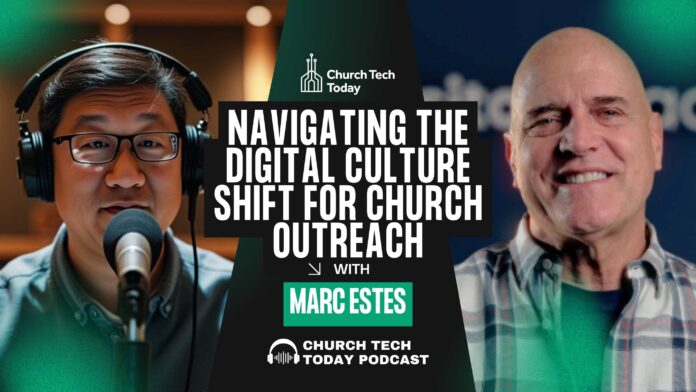
In this episode, host Kenny Jahng welcomes Marc from Visitor Reach to discuss the seismic shifts in digital culture impacting churches today. Mark shares data-driven insights into why the traditional ministry model is falling short, and how churches can adapt by embracing new forms of digital touchpoints and relational engagement. Listeners will come away with practical strategies for leveraging technology—from texting to tap technology—for both outreach and follow-up, all aimed at creating real connections with people in their communities. If you want your church to thrive in a rapidly changing cultural landscape, this conversation is essential listening.
In This Episode, You’ll Learn:
Why digital contact points have expanded from 3–5 to 12–15 before someone visits church in person
How to shift your ministry model from a “come to us” to a “go to them” approach, especially in digital spaces
Ways to use two-way texting and real-time conversations to reach people when and where they’re most open
How tap technology can streamline visitor connection, giving, and follow-up on-site
The critical impact of a church’s kids ministry experience on family attendance and retention
How pastors and leaders can shift staff culture to prioritize outreach and digital engagement, not just internal programs
Practical steps to personalize, automate, and track digital engagement efforts for meaningful results
Key Takeaways:
“You have people now seven and a quarter hours a day on digital devices, and that’s where they wanna talk. That’s where they’re living.” — Marc Estes
“We want people to come to my place, my terms, my people, my culture, my language, and that just isn’t working anymore. So we have to be thinking, how do we go to where they’re at?” — Marc Estes
“If we’re too busy doing church to be the church, we have some real hard conversations we need to have, first of all, with the lord and then with our team.” — Marc Estes
“For our websites, we’re thinking mobile first, but we’re not thinking about our whole ministry model to be mobile first.” — Kenny Jahng
“Technology isn’t something that you delegate…when it comes to communication technology and assimilation technology, we have to realize that these are significant tools that we should, make a priority in our lives and also give time in our meetings, our staff meetings, and when we’re meeting with people to just talk about it.” — Marc Estes
Links & Resources Mentioned:
www.visitorreach.com
About the Church Tech Today Podcast:
The Church Tech Today Podcast helps pastors, church staff, and ministry leaders navigate the intersection of faith and technology with confidence. Hosted by Kenny Jahng and brought to you by www.MinistryLibrary.com.
EPISODE TRANSCRIPT
Kenny Jahng [00:00:00]:
Hey, friends. It’s Kenny Jahng. It’s that time again. We’re gonna sit down with another leader of a great organization that is helping to resource churches at scale. We’ve got Mark on the line here. Thank you for joining us, Mark. How are you doing today?
Marc Estes [00:00:14]:
It it is a great pleasure to be with you today. Thanks for the thanks for the invite.
Kenny Jahng [00:00:19]:
One of the things we bump into two other at events, and your team has been doing such a great job. One of the reasons I wanted to have you on today is because some of the conversations that, I’m involved in every time we’re sitting and standing in a circle with you guys. And it’s talking about the culture today and how churches are intersecting with that or not. And just the acknowledgment that there’s things going on where the ministry model of old doesn’t necessarily fit or has not caught up with where people are out there in society, in our ZIP codes, in our neighborhoods out there. Right, Mark? And so Yeah.
Marc Estes [00:00:56]:
That’s right. What
Kenny Jahng [00:00:56]:
can just give us a a framing of where where do you think culture stands today?
Marc Estes [00:01:02]:
Yeah. I think it’s a great great question, Kenny. You know, just in the last couple years, we you’ve seen some tectonic shifts, and probably the biggest one, people are more open to spiritual things now than since perhaps the Jesus people movement. That is a win for the church. Right? However, what we’re seeing, and this is really important for churches to understand, is is that people are more reluctant than ever to walk through the door of your church. And what used to be this three to five connect points before someone would walk through the door of a church, that’s moved to 12 to 15 connect points. And most churches today aren’t simply prepared to have that kind of a strategy, and it’s no wonder why people aren’t showing up. But here’s where they’re hanging out at.
Marc Estes [00:01:44]:
They’re hanging out in digital spaces. Right? You have people now seven and a quarter hours a day on digital devices, and that’s where they wanna talk. That’s where they’re living. And I let’s let’s just call it the new Roman Road. And so I think some of the shifts that have happened is that we need to to recognize people are open. They’re more reluctant than ever. They’re hanging out in digital spaces, and we need to go where they’re at to be able to reach them on their terms.
Kenny Jahng [00:02:12]:
Absolutely. I mean, I’d I’d say, first of all, I think you’re right that the number of touchpoints has increased. I I have something that I call the law of seven eleven. If you look at traditional, like, retail sales or business business sales, there are studies where salespeople give up after two to three touch points. But really, the ones that actually close the deal, that actually engage the customer, the ones that hang out and and go to the seven, eight, nine, 10, 11 touch points before someone responds. And I think churches need to start thinking that way. It’s like, you can’t just invite someone to church once and think that they’re gonna come. And so and and I think the other one I think you you hit it on the head is like, man, we’re living in these digital spaces.
Kenny Jahng [00:02:53]:
We, our websites, we’re thinking mobile first, but we’re not thinking about our whole ministry model mobile first. And so I I I just love what you’re saying there. That’s right. Of of all those shifts, right, what’s one like, how do you reduce it down to if a pastor’s listening today, what’s their main takeaway that they need to frame their lens of how to rethink what are they doing in terms of external communications and engaging new people in their ZIP codes? What’s one of those shifts? How would you capture that that the church should be embracing as a priority?
Marc Estes [00:03:27]:
I I think we need to go to where people are at. Right? And when you when you think about Jesus, he always found the one in the crowd. Mhmm. And he always made sure that that and that point was personal. It was intimate.
Kenny Jahng [00:03:39]:
Yeah.
Marc Estes [00:03:39]:
And so we’ve got to go beyond even when it comes to social media. Right? Some churches are going, hey. I do social media. Well, let’s change the scoreboard from likes to engagements. Like, how do we get in front of someone when they wanna talk and at night? It’s Thursday. They’re sitting on their bed scrolling through social media. How do we engage with them when they wanna talk about or or the time they wanna talk and what they wanna talk about. And that’s where we’re we’re we’re having to shift some of our focus.
Marc Estes [00:04:11]:
It can’t just be a gospel of come, come to Easter, you know, come to Christmas, come to my weekend service, and we wanna box our evangelism into these little seventy five minute segments. And we want people to come to my place, my terms, my people, my culture, my language, and that just isn’t working anymore. So we have to be thinking, how do we go to where they’re at? And that in particular is going to the place of the digital spaces and getting in front of them and starting these live engagements.
Kenny Jahng [00:04:42]:
I mean, how is that going to change in terms of I mean, pastors are busy. Staff are busy. How does that change in terms of, like, what their task or assignment is, what their budgets are, around all this stuff? What what’s the impact that you think needs to happen?
Marc Estes [00:05:01]:
Well, you’re you’re gonna get me on a soapbox here. If if we’re too busy doing church to be the church, we have some real hard conversations we need to have, first of all, with the lord and then with our team. Jesus, a 28 out of a 99 recorded ministry situations, they were evangelistic. And so we see that the majority at this time and focus were reaching lost people. And it’s no wonder that the church in America for the most part is plateaued and declining because we’re spending all of our time, our staffing, our money, and our energy and building the church internally. And let’s do that. Listen, I’m a pastor. I’ve been a pastor for forty years.
Marc Estes [00:05:42]:
We need to build the church. We need to pastor people. But we also need to understand when we talk about primary purpose or great commission, it’s not a great suggestion. It’s the great commission. And so what are we doing when it comes to our time, our finances, our staffing? How are we building this culture that we’re making sure that our church is thinking about the world in which we live and reaching the community around us? It’s so important.
Kenny Jahng [00:06:08]:
Yeah. And so I I wanna go back to that idea that you said that digital engagement is high right now, yet church attendance is low. Are are you seeing or maybe can you characterize how are churches using digital, or what’s the potential for them to do it relationally? Right? Like, I think we all know that we can post, like, bulletin boards on social media and do email blasts that, like you said, just come to Easter, come to our bed, come here, come here, come right. Can you talk a little bit about that mindset shift in terms of evangelism for the target on the digital platforms?
Marc Estes [00:06:50]:
Yeah. And so what a church is doing versus what they should be doing are two different questions. Right? And so what we find today, again, we’re in a traditional mode of digital marketing and social media advertising that is really technical at best, and that is we’re just we’re getting the message out. We’re getting clicks. We’re getting awareness. We’re hoping somehow that someone will see an image, a real, a cool picture of the pastor preaching, and that’s gonna translate into them walking through the door of the church. Again, we talked about 12 to 15 connect points. And however you do it, our platform and what we’re doing is trying to take the connect point and trying to get it personal and intimate and relational.
Marc Estes [00:07:35]:
Today alone, America is gonna send 5,500,000,000 texts. We’ll send 2,000,000,000,000 texts. We find that 93% of people will share their deepest hurts, pains, and secrets via a text to a stranger and only 13% face to face. And so we we’d have to use that data to say, what are we doing to get in front of people? I believe that texting is the best way in which to do that, especially if we are doing it immediately. 92% of people will text back if you text them within ten minutes. We wanna talk when they wanna talk. And, also, we just we just wanna make sure that when we start conversations, we know their name, they know our name, and it’s not just about come. I’ve I’ve I want you to come to church.
Marc Estes [00:08:27]:
It’s no. How can I pray for you? What’s going on in your world? And we’ve got to get into their world like the good Samaritan. We gotta get into the ditch, bandage their wounds, pour oil and wine on them. And so that whole gospel of go has this idea that we’re we’re going to go where they’re at and really let them know that they matter to us and they matter to god. But we’ve in a digital sense, we just gotta find the means of which we can get a personal, intimate, conversational, and immediate.
Kenny Jahng [00:08:58]:
I love it. Now, I think digital is not just good for outreach before they come to the church. It’s even follow-up, assimilation, etcetera. Can we focus a little bit on the weekend service? So what are some of your tips in terms of how do we actually employ this, digital first engagement strategies for, following up for weekend services?
Marc Estes [00:09:23]:
Yeah. Well, nothing can replace face to face. Right? So So let’s just make sure that we don’t have a digital strategy that that actually
Kenny Jahng [00:09:29]:
Yeah.
Marc Estes [00:09:29]:
Removes the the conversational piece. So that goes without saying. But we just have to find ways in which we can connect with people intimately and immediately. We just come out with visitor tap. And so we have tap technology that allows you not just to use tap technology for giving, but also for you know, we’re seeing a high increase of people giving their name, number, email, because there’s a tap opportunity in front of them. And so more than just gathering their name and trying to send an email out a day or two laters, what would it look like if that person’s actually getting a text before they get to their car and just saying, hey. Thanks so much. This is pastor Mark here.
Marc Estes [00:10:09]:
Thanks for coming. Hey. Before you leave today, we just love to know how can we pray for you today? And so there’s ways in which we can get technology, whether that’s a tap technology, which I think is one of the greatest ways. What we’re trying to do is we’re trying to build those relationships with people before they come via texting so that when they do come, we can connect them live with people. Awesome. So so the a couple of thoughts that maybe maybe I’d throw your way.
Kenny Jahng [00:10:38]:
The other thing that I’ve always found in church plants and growing churches is that they have a thriving family or kids ministry. Right? Can you speak to that? Because I think you guys do a lot of work around the coaching churches to actually pay attention and seize the opportunity in that regard.
Marc Estes [00:10:56]:
Yeah. And so here’s a staggering statistic, and that is 49% of all people come to church because of their kids, not themselves. And so we should probably be thinking as much about our kids’ ministry as we do about our weekend services. And I know right there, I probably lost a few pastors. Again, I’m I’m a local church guy. I get it. I’m a pastor. But people will make the decision of whether they’re gonna stay by how their kids’ experience was on that particular weekend.
Marc Estes [00:11:28]:
So we need to stop that best. If you have a smaller church with volunteers, you need to put your best volunteers in there, and it’s not a babysitting service. This is where we’re shaping the next generation. And so we can build a culture where actually people are wanting to serve in kids’ ministry, not having to feel like they’re being coerced to serve in kids’ ministry. But at the end of the day, what are we doing to build a world class kids experience? And once again, this is where technology can come in even with texting. If you have TAP technology, you can be talking to those parents. Hey. We just wanted to thank you for dropping your kid off today.
Marc Estes [00:12:07]:
We had such a delightful time. Is there any other way we can serve for you or pray for your family this week? And so what are we doing innovatively and technology wise, not just in the moment, but also ongoing throughout that week to be able to connect with those families personally, relationally, intimately.
Kenny Jahng [00:12:26]:
Now, a lot of this seems intuitive, and I think people go along with it. But then as a leader, sometimes you realize not everyone is on board or there are some laggards in understanding that, hey. We have this huge opportunity to deploy technology for our objectives. Can you talk about your experience of how you can affect the culture in a church, on the staff, and across your volunteers and leaders? What are some important things that the pastor listening today needs to think about when they’re talking about this? Right? Because it’s not just about adoption of a new technology. It it goes way beyond that.
Marc Estes [00:13:05]:
Yeah. I I think it starts first and foremost with the idea that the leader makes it a very important thing in their life personally in the way that they lead. It’s not technology isn’t something that you delegate. And I understand that when it comes to your CRM or your ADP, you know, when it comes to your payroll, those aren’t things that you’re living and breathing and preaching. But when it comes to to communication technology and assimilation technology, we have to realize that these are significant tools that we should, make a priority in our lives and also give time in our meetings, our staff meetings, and when we’re meeting with people to just talk about it. Like, it’s not just something that you implement and then you delegate. We’ve gotta share testimonies. We gotta share stories.
Marc Estes [00:13:51]:
We gotta have some kind of metrics and accountabilities on the back end to see how well that we’re doing. And so even if you’re a church of 75 or a church of 7,500, this this is a really important point because technology is here to stay, and it can be our best friend in regards to connecting with people.
Kenny Jahng [00:14:09]:
I love it. So one of the things that I I’m really interested in hearing about is what is the the largest, when someone adopts your platform in your system and they come in and they train their volunteers and the staff to do it, what is the first biggest moment or benefit that they actually get? Like, there’s a sequence in, of experiences where they say, wow. This stuff works, and they just continue to discover more and more, value out of applying these types of things. But what’s the square one that in terms of expectations of once they start to go down this path, what are they what are they seeing in terms of your customers?
Marc Estes [00:14:49]:
Well, on on a positive side, what they’re seeing is the ability to connect with the masses one person, one relationship at a time. And so we have the ability, again, even though we’re dealing with hundreds or perhaps thousands of names, our automated responses and our nurture points and our quick replies give us the ability to connect with people personally as well as because it’s not just push notifications and we’re not just pushing emails, or we’re not just pushing text through mass texting platforms. We’re putting it in a two way two way conversational point, which always gives the person the opportunity to respond back, which makes it, like, they feel valuable, and they they feel seen, and they feel heard. And so I think that’s the first and most significant thing that we’re seeing is that people are going, wow. We have the ability now to connect with people one on one in a very professional, immediate way that seems very personal and intimate.
Kenny Jahng [00:15:47]:
I love it. Yeah. There are thousands of pastors that are listening into this conversation. If they have not come across, Visitor Reach, could you just give us a 10,000 foot overview? Because I think there’s so many different things that you have integrated into all the things that you offer. So, maybe maybe just give us a thirty second, overview of what visitor reach is and how it works.
Marc Estes [00:16:14]:
Yeah. Thank you. It’s you know, basically, we do four things. We help you on your digital front so to make sure that you’re seen. We wanna make sure when it comes to voice recognition, maps, social media, website authority, everything, that when someone is searching for you or searching for church or Jesus or an answer, you can be found. Second thing that we do is we just do personalized ad campaigns, campaigns, and we’ll use AI along with your pictures and website to build some personas. And we’re gonna go target people that are new to the area, people that are looking for a church, people that are on a spiritual journey. The good news is once we grab those people, we drop them into our app.
Marc Estes [00:16:56]:
People just get texts because that’s the way that they communicate the quickest and easiest. The church has an app and a dashboard where you can begin to manage those hundreds and hundreds of conversations and to be able to create customized nurture points, emails, texting strategies. It incorporates, visitor tap technology, QR codes. All of those things drop into the app that allow you to be able to work with people as they journey through not only just coming through the front door, but all the way through the back door. And then lastly, we simply just put a coach alongside of you. And we wanna make sure that every month, we’re gonna give you a call and say how you’re doing. Let’s look at the analytics, and let’s make sure that you are thriving and reaching and keeping people.
Kenny Jahng [00:17:41]:
Awesome. Hey. I just wanna call out one thing because, you’re referencing a tap technology, visitor tap. For those that may not I mean, I think everyone’s sort of texting and email the app and all that kind of stuff and ads. For someone may that may not be familiar, why don’t we just explain to them what your visitor tap, feature is?
Marc Estes [00:18:02]:
We would most people would be using this today when they go to the store or Starbucks. They pick up their phone, and they just tap it to pay. It’s a very seamless, quick way, NFC technology, new fear of communication, that you just tap it and information takes place very, very seamlessly. And so we’ve taken that technology, allow you to put a sticker on the back of the seats of your, sanctuary to where people just walk in. And if you’re new, tap. If you’d like to give tap, if you’d like to sign sign up for groups, tap. Our dashboard allows you to custom tailor that. We have a built in TapTree editor that allows you to build a a complete, TapTree for that particular weekend and run sheet, and so you can always change it.
Marc Estes [00:18:47]:
But at the at the end of the day, it’s it’s having the ability to seamlessly give people the opportunity at that moment to connect without filling out a car or without doing some other more laborious, process.
Kenny Jahng [00:19:01]:
Yeah. I, I think that is, an innovation that all churches really should think about because everyone walks into church with one of these. Right, Mark?
Marc Estes [00:19:10]:
Like, at
Kenny Jahng [00:19:10]:
this point, everyone has this. In fact, you you have more people carrying your mobile phone than a Bible into a church today. And so, taking advantage of that, making it a frictionless experience is, I think, what the tap technology offers. Hey. So if someone’s listening in today and they wanna learn more, you’ve got tons of insights. If they want to follow you or connect with you further, what’s the best way for them to actually get involved, engage with you, and Visitor Reach?
Marc Estes [00:19:38]:
Yeah. So I’m gonna go ahead and just share my screen real quickly, and I know that this will also be shared in an audio context. So I’ll refer to that in a second. But there is a, promo code here, a QR code. If you just click on that, it’ll take you directly to an opportunity to set up a phone call. We’d love to hear what you’re doing personally. So that would be the simplest way to do that. The second thing that you can do is just go to visitorreach.com.
Marc Estes [00:20:05]:
That’s visitorreach.com, and you can see everything that we have to offer. You can see our plans. There’s a large resource of blogs. We we believe we’re a thought leader in this space, and so we wanna offer those things. And so I just encourage you to either do the QR code, go to visitorreach.com. If you wanna look at the TAP technology, just go to visitorapp.com, and you’ll be able to see everything that we’re offering to churches in that arena as well.
Kenny Jahng [00:20:34]:
Okay. Well, there you have it, folks. A quick insight in terms of where we are going with our culture, this culture shifts, and how we can respond in order to maximize, what we’ve been called to do, and that is to take this gospel, be a herald of it, but use it in channels and methodologies that we have available to us today. Mark, thank you so much for joining us today. I know you’re busy. We’d love to have you on again. For those listening in today, we’d love to hear from you. What resonated from our conversation today? What is the rabbit hole you wanna go down further so that we can somehow twist Mark’s arm to come back and actually nerd out a little bit more? I know Mark loves this stuff and would love to actually resource you guys further.
Kenny Jahng [00:21:15]:
So Yeah. Send me an email, kenny@churchtechtoday.com. Let me know what you thought and what questions you have about all of this stuff in terms of, tap technology, texting, engagements so that we can actually further this conversation and resource you and your teams further. Thank you so much for joining in. We’ll check you out here in the next conversation.