



|
TL;DR Better subject lines, A/B testing, and smart content design can dramatically increase church email opens and engagement. 1. Subject lines drive 80% of results—use proven frameworks (benefit, curiosity, challenge, testimony). 2. Keep them short, personal, and action-oriented; never generic. 3. A/B test subject lines, sender names, times, and preview text for data-driven wins. 4. Optimize email content with clarity, simplicity, and clear next steps. 5. Small improvements = big ministry impact. |
Look, if you’re sending church emails with mediocre open rates, you’re missing ministry opportunities. After years in the trenches helping churches transform their digital communication, I’ve seen what works and what fails. Let’s cut through the noise and get to what actually drives results.
The Subject Line: The Make-or-Break Moment
Hard truth: You can craft the perfect email with life-changing content, but if your subject line doesn’t get clicked, it’s wasted effort. Period.
The data is clear: subject lines determine 80% of whether your email succeeds or fails. This isn’t marketing fluff—it’s the reality of how human attention works in an overcrowded inbox.
When I analyze church email performance, the pattern is consistent: thoughtful subject lines drive engagement, generic ones kill it. Let’s fix that.
9 Subject Line Frameworks That Actually Work for Churches
Here are nine proven approaches that consistently outperform the average. I’ve included real examples that have delivered results:
The Specific Promise: “5 minutes that will transform your family devotions”
The Direct Question: “Are you making this mistake in your prayer life?”
The Testimony Hook: “How Lisa found community after 3 years of isolation”
The Clear Benefit: “The simple prayer practice that reduced my anxiety by half”
The Urgent Need: “We need 18 more volunteers before Sunday morning”
The Pattern Interrupt: “Why serving others might be hurting your faith”
The Proof Statement: “What happened when 40 people committed to daily prayer”
The Curiosity Gap: “The overlooked scripture that’s changing our church culture”
The Challenge: “Could you go phone-free for your next family dinner?”
Match these to your email purpose:
- For testimonies and stories: Use the Testimony Hook
- For teaching content: Try the Specific Promise or Pattern Interrupt
- For volunteer recruitment: The Urgent Need or Proof Statement works best
- For spiritual growth: The Clear Benefit or Direct Question creates engagement
- For behavioral change: The Challenge or Curiosity Gap gets attention
Subject Line Do’s and Don’ts (Backed by Data)
Do:
- Keep it under 50 characters (mobile optimization)
- Create genuine urgency when appropriate (“Registration closes tomorrow at 5pm”)
- Make it personally relevant (“John, we saved you a spot at the men’s breakfast”)
- Add clear value (“3 practical ways to talk to your teen about faith”)
- Use action-oriented language that creates forward momentum
Don’t:
- Default to “Weekly Newsletter” (instant deletion)
- Use churchy jargon that means nothing outside your staff meeting
- Make promises you can’t deliver on
- Sound like every other promotional email
- Waste the first 3-5 words (they’re all some people will see)

A/B Testing: Stop Guessing, Start Knowing
A/B testing is the difference between amateurs and pros. It’s not complicated, but most churches skip it—and their results show it.
How A/B Testing Actually Works
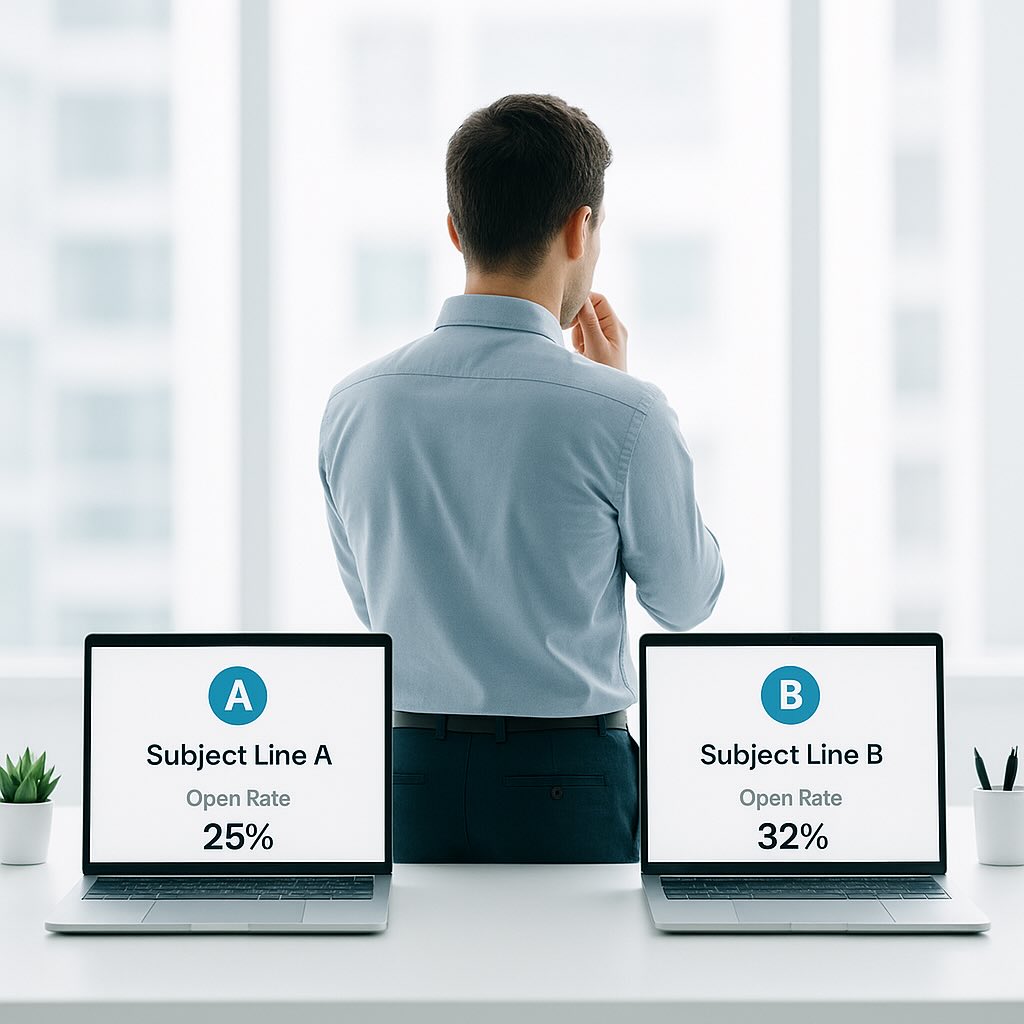
- Create two different subject lines that both could work
- Send each version to 10% of your list (so 20% total)
- Wait 3-4 hours to collect enough data
- See which version gets more opens
- Send the winner to the remaining 80% of your list
Every major email platform has this feature: MailChimp, Constant Contact, Flodesk, ConvertKit. If yours doesn’t, switch immediately—this single feature is worth it.
Why You Must Test Every Single Email
- It ends arguments: No more debating which subject line is better—the data decides
- It builds knowledge: You’ll quickly learn what your specific audience responds to
- It improves results: Even a 5% boost in opens means dozens more people engaging
- It reveals segments: Different groups in your church respond to different approaches
A church I worked with increased their volunteer response rate by 22% simply by testing which subject line approach worked better with their congregation. This isn’t theory—it’s practical ministry improvement.
Beyond Subject Lines: What Else to Test
Once you’re comfortable with subject line testing, expand to these:
- From Name: Test “Pastor Mike” vs. “Mike Johnson” vs. “First Church” (personal names often win)
- Send Time: Test Sunday afternoon vs. Thursday morning (timing matters more than you think)
- Preview Text: The 85-character snippet after your subject line that most churches completely waste
- Button Color: Yes, it matters (I’ve seen 31% higher clicks with orange vs. blue in some churches)
One church I consulted with boosted their small group signup rate dramatically by testing a simple preview text change from “Join a small group today” to “Find your people and grow your faith.”
Beyond Opens: Making Your Content Actually Work
Getting opens is step one. But what happens after the open determines whether your communication actually achieves its goal.
7 Practical Content Principles That Drive Action
- Front-load what matters Put your most important information in the first 3 sentences. Most people won’t scroll further if you don’t hook them immediately.
- Design for skimmers
- Use clear, descriptive headers
- Keep paragraphs to 1-3 sentences max
- Use bullet points for multiple items
- Bold key phrases (not whole paragraphs)
- Mobile-optimize everything Over 70% of church emails are opened on phones. If it doesn’t work well on mobile, it doesn’t work. Period.
- Focus on ONE clear next step Multiple calls to action kill response rates. What’s the single most important thing you want readers to do? Make that unmissable.
- Tell real stories, not church announcements Stories of life change get clicked. Administrative announcements get ignored. Frame your content accordingly.
- Segment your audience Sending everyone identical content is lazy and ineffective. At minimum, create segments for:
- New vs. established members
- Parents of different age groups
- Ministry volunteers
- First-time visitors
- Make responses dead simple Every extra click costs you 20-30% of your potential responses. Make the path to action absolutely frictionless.
Metrics That Actually Matter
Forget vanity metrics. These are the numbers you should track and improve:
- Click Rate: What percentage took action? (Benchmark: 3% is average, 8%+ is excellent)
- Conversion Rate: Did they complete the desired action? (Track registrations, signups, etc.)
- Share/Forward Rate: Are people passing it along? (Look for 0.5-1%)
- Reply Rate: How many people hit reply? (The most overlooked engagement metric)
- List Health: Unsubscribe rate under 0.3% suggests you’re providing value
Set up a simple monthly dashboard tracking these metrics. What gets measured improves.
Email Strategies That Align With Ministry Goals
Your email strategy should directly support your church’s mission. Here are proven approaches:
- Create Sermon Application Sequences Set up automated 3-part email series that arrive Monday, Wednesday, and Friday after each major sermon series with reflection questions and next steps. Churches using this approach see significantly higher small group participation.
- Build Automated Discipleship Tracks Map your church’s growth pathway, then create email sequences for:
- New believer follow-up (6-email series)
- Baptism preparation (4-email series)
- New member onboarding (5-email series)
- First-time giver nurturing (3-email series)
- Develop Emergency Response Templates Create templates for community crises, weather emergencies, and important announcements that you can quickly deploy when needed.
- Design Seasonal Campaigns Create email calendars aligned with your ministry year:
- Easter/Christmas visitor follow-up sequences
- Fall ministry kickoff campaigns
- Summer mission trip support
- Stewardship/giving series
- Segment by Ministry Interest Beyond demographics, segment based on ministry involvement and spiritual interests. This targeted approach has consistently shown higher engagement rates.
Final Thoughts: Email That Actually Makes a Difference
The difference between effective and ineffective church email comes down to this: treating it as communication that matters, not just another checkbox.
Every open represents someone who has given you their attention.
Don’t waste it with generic content or unclear calls to action.
Your subject line is what gets people to stop and pay attention in a crowded inbox.
Craft it with intention, test it rigorously, and watch your engagement climb.
Your content is what moves people to action.
Make it clear, concise, and focused on the next step you want them to take.
Start implementing these strategies today, and you’ll see measurable improvements in how your church communicates digitally. Your message matters too much to be ignored in an inbox.


Thanks Kenny! This is really good!