


TL;DR: 3 Logos leaders explain how AI Bible study tools can cut the busywork out of sermon prep, giving pastors more time to study the text deeply and be present with their people.
1. Logos AI tools search your library, give AI summaries with citations, and help with sermon illustrations. Writing the sermon stays with the pastor.
2. When congregants bring AI answers to their pastor, the Logos leaders see a chance for discipleship and better Bible study.
3. One church using Logos for Church ends each sermon with 5 questions for people to ask Study Assistant, then shares answers at the next gathering.
Ask a pastor why they went into ministry, and you will hear about calling, about shepherding and teaching the people God entrusted to them. You will not hear that they signed up to spend their week on busywork. And yet a real portion of the ten to twenty hours that can go into sermon prep is not theological wrestling at all. It is hunting for the right commentary, or the cross-reference you know is in there somewhere.
When a pastor is stretched thin and spinning their wheels on mundane tasks, they pay for it in rushed prep, burnout, or both. The temptation, especially when money is tight, is to hunker down and absorb the time cost rather than spend church funds on tools that might lighten it. But there is still a price to pay: lost family time and reduced capacity to notice a ministry need before it becomes a crisis.
Some of the friction in Bible study is important, and any pastor who has wrestled a passage to the ground before the message came knows it. So which friction is worth protecting, and which is just wasted motion?
We recently sat down with Mark Barnes, Mike Brown, and Beka Johnson of Logos to talk about what the church loses when study becomes a chore, and what it protects when it doesn’t.
Q: Mark, Mike, and Beka, thank you for being with us, and for sitting down to talk about pastor capacity. Let’s start with the problem itself, before any tool enters the picture. A pastor can lose a large share of the week to sermon prep, and a lot of that time goes to hunting rather than studying. When that hunt becomes the dominant experience of study, what does it actually cost a church, both in what the pastor has left to give and in what ends up getting preached on Sunday?
Mark Barnes: There aren’t enough pastors, generally speaking, and pastors are often stretched and often have to respond urgently. If they are spinning their wheels on mundane tasks, whether that’s finding information for a sermon or anything else, the church is not getting the most out of them. That can result in rushed sermon prep or burnout, sometimes both.
Beka Johnson: I bet if you ask most pastors why they went into ministry, you’d get a beautiful answer about God’s call on their lives to reach and disciple the lost, to shepherd and teach the people of God. But it’s unlikely anyone will tell you they went into ministry to spend their days doing busywork, and yet, so many pastors find themselves burdened by peripheral ministry tasks that take time and energy away from the work they really need (and want) to be doing.
As with any role or calling, when your attention is diluted from the main focus, everything begins to suffer, sometimes subtly at first. But eventually, disappointment, burnout, and resentment can begin to take hold.
I think sometimes pastors feel trapped. Especially when finances are tight, they don’t want to spend church funds on tools that will help them stay better organized, simplify the workload, and/or eliminate busywork. So, they hunker down and just try to get it all done, not realizing the hidden cost (their own mental health, quality time with family, well-researched and powerful sermons, discipleship, pastoral care, hospital visits, answering tough questions well, Bible studies, simply being present at church events, and having the mental space to pay attention and notice ministry needs as they arise).
Overly busy pastors cannot shepherd or disciple well. They will become blinded by their own insufficiencies, and those insufficiencies will begin to rule their lives. An unhealthy pastor will inevitably create an unhealthy church culture, and he might not even notice it happening.
Mike Brown: One thing that Logos has done very well for a very long time is minimize the mechanical work of doing sermon prep and study. My Logos story was significant. I came to it right after we had moved to Chicago to plant churches. We moved, with two little ones, to a brand-new city where we didn’t know anybody. And then I decided to go back to school. It was a lot happening at once. I was doing sermon prep all the time. I could not have done all of that without Logos. I went to it almost out of desperation, and it delivered in spades. I remember having tables with books spread out everywhere and begging my family to not touch any of them. When I was able to save a layout in Logos, I was happier and so was my family.
It was a season where I was always brushing up against burnout, but with Logos I knew every week that I would be a good steward with my sermon prep time. That also gave me more time for all of the other things that were critical to pastoring and church planting, like being present with people.
Q: You’ve all described study that gets bogged down in mechanical work, and the relief of clearing it away. But there’s a tension a lot of thoughtful pastors feel here. Some of the most formative moments in a pastor’s development occur in the slow, agonizing work of sitting with a text they don’t yet understand. Is there a point where making study too easy actually erodes the spiritual formation that is supposed to happen in that struggle, and how do you tell the difference between removing the wrong kind of friction and protecting the right kind?
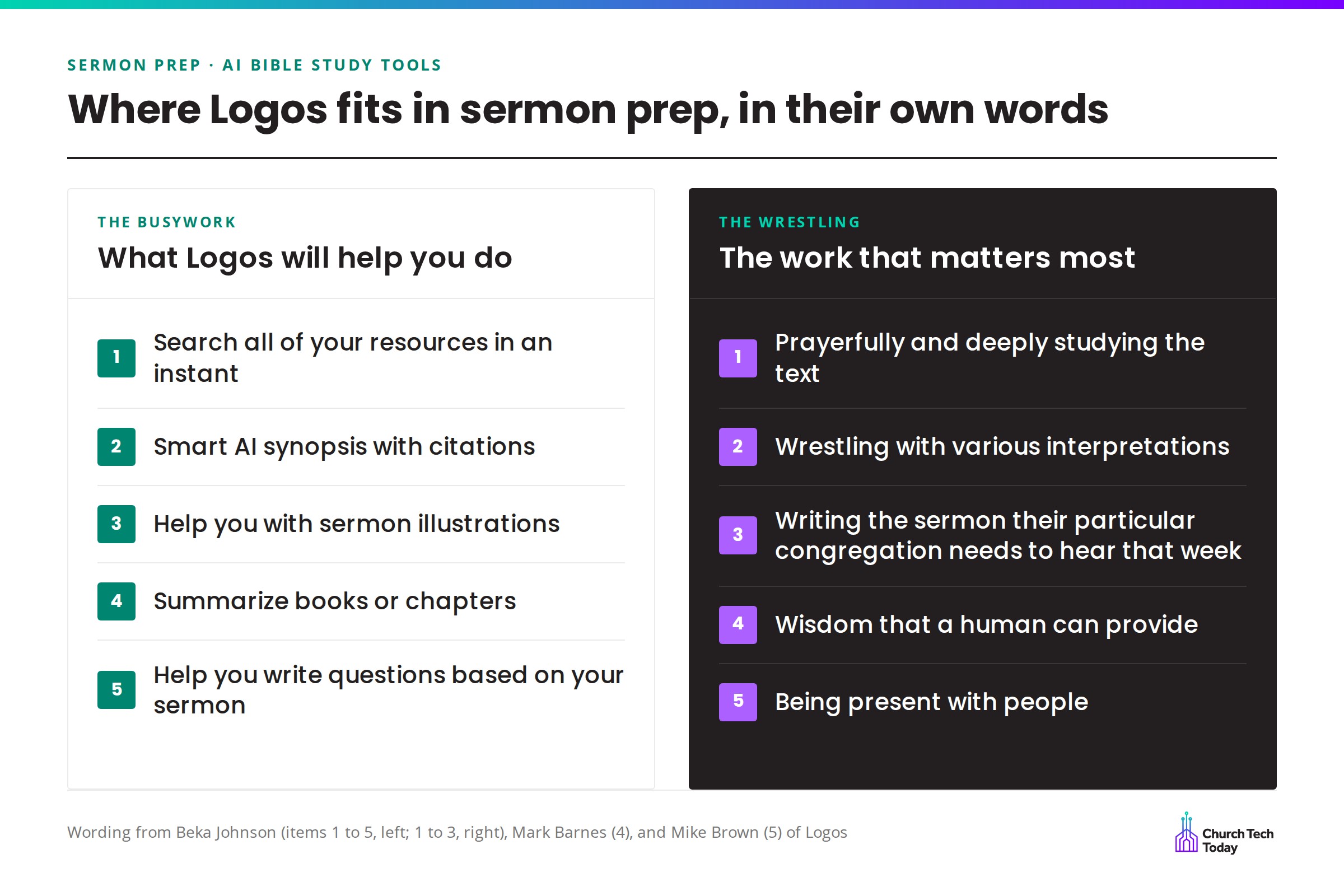
Beka Johnson: Absolutely, there is. And we try to walk that line carefully and intentionally as we build our Bible study tools. For example, Logos won’t write your sermon for you. That’s a hard line we draw. But Logos will help you search all of your resources in an instant, it will provide a smart AI synopsis with citations, it can help you with sermon illustrations, summarize books or chapters, and it can even help you write questions based on your sermon.
Logos is about eliminating the busywork so pastors can spend their time and energy on the work that matters most: prayerfully and deeply studying the text, wrestling with various interpretations, and writing the sermon their particular congregation needs to hear that week.
But when people are trying to cut corners, they’ll find all the ways to do that, both in Logos and outside of it. And this is a real temptation pastors are going to have to wrestle with in an AI world.
I’m not a pastor, but I am working on my MABS right now for my own edification, and my seminary uses Logos for Education. I can tell you, there have been moments where Smart Search, Smart Synopsis, and Study Assistant have helped me get through my work much more efficiently while sacrificing nothing important, and there have also been moments where I used those tools as a crutch when I should have forced myself to dig more deeply than I did in the moment.
So my caution even with a tool like Logos that does have guardrails is to always begin your study prayerfully and intentionally. Set AI guidelines for yourself about how you will and won’t use it. Identify triggers for where you need to push yourself further and not simply rely on the easy solution. Just like with any tool, it can be used for good or ill.
Mark Barnes: I’ve thought a lot about this theologically and philosophically, and I think there’s very little danger that Logos removes the good friction. Bible study is supposed to be hard. That is a good thing. It develops spiritual muscles if you let it. But really what we’re trying to do is help people to find valuable, trusted content. That’s what all those citations in Study Assistant are for. What we’re not doing is write my sermon for me or that kind of stuff. That’s where you need to do the wrestling. What’s right for my congregation in this scenario? The positive of Logos is it’s locked down. Study Assistant can do things ChatGPT or Claude can’t do, but equally it deliberately doesn’t do some things that they can do. That’s deliberate. Having a system that won’t allow you to take those shortcuts is where a good part of the value is.
Mike Brown: This question touches on a wider philosophical assumption, that ease equates to a lack of value, or that making something easier diminishes its capacity for spiritual growth and formation. While I see the general logic behind that view, it wrongly implies that simplifying the study process hinders personal transformation. What we’ve actually done is make it easier to get to the points where you have to wrestle with theology. It used to take so much effort to get to the key points that by the time you got there, you’ve already spent energy that you could have been using to wrestle with the theology. Logos preserves your energy for the essential wrestling required for personal formation, instead of forcing you to exhaust half of it by the time you simply arrive at the starting line.
Q: That line you draw, the wrestling a tool won’t do for you, runs straight into a fear a lot of pastors are carrying right now. AI can now synthesize Greek and Hebrew and generate a competent exegetical outline in under a minute, pulling from centuries of commentary as it goes. If a machine can produce a better research document than a first-year seminary student, what is the irreplaceable thing the human pastor still holds that the aggregator never will?
Beka Johnson: AI isn’t sentient. It doesn’t have a soul. It can’t be indwelt by the Holy Spirit, and it’s ultimately not a human being, no matter how we dress it up to look and sound like one. Yes, AI can do incredible things faster than humans, but AI is still just technology.
Pastors, on the other hand, are called by God to their vocation, and they are accountable not simply for instilling information but for shepherding their flock. That means they know their sheep and are crafting messages week in and week out that are designed to disciple and equip the specific people they’ve been charged to care for.
AI would be a weak comfort to the sick or dying, a poor companion in dark times. People want and need real people they know and love to be by their side all the time, but especially when life gets hard. A congregation without a pastor would be like sheep without a shepherd. Those of us with beloved pastors know how empty the church can feel when our pastor is on vacation. Good pastors have a presence everyone can feel, and while we need to guard against celebrity culture and placing anyone on a pedestal, pastoral presence is actually very important and part of God’s design for our care and spiritual formation.
A great use of AI in the church is to absorb all of the busywork that is keeping the pastor from being with and ministering to people. Sermon prep is not busywork, but there are elements of prepping for a sermon that can include busywork, and that’s the sweet spot.
AI (when responsibly trained on trustworthy resources like Logos Smart Search) can also provide a first line of answers for parishioners with lots of questions. Pastors should always be free and available to answer questions, but if they can also train their people to learn how to find great answers on their own and study the Bible well for themselves, that’s a win. Logos for Church exists in part to put tools like this in the hands of laity.
Mike Brown: I truly believe that the church is meant to be a contextual community of discernment. We are not to replace the Spirit of God with AI. I see a lot of talk these days about sermons like they are a consumer product. Well, what is a better sermon? Is it one that gets a bunch of views and likes or is it the one that’s contextually relevant within a community? Logos, AI, machine learning, none can contextually discern what the Spirit of God wants to speak to a specific community. And you know what? Everybody has to write bad sermons. They should get better over time, but you have to write bad ones to write good ones. I remember watching an interview with George Harrison of The Beatles and he was talking about how Paul McCartney and John Lennon wrote so many bad songs early on and got them out of the way before writing good songs.
Mark Barnes: Wisdom is the one-word answer to that question, wisdom that a human can provide. An AI will never be able to provide genuine wisdom.
Most pastors, I think, would love to have a research assistant, to have someone do the manual work we described about sermon prep. I think personally that having AI help with that is only beneficial.
Very often you could read 20 commentaries on a particular passage that you were preaching on. There’s a reasonable chance that half a dozen of those commentaries are basically saying the same thing in pretty much the same way, and you’re not going to get anything new from them. If AI can identify key differences, when there is something distinctive you need to think about, you can see that you don’t need to read six different commentaries all saying basically the same thing, and you’d be better off getting a fresh perspective from the fourteenth book in your pile.
Now, Logos doesn’t quite do that just yet, but that is the direction we’re heading in. And I think that’s only positive really, that kind of assistance.
Q: You keep coming back to what the pastor uniquely brings: presence, and the wisdom of actually knowing the sheep. But there’s a practical edge to this… A congregant can pull up five commentaries and an AI summary before Sunday, plus whatever their favorite preacher posted on YouTube that week, which makes the pastor’s interpretation one voice in a crowded room. How should a church leader think about their own authority and credibility when the pew has access to everything the pulpit has, and sometimes more of it?
Mike Brown: We should not be fearful of or threatened by people wanting to study, learn, grow or even use some of the same tools as their pastor. Instead, we should be leaning into that desire and excitement and really discipling people. It’s a discipleship opportunity, not something that we should be fearful of, defensive about, and certainly not gatekeepers.
If somebody comes to me saying, “Hey, I don’t know if that’s right. Here’s what ChatGPT said,” there we go! A significant learning opportunity just opened up for me to say something like, “I’m not at all surprised ChatGPT said that. In fact, if I asked the same question, it would likely give me a different answer, which shows part of the problem of trying to use generalized AI to answer theological questions.” That’s why we’ve built Logos and Study Assistant the way we have, to be a “specialist” that utilizes your library.
Beka Johnson: I think pastors have always had that one guy (or gal) who reads broadly, is exposed to a lot of ideas and thinkers, and just has questions. And they’ve always had that guy (or gal) who will without fail poke holes in their sermons week after week. So in some ways, this isn’t a particularly new problem.
The fact that some people are deeply curious and have questions is a good thing. It’s an opportunity for teaching and discipleship and great discussions. And it’s also a great time for equipping laity with trustworthy tools for deeper research.
I think it’s great when pastors share their sources of information, who they read, what tools they use, what their process for discerning truth looks like, and more.
A pastor who isn’t up for difficult questions in this cultural moment is going to have a hard time, and a pastor who doesn’t speak tech or engage with it at all will be ill-equipped to disciple people who are living in this tech-drenched, rapidly changing world.
Again, a pastor’s job isn’t just to impart head knowledge (that’s certainly part of it), but the pastor exists to shepherd the flock and to lead them continually back to Jesus and what it looks like to live as followers of Jesus.
When it comes to discipling in this day and age, I think pastors have to talk about topics like technology, information sources, doomscrolling, and more. Part of discipling people today necessarily includes talking about habits, addictions, and influences.
Mark Barnes: A pastor’s authority must never come simply because he’s a gatekeeper to the Scriptures. The opposite is true! His authority is derived from the Scriptures, as he opens them up and applies them to the congregation. I do a lot of personal study, but I love sitting under my pastor’s preaching and hearing him give a fresh perspective on a passage, or even just bringing a familiar passage close to home. A sermon in my home church, preached by a pastor who knows and loves me, and can look me in the eyes, is so much more powerful than listening to a famous preacher on YouTube. And a large part of my pastor’s authority comes precisely because God has given him responsibility to care for me. Pastors who love their people and demonstrate that in their preaching and pastoral care won’t need to worry about pastoral authority.
Q: That gets at something bigger than authority. The stated mission behind tools like this is to increase biblical literacy, and yet by most measures the church is more polarized and more biblically illiterate than it was before any of these tools existed. The average believer has more Scripture data at their fingertips than Augustine ever dreamed of and is arguably less formed by it. What is the missing piece that better tools and faster search cannot solve, and does naming it change how you think about your own mission?
Beka Johnson: Information and formation are not the same thing. It’s a danger at an organization like ours to forget that sometimes, and it’s absolutely true that our most loyal and rabid customers are highly intellectual.
But this exact problem is something we’re actively hoping to combat with Logos for Church. We’re building tools to make engagement with the Bible more communal and sticky for leaders and laity (think milestones, streaks, and shared plans) because we want to help people be in the Word daily as a matter of habit. We know this is when true change starts to take place. The Holy Spirit will do the heavy lifting in the hearts and lives of readers.
And yes, some people will probably push back at our use of gamification for Bible reading, but here’s the reality: I have a 716-day Duolingo streak because Duo haunts me if I don’t do my lesson. I don’t have a 716-day streak in my Bible app. I’m not proud of that fact, but it’s also the truth.
Gamification is just an accountability tool that helps people do the thing they already say they want to do. It’s like a trellis in a digital rule of life (if you’re familiar with that concept).
Our goal at Logos isn’t biblical literacy as an intellectual achievement, it’s being in the Word, meditating on it, and allowing it to take root in such a way that theology flows out of us and into the world through our lives and vocations, which (to quote my pastor) “are the primary channels through which God touches the world, both redemptively and for the common good.”
Mark Barnes: Augustine is a once-in-a-millennium theologian, and comparing him with an ordinary Christian today isn’t fair. The comparison should really be to Augustine’s next-door neighbor or the guy who polished Augustine’s shoes. What did that person know compared with what Logos makes available to ordinary people today? Within every generation, there will be key leaders who can take whatever God gives and use it in a much greater way than everyone else. But, nonetheless, the democratization of Bible study remains incredibly valuable.
Q: As study gets centralized into a searchable, AI-assisted database, we can start training believers, and even pastors, to treat knowing as a solo act of research rather than something that happens in community. Some people call this “digital gnosticism,” the idea that maturity is mostly about having more information than the person in the next pew. How worried are you about that drift, and what keeps a tool like this embedded in community rather than replacing it?
Mike Brown: We shouldn’t be scared of democratizing Bible study. Earnest, theologically untrained people have been around long before Logos. This is an opportunity for those with theological training to stay sharp and come alongside those without, which is not a bad thing. Discipleship anyone?
At the end of the day, it still continues to push theology in the right direction. If you have someone in your church fact-checking you every week, that shouldn’t be a threat, because what you have is someone who is excited about Bible study. Instead, ask “How do I help this person do better Bible study?” Again, discipleship anyone?
Mark Barnes: For centuries, pastors have locked themselves in their studies to prepare a sermon. They’ve always done that and still are doing that today so that they can teach it to others. Being digital doesn’t change that. The important thing to focus on is that it’s not just for self-knowledge. It is for the purpose of teaching. That’s where the wrestling that we’ve talked about comes in and is something that no AI can provide: How is this right for my congregation? That element of wisdom and knowledge of the community is always going to be essential.
With Logos for Church, we’ve had stories of pastors doing study with their congregation to teach them. They’ve got the Logos app open in front of them and walk through how that study happens with lay leaders. Instead of just teaching the Bible, they’re also teaching how to study while studying the Bible.
Beka Johnson: For most of our 30+ years, Logos has primarily been a professional tool for pastors, lay leaders, and academics. But over the last couple of years, we’ve been working on making Logos more accessible for the average layperson. We’re currently working on adding more collaborative elements to the platform as well.
Now, if you can ask a question, you can use Logos. And you can use it really similarly to how you might use Google or another search engine, only the data under the surface is more trustworthy and less likely to hallucinate and/or provide questionable answers because it’s searching trusted Logos resources.
We also recently expanded Logos for Church to no longer just serve pastors and lay leaders. Now Logos for Church comes with Leader and Attendee licenses to equip the whole church. The subscription includes fill-in-the-blank small group resources, NT survey videos, BibleProject videos, and more. And we also introduced the most affordable pricing I’ve ever seen us do because we want everyone in the pews to have access to Logos, too.
Our intention and hope is that over time, Logos can become a rich, collaborative tool for doing reading plans, small groups, Sunday school, campus Bible studies, and even family devotionals together in community.
I personally tested this out on a small group that met online at noon every week with eight people from my church using the fill-in-the-blank Sermon on the Mount resource from our Small Group in a Box, and did a 16-week study together. We even used the included Text in Church workflow, so each person would get a text message with a link to each week’s reading. While one person facilitated the discussion, I was able to share Logos on the screen so we could run Smart Searches whenever we were stuck or had additional questions.
It was a great study! And I was able to catch a glimpse of what’s to come as we roll out more and more collaboration. It is really becoming a beautiful tool for communities to learn and grow together.
Q: You mentioned the breadth of what’s in the library… When you’re the platform holding 250,000 Christian books and resources, the way search ranks results is not a neutral act. The scholars who surface first and the summaries the AI generates all reflect choices, even when no one set out to make a theological statement. How do you navigate the responsibility of being, in effect, the librarian of global Christianity, and how do you keep minority traditions and voices outside the Western Reformed mainstream from disappearing into the back pages of a search?
Mike Brown: With Logos, the tools are one part of the equation while your library is the other. I think our tools do a very good job of not controlling a theological direction by using the resources that are in your library. If you have curated your library in a particular theological direction, the tools are going to move in that direction, and every user has the ability to curate their library to their preferences and theological leanings.
Mark Barnes: We want to improve that in the future. We already have a wide and growing library of content available across all traditions in Logos that makes it much easier for people to discover and access, particularly when they’re using Study Assistant to search all books and therefore can be exposed to content they wouldn’t necessarily buy but can learn from if they choose to.
Beka Johnson: We talk about this quite a bit internally. Early on, Logos mostly served Baptist and Reformed pastors and has gradually expanded from there to serve folks across many different traditions and backgrounds today (Logos is also available in eight languages).
That said, our content offerings still skew broadly evangelical, and since search results are based upon the content and resources that are available, the results will still naturally skew broadly evangelical in most cases (unless a user has built a very particular sort of library).
However, a user’s search results will come directly from the way they set up their library. People can limit searches to specific sets of books, specific authors, and so on. Logos users have much more control over the results they get than, say, someone searching ChatGPT.
Because we want to give our users more control and visibility over their libraries, our content team is working hard to source new content from a wide variety of perspectives, voices, and traditions. And I know our product team is thinking about ways to address search customization settings, personalization, and more.
This is not an easy thing, and there’s no perfect solution. I’m not going to pretend we have this fully dialed. But I can say it’s something we’re thinking about and actively working on.
Q: A lot of pastors reading this are thinking about their staff and their volunteers, the small group leaders who teach midweek. What actually changes in a congregation’s culture when the senior pastor, the associate, the children’s director, and the small group leader are all working from the same library and the same tools instead of each doing their own thing?
Mike Brown: We have stories already of people who are reading the same things together, whether it’s a reading plan or other theological resources. We are seeing that churches are able to have a much better time studying together even when outside of a Sunday gathering.
I was brainstorming with a pastor of a church using Logos for Church, and one of the ideas I gave him got him really excited. I heard from him recently and now, at the end of his sermon, he has a slide up with five questions that he wants everybody to go ask Study Assistant in Logos. At the next gathering they take the first 10 to 15 minutes for people to share their answers. He’s made it more interactive by giving them homework to do. What it’s doing is it’s teaching them to not just get the answer but also how to use Logos, so they’re using it for other stuff too. He’s finding already in a short amount of time that they’re not just asking the five questions, they’re going and asking even more questions and coming back and sharing that too. So, at least for his church, it’s creating a culture where people are actually enjoying doing more study and it’s happened quite quickly. They’re enjoying doing deeper study rather than just surface-level reading.
Beka Johnson: When the pastors, leaders, and attendees are all using the same Bible app, they’re not simply becoming more individually efficient, they’re laying the groundwork for changing the entire culture of how a church studies together.
When everyone is in Logos, you can start to do next-level teaching and discipleship across every touchpoint, including: Sunday school, the sermon, small groups, and even the midweek newsletter. Pastors and leaders can share specific links that will open right inside the app, including reading plans, links to Bible passages or sections of books, references like maps or visuals, and questions for discussion and study, and more. There’s not just an individual benefit here; there’s a deeply collaborative one.
And when everyone has the same resources (like the included small group resources), you don’t have to worry about everyone ordering their own book for your next study, everyone will already have access to books they can read or listen to and videos to watch on the go.

Q: Last one, and I want to give you the floor. For the pastor or executive pastor who has maybe heard of Logos but never pulled the trigger, or bought it years ago and never really learned it, what is the one thing you most want them to walk away with?
Beka Johnson: Here’s what I want the pastor or executive pastor sitting with this to walk away with: When people are in the Word regularly, everything starts to change. That’s the conviction that drives everything we build at Logos.
We want to put powerful Bible resources into the hands of every Christian, globally, not just the seminary grad, not just the senior pastor, but the small group leader, the children’s director, the new believer who just started asking hard questions. Every person in your congregation deserves to encounter the Word with depth.
Now, I know there are pastors reading this who looked at Logos years ago and walked away. Maybe it was overwhelming. Maybe it never quite clicked. Quite frankly, I don’t blame you. Logos was hard to use. I struggled with it personally. But you’ll notice I said “was.” Today, if you can ask a question, you can use Logos. And so can everyone in your church.
If you haven’t looked at Logos in the last two years, you may not know about Smart Search, Smart Synopsis, or Study Assistant, our most popular responsible AI features. You may not know we moved to an affordable subscription model. You may not know we ship platform updates every six weeks. And you almost certainly don’t know about Logos for Church, which means your whole congregation, from the pulpit to the pew, can finally be working from the same small group books and videos, going deep together.
The gap between information and formation is real. But you can’t have formation without engagement, and you can’t have engagement without access, habit, and community. That’s the problem we’re solving. We very much hope you’ll join us.
Mike Brown: There are two parts to the answer to this question, and they follow the two parts of Logos for Church. There’s the leader side where you’re equipping your leaders with the best tools to study Scripture. I know I’m biased, but I felt that way long before I worked at Logos. The thing I still go back to is that Logos is good stewardship. I hear people talk about the lower price now that we have a subscription, but what about time? Logos minimizes the time consuming mechanical parts of studying. That’s a big deal because a pastor’s job, if they’re a pastor and not only a teacher, is more than just teaching. A pastor should be with people and cultivating the culture of their team and community. You have more space to be able to do that when you’re not spending half of your sermon prep time just trying to find the resources you need.
Then on the congregant side of it, Logos for Church has the opportunity and potential to create excitement around studying Scripture. Not just reading it, but studying it. Getting their hands on a tool like Logos and jumping right into Study Assistant and being able to ask theological questions and get answers that come straight from the resources in their library is a huge win. If somebody can ask one question that they’ve been dying to ask and then get excited about it, you know what they’re going to do? They’re going to ask another question when they have it, and they’re going to keep coming back. Now you have people getting excited about studying Scripture instead of feeling like we’re giving them another task. Healthy excitement around studying Scripture and theology can really lead to excitement about how God is at work in the world and how we get to participate in that amazing work!
Mark Barnes: Very simply, this: We owe our people the very best tools for understanding and applying the Bible. Logos for Church is our way of helping churches do just that.
Q: Anything you’d add before we close?
Mike Brown: Discipleship is something that has to be cultivated, and it is so much more than just reading. Logos is not the answer to discipleship, but it can greatly enhance it. As far as the reading and studying side of discipleship, I can’t think of a better tool than Logos. There’s still challenging work to be done, but Logos can make that work a little more enjoyable. If you can go from spending 30 hours in sermon prep to 20 hours or 10 to 15 hours in sermon prep and still deliver the same quality, you now have time to invest in that culture of discipleship that you want. If you’re starting from nothing, Logos for Church is a great place to start.
If you need to improve your health by working out, you shouldn’t buy a Peloton and think, “Problem solved!” You’ve got to get on that thing and make a commitment to use it. That’s when you see results. Discipleship is hard work, and it requires sacrifice that has a real impact on your life. If you can get a tool that is fun and easy to use, why wouldn’t you? Having fun while studying Scripture and theology is underrated. Logos makes studying fun, and that doesn’t get the attention it deserves. After all these years (I’m in double digits of years using Logos) I still have moments where I push myself back from my desk and think, “I can’t believe that I just was able to discover and learn this!” The right tool can make the job more enjoyable even if it doesn’t solve the problem on its own.
Beka Johnson: The new Logos for Church license types are geared toward each user’s use case. Leaders get the robust Bible study platform they’ve always counted on, and they can go as deep as they need to go. Attendees, on the other hand, get a simplified experience with the exact right tools they need, including our newest AI features: Smart Search, Smart Synopsis, and Study Assistant.
If someone in your congregation can ask a simple question, they can use Logos. And trust me, you want them bringing their deep theological questions to Logos instead of Google.
We’re thrilled to offer this for an unbelievable price right now. A church of 100 can implement this across your entire congregation for only $50/month. Just head to logos.com/church to check it out!