

Episode Summary:
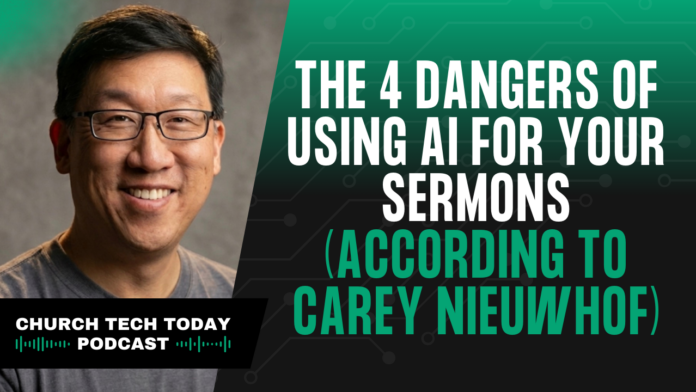
ChatGPT can generate a sermon manuscript faster than you can brew your morning coffee. But should it?
In this episode of the Church Tech Today Podcast, host Kenny Jahng breaks down Carey Nieuwhof’s recent message on the ethics of AI in ministry, and the 4 dangers every pastor needs to hear before letting algorithms into the pulpit.
From stunted spiritual formation to a subtle form of plagiarism, Nieuwhof argues that bypassing the hard work of sermon prep doesn’t just shortchange your congregation—it shortchanges you.
In This Episode, You’ll Learn:
- Four concrete ways AI can undermine your spiritual and vocational growth as a preacher
- Why the struggle of wrestling with Scripture is crucial to your formation and sermon impact
- How passing off AI-generated content as your own crosses ethical lines
- What happens to authenticity and resonance when sermons lack your personal investment
- The long-term risks of letting AI replace your study and mastery of biblical texts
- Practical boundaries for using AI appropriately in ministry tasks
- How to facilitate healthy team discussions on technology, ethics, and spiritual leadership
Key Discussion Points:
“AI can outline a message in seconds . . . but is this efficiency coming at a cost to your soul?” — Kenny Jang
“When you outsource that struggle to an algorithm, you might get a finished product, but you bypass the process that shapes you as a man or a woman of God.” — Kenny Jang (summarizing Carey Nieuwhof)
“Passing off insights generated by AI as if they were your own, your own aha moments, that’s actually a form of plagiarism.” — Kenny Jang
“If the message didn’t move you during the week, it likely won’t move them on Sunday.” — Kenny Jang (reflecting Carey’s warning)
“You basically remain a novice…a curator of other entities’ intelligence, but you’re not a cultivator of your own wisdom.” — Kenny Jang
Links & Resources Mentioned:
churchtechtoday.com (full article and video discussed)
Carey Nieuwhof’s YouTube Video (linked via ChurchTechToday article)
About the Church Tech Today Podcast:
The Church Tech Today Podcast helps pastors, church staff, and ministry leaders navigate the intersection of faith and technology with confidence. Hosted by Kenny Jahng and brought to you by www.FrontDoor.church.
EPISODE TRANSCRIPT
Kenny Jang [00:00:01]:
Hello, folks. It’s that time again. We’re here with the Church Tech Today podcast. My name is Kenny Jiang, your host, and today we’re going to talk about what Carrie Newhoff thinks about using AI for preaching. Now, artificial intelligence is undoubtedly the biggest technological disruption the church has faced for decades. And for pastors, I think the allure is obvious, right? Like, AI can outline a message in seconds. It could summarize complex commentaries. It could even generate full manuscripts if you really wanted to.
Kenny Jang [00:00:34]:
But I think the question of the day right now is, is this efficiency coming at a cost to your soul? Is it coming at the cost to your sermon? And so there was a video that Karen, you have put up on YouTube. And in that recent deep dive into the ethics of AI ministry, Karen Youhoff basically issued a sobering reality check. And I think it’s worth talking about it today because. Well, first of all, let’s back up. While Kary is not anti tech, he is pro human right. And so in this recently published YouTube video, Carrie argues that while AI makes a fantastic research assistant, it does make for a dangerous preacher. And so if you’re a pastor who writes and preaches sermons, I think there are four specific warnings that Carrie gives about letting AI take the wheel. That is worth discussion, both noting yourself, but also, I think it’s a great, almost like a team meeting discussion to bring up the dangers of AI as a preacher.
Kenny Jang [00:01:43]:
But it also translates into other facets of ministry. So let’s go through it. Here are four warnings against using AI for preaching, according to the one and only Carrie Newhoff. Ready? So the first one he talks about is it says it stops you from wrestling with the text. So according to Carrie, the difficulty of sermon prep is not a bug. That’s what he’s saying. It’s actually a feature. That harshness of the process, the grind, the hours spending reading, praying, staring at a blank screen, wrestling with God over the meaning of a text.
Kenny Jang [00:02:20]:
Carrie is saying that that is actually where your spiritual formation happens. And when you outsource that struggle to an algorithm, you might get a finished product. But that’s, I think, when you bypass the process that shapes you as a man or a woman of God. This is where Carrie warns that if you skip the hard work, you stunt your own growth. And the net of it is the sermon may be done, but the preacher is undone. In a way, the number two danger against using AI for preaching he talks about is it can be intellectually dishonest. And so this is where in the video he talks about There’s a fine line between research and theft. Yep, that’s right.
Kenny Jang [00:03:05]:
He talks about theft, like Carrie points out, that passing off insights generated by AI as if it were your own, right, your own aha moments, that’s actually a form of plagiarism. And he calls it out. It actually is going to sit unwell with a lot of preachers using AI these days. So basically, when a congregation sits under your teaching, there is basically an unwritten social contract. And here they assume that the words coming out of your mouth are the result of your study, are a result of your prayer life, and they are from your heart. And so standing in the pulpit and delivering a message generated by AI or the machine without disclosing it violates that trust, according to Carey, and the way he puts it, it’s a form of theft that pastors really need to take seriously. That’s a harsh one. The third one, the third danger of using AI for preaching is that your message will lose its authentic resonance.
Kenny Jang [00:04:10]:
So have you ever heard a sermon that was basically technically good and perfect even, but felt hollow? And this is where Carrie suggests AI Written content often suffers from this unhuman quality. One of the reasons a message lands with power is because it comes from deep within the preacher and it resonates because it has been filtered through basically the human soul, the human life, with all its pain, its joy, its experience, and an AI algorithm. It’s going to mimic emotion, but it can’t feel it. And so this is where Kerry argues that audiences are intuitive and they can tell the difference between a word that came from deep conviction and a script, one that was generated by predictive text or something from your own human heart. And so if the message didn’t move you during the week, it likely won’t move them on Sunday. Okay, danger number four. The danger of using AI for preaching is that you will never become a true authority. And this is so true, right? Like, this is probably the long term danger that’s easiest to overlook.
Kenny Jang [00:05:29]:
There’s all these little things, nitty gritty in the present tense and the immediate proximity. But long term true authority, he says, comes from mastery. I love this idea. And mastery is the result of years and years of digesting ideas, reading widely synthesizing thoughts that struggle that you do week in, week out, year after year. All of that is where your authority comes from. And if you rely on AI today to do basically the synthesizing for you to tell you what all the theologians say, rather than you reading what the theologians say, and you wrestle with it and you translate it into your own context. At the end of the day, he says that you basically remain a novice, you become a curator of other entities, intelligence, but you’re not a cultivator of your own wisdom. And so over time, there’s this erosion of study habits that prevents you from ever becoming a true authority on the scriptures, which if you are a preacher, that’s what you’re tasked to do, right? And so that’s totally a downside.
Kenny Jang [00:06:42]:
So those are the four dangers that he talks about. I mean, bottom line is he’s not saying that you should delete ChatGPT your account and you should avoid it at all costs. I know Cary uses AI himself in many ways. He acknowledges AI is a powerful tool for research or administrative tasks or even brainstorming. But when it comes to the sacred task of dividing the word of truth, of going deep into the studies, this is where he’s basically issuing the caution flag. You can use AI to find a quote, but don’t basically ever let it find your entire message. You don’t want it to go. And just predictively come up with the core thoughts of what you’re supposed to preach on on any given Sunday.
Kenny Jang [00:07:39]:
So I think it’s a good reminder. It’s a good thing to underline. You want to let the text do its work on you so that you can do your work for them. Right. So there you go. It’s a great video. He talks about other things in the video. Pros and cons of preaching with AI.
Kenny Jang [00:07:57]:
It’s available. You can check out the full article and rundown on churchtechtoday.com we actually have his YouTube video there and you can watch it further. Would love to know your thoughts on these four dangers. Are these the top four? Are there others that we should be thinking about? Let me know and we’ll see you here on the next episode.