

|
TL;DR At Ai4 2025, 8,000+ AI leaders debated regulation, ethics, and alignment—yet the Christian voice is almost absent, leaving a critical gap. 1. Education leaders push for safeguards without halting innovation. 2. Experts like Geoffrey Hinton and Emmett Shear stress AI alignment with human values. 3. Companies showcase “agentic systems” moving beyond automation. 4. The Church has a rare window to shape AI ethics before culture sets the terms. |
I’m writing this from the MGM Grand in Las Vegas, where over 8,000 AI professionals from 85+ countries have gathered for what’s being called North America’s largest AI industry event. After an eventful first day at Ai4 2025, the energy here is palpable as the industry grapples with some profound questions about the future.

Education in the Crosshairs
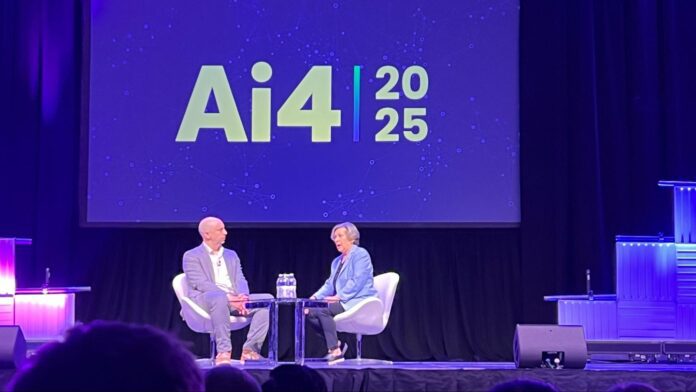
Monday’s opening keynote featuring Randi Weingarten, President of the American Federation of Teachers, was particularly relevant for our audience. Her conversation with NBC’s Jason Abbruzzese revealed how educational institutions are struggling to adapt as AI reshapes learning. Without federal guardrails, Weingarten explained that states will likely lead regulatory efforts around AI in education.
What resonated with me was her organization’s fight against a proposed 10-year moratorium on AI legislation—they want the flexibility to implement safeguards as this technology evolves. This mirrors the conversations many church leaders are having about adopting AI tools while maintaining their values and mission.
Today’s Key Conversations
This morning promises fascinating discussions. Geoffrey Hinton, the Turing Award winner often called the “Godfather of AI,” will share insights from his decades of neural network research in a fireside chat with Bloomberg’s Shirin Ghaffary.
We’re also expecting to hear from Emmett Shear, the former interim CEO of OpenAI, who will discuss “Defining the Future of AI Alignment.” The concept of AI alignment—ensuring AI systems act in accordance with human values and intentions—is becoming increasingly critical as these tools grow more powerful and autonomous.
Catalina Herrera from Dataiku is set to deliver what’s being billed as hard truths about AI’s next chapter. After seeing so many exciting demonstrations and ambitious promises, some grounded perspective on actual challenges will be valuable.

Innovation at Scale
Over 250 vendors are showcasing everything from AI agents and applications to cloud infrastructure and security solutions. The 50 industry tracks cover sectors from healthcare to finance, each exploring how AI is transforming their domain.
What’s particularly striking is seeing companies move beyond simple automation to “agentic systems”—AI that can act more independently and make decisions within defined parameters.
The Missing Christian Voice
One of the most encouraging aspects of being here has been meeting other leaders from the church and ministry space. However, we’re clearly underrepresented in these critical conversations. This is precisely where more Christians and believers need to be actively participating.
This technology innovation is still at such an early stage that biblical worldviews have a genuine opportunity to influence the formation of ethics, standards, safeguards, and directional aspirations. The questions being asked here about AI alignment, values, and human-centered development are fundamentally about what it means to be human and how technology should serve humanity—conversations where faith perspectives have vital contributions.
Tomorrow’s Anticipation
Looking ahead to Wednesday’s final day, I’m especially interested in Fei-Fei Li’s discussion on “World Models, Spatial Intelligence, and Human Centered AI.” As a renowned AI ethics advocate and Stanford professor, her perspective on keeping humans at the center of AI development should provide valuable insights for ministry contexts.
The Crossroads Moment
We’re witnessing the early stages of a technological shift that will impact every aspect of society, including how we do ministry. The conversations happening here about AI safety, alignment with human values, and responsible development aren’t just technical discussions—they’re fundamentally about the kind of future we want to build.
What puzzles me is why our Christian ministries, companies, entrepreneurs, and leaders don’t seem to recognize the opportunity to influence marketplace development in this industry. Are we witnessing the early stages of another “Hollywood scenario”—where Christians essentially opt out of engaging with a transformative cultural force, instead choosing to build isolated “Christian bubble” solutions while critiquing secular culture from the sidelines?
The AI industry is still forming its ethical foundations and operational principles. Unlike other industries that developed their cultures over decades before Christians recognized the need for engagement, AI is happening in real-time. We have a unique window to be part of foundational conversations rather than trying to retrofit Christian perspectives into an already-established secular framework.
The questions being debated here—How do we ensure AI serves human flourishing? What values should guide AI development? How do we prevent harm while maximizing benefit?—are questions the church is uniquely equipped to help answer, grounded in our understanding of human dignity, stewardship, and love of neighbor.
As the conference continues, I’ll be listening not just for the latest innovations and capabilities, but for opportunities to ensure that biblical wisdom and Christian values have a seat at the table as this technology shapes our future. The question is: will we take that seat while it’s still available?