

|
TL;DR Digital evangelism is no longer optional—Justin Khoe and Kenny Jahng share practical strategies for churches to use short-form video, automation, and affordable ads to turn online engagement into real-life discipleship. 1. Short-form video outperforms long-form content. 2. Automation + personal follow-up creates real connections. 3. Effective campaigns can run on just $5–$16/day. |
Episode Summary:
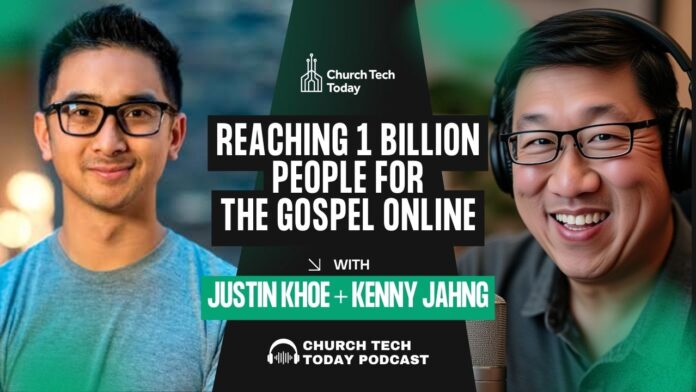
In this episode, Kenny Jahng sits down with Justin Khoe, founder of the Digital Missionary Academy, to explore practical strategies for churches to amplify their impact using digital content. The conversation centers on how church leaders can leverage short-form video, automate outreach, and transition online engagement into real-life discipleship—all without needing a massive budget or media expertise. Listeners will discover actionable ways to move beyond livestreaming and Sunday uploads, empowering local ministries to connect with unreached people in their community and beyond. If you’re a pastor wondering how to make digital ministry sustainable and effective, this episode is packed with encouragement and real-world ideas.
In This Episode, You’ll Learn:
Why short-form video outperforms long-form content for local church outreach and practical steps to get started
How to use automation and simple digital tools to turn social media engagement into discipleship opportunities and in-person connections
What it takes to build a robust church marketing campaign on just $5–$16 a day
The power of personal, non-automated follow-up—even in an age of automation and AI
Creative ways to fund digital advertising through congregation support and community vision casting
Tips for repurposing sermon content into daily social media touchpoints, including tools and workflow suggestions
Approaches to train staff and volunteers in digital ministry, even if leaders feel hesitant or skeptical
Key Quotes:
“Short-form content is powerful—when you partner it with automations, you can move people from discovery to next steps at scale.” — Justin Khoe
“The simple idea of how the church serves today is an exciting value proposition in and of itself.” — Justin Khoe
“500 bucks a month is not as much as you think. . . Can you find 3 people willing to donate $5 a day? There you have $500 a month to fuel a campaign and show results.” — Kenny Jahng
“Churches have a unique value proposition in that we are flesh and blood, we actually care about you… That is the thing people are hungry for.” — Justin Khoe
“If not digital outreach, then what are we doing? Are we really going about the Great Commission?” — Justin Khoe
Links & Resources Mentioned:
• Justin Khoe on Instagram: https://www.instagram.com/jkhoe
• Digital Missionary Academy: [Search “Digital Missionary Academy” on YouTube]
• Book: Empty Pews to a Million Views https://amzn.to/45jD2M1
• ChurchTechToday: https://churchtechtoday.com
About the Church Tech Today Podcast:
The Church Tech Today Podcast helps pastors, church staff, and ministry leaders navigate the intersection of faith and technology with confidence. Hosted by Kenny Jahng and brought to you by www.FrontDoor.church.
EPISODE TRANSCRIPT
Kenny Jahng [00:00:03]:
Hey, friends, it’s that time again. My name is Kenny Jahng, here with the Church Tech Today podcast. And guess what? We’ve got a legitimate Internet celebrity. Is that what it is? We got Justin on the line.
Justin Khoe [00:00:15]:
I don’t know that I would ever introduce myself that way. But Kenny, I’m grateful to know you and I’m glad to be your friend. And thanks for having me on the podcast.
Kenny Jahng [00:00:22]:
Absolutely. Now, Justin Khoe is just one of the guys that you need to immediately abandon this podcast. Whatever you’re doing, get onto YouTube and click that subscribe button. We’re going to put the links in the show notes. But Justin Khoe, you can find him on YouTube, also on Instagram. Those are the two places that I follow him. And we’re going to talk about some other things that are cooking in the kitchen for him. But let’s quickly get to the point.
Kenny Jahng [00:00:46]:
Justin. We are here to talk about video content videos. The new Black. I’ve been saying this for decades now at this point that every single church needs to think about their content marketing, their content production, and that video needs to be part of the equation. And this is why I rang you up because, Justin, you are a master at that. And what I love is your generosity of teaching church leaders and Christians that are interested in really furthering the kingdom of using video. So give us your 30 second pitch. What are you doing right now? You’ve got this thing called the digital Missionary Academy.
Kenny Jahng [00:01:24]:
What is the premise of that? Who is it for? And then let’s just dive into some of the concepts and teaching that you are teaching there.
Justin Khoe [00:01:32]:
Yeah, absolutely. I’m on a mission to help churches and missionaries reach a billion people with the gospel. And I do that in a number of different ways. I do this in the realm of education, realizing that many pastors did not learn how to do media and communications and video in seminary. So I have an education branch of it where you can learn how to do that. I also have kind of a service side of this where churches, hey, if you want to completely outsource everything from the clip selection, the editing, the branding, all the way down to the upload itself so that all you have to do is worry about what’s happening on the weekend, we’ll have her, we’ll have handle everything that’s happening in the week, we do that as a service. And then last but not least, I’m trying to help a sub niche of missional leaders, specifically those who are bivocational, those who are lay leaders, those who are just kind of entrepreneurial at Heart. And what I’m trying to do is help ministry leaders earn money by converting their sermons into courses and coaching programs.
Justin Khoe [00:02:30]:
A little thing called tent making, but kind of applied into the modern context. And so the reason why I’m doing that last third is one of the reasons why many people don’t feel like they can go all in on social is, is because they’re still having to pay the bills. And I try and offer, hey, listen, churches all over the world are solving problems already. Whether that problem is something as simple and obvious as how to study the Bible, great problems around how do I parent my children in a rapidly changing world? Or as like one of my students was able to do, to share the gospel, but in a specific context, to help people who are struggling from an addiction to L U S T. The idea is this, that the gospel fundamentally transforms people’s lives. And so when you realize that and then position what you do as a solution to someone’s problem, number one, you’re gonna reach more people with the gospel, period. Because social just inherently works when you solve people’s problems. But also number two, you can actually generate revenue, pay the bills, earn a cool 10 to 100k per year by doing what you’re already doing if you just figure out how to repackage it.
Kenny Jahng [00:03:35]:
Yes, I love the Venn diagram that you’re offering to church leaders everywhere. Now, in terms of YouTube, one of the prescriptions that we talk about all the time, at least in our circles here, is that you need to go all in on video. Everyone has this guilt complex that’s in the church communication space. Knowing we should be investing in YouTube, we should be doing more on YouTube. We shouldn’t just take our hour, hour and a half, dare I say, sometimes two hour worship services. Don’t cut it and just post it and copy paste it online. That’s not enough in YouTube. And we were talking about how long form content is the place where it’s the only place where the value of your asset increases over time.
Kenny Jahng [00:04:23]:
And then I get this loud ringing in my ear. Justin is saying, hey, hold your horses. Content is not the place where you should be going first. I mean, it’s someplace that fits in your ecosystem. But it’s not the first place that church should be thinking, this is serious crazy contrast to what everyone else is saying out there. Justin, tell us why long form content is not the solution that a church should be investing in first.
Justin Khoe [00:04:53]:
When I first started as a digital missionary, if it’s okay for me to coin the term and brand the term, uh, when I made the transition to IRL ministry into online ministry, all the, all that there was available was long form YouTube. I remember taking courses. Uh, we have mutual friends that are in this space, shout out to Sean Cannell, who’s been a mentor and a coach to me. I drank the Kool aid, went all in, and over the course of a couple of years built a, a, a pretty successful YouTube channel. 120,000 subscribers, reaching multiple millions of people with the gospel through YouTube. And in many ways I want to say yes. And YouTube is fantastic. It is a powerful tool.
Justin Khoe [00:05:31]:
It is absolutely maybe one of the greatest bets you can have in the online space of saying, you know what, this platform probably is going to exist 20 years from now, so it’s worth investing in. Yes. And my personal journey was that it was very difficult to monetize. That was problem number one. And I realized that not everyone has that goal, so that’s okay. But then let me extrapolate by extension, it was very hard number two, to get people to make decisions to move them off platform. YouTube is a, is a fantastic tool, but the challenge is that it has a very high barrier to entry. The reality is that many people, even though they speak for a living, pastors, I’m talking about, they get behind a camera and they realize it’s a different skillset.
Justin Khoe [00:06:14]:
They’re related in the loose sense that, yeah, we’re still talking to people, but the presentation skill to cameras, very different to a live audience. And all things being equal, trying to teach pastors how to do YouTube for a number of years proved to be a difficult thing. The attrition rate was quite high. But what I started to learn for my own ministry and then in my kind of working with other pastors, was that the idea of showing up in 30 second increments, 60 second increments, was not only much more reasonable, much more plausible that they could actually do it, but we started to see the kinds of results that they actually wanted. And so when I was talking to pastors, I would ask them, well, why, why do you want to be on social beyond just believing everything that Kenny says? Cause he’s an awesome guy and he says, you gotta be on YouTube. So I’m gonna be on YouTube. Beyond that, what are you hoping that the YouTube channel does for you? And I think that there is the altruistic, I just wanna reach more people. The message, that’s fair.
Justin Khoe [00:07:06]:
But most churches, at least that I work with, that are on the smaller to medium size, don’t have the luxury of just merely saying I want it to be an outreach vehicle at some level in order to justify either the resources or number two, their personal time invested into the platform, their core stakeholders, their board members, their elders need to see some type of return on investment before it starts to look a little bit reckless, if you will. And so really what it comes down to is, well, we need to see people coming to faith in Christ. We need to see people joining the church, we need to see them, you know, enrolling in discipleship classes or small group experiences and all things being equal, YouTube seemed to be challenging for people to reach a local area. This is where I think short form content actually has the advantage. Number one, it has an advantage because it works within meta and you can do a very easy kind of geographical approach to reaching people so that you can actually reach those who live near you much more simply than you can through Google’s platform. But maybe the most exciting part is number two is that you can now use things like manychat to use automations for the follow up experience. Meaning if you have a piece of content that, that pops, you’re going to be able to move them off platform quickly. You can move them to your discipleship enrollment, to a plan of visit and you can make, you can help people take the next step much more quickly.
Justin Khoe [00:08:29]:
And everyone knows that when you upload a 10 minute video versus a 30 second video, which one, if you just keep everything equal, what are the odds that one goes viral versus the other? Everyone knows short form has the biggest chance to go viral compared to long form content. And so with those factors in place, what we’ve been able to see is churches enroll hundreds and hundreds of people into their discipleship experiences. I planted a church on the Internet a couple of years ago. We had 10,000 people go through our discipleship course in one year without spending a single dollar on advertisement just using organic content alone. And so this is the beautiful thing is that short form content is powerful when you partner it with automations, you can at scale move people from discovery to next steps very quickly.
Kenny Jahng [00:09:15]:
Awesome. So one clarifying question just to pierce through everything is that a local church could utilize these online platforms today in order to reach people only across the world or realistically, how practical is it, how practical is it for local church to actually take advantage of short form video today and reach people in their own driving distance, in their own state and or figure out how to get them off platform into something that’s a little bit more engaging?
Justin Khoe [00:09:52]:
Yeah, through, through meta you can very easily Reach people within a five mile radius of your church, if you want to set it to 7 miles, 10 miles, whatever the radius is. But you, you pick the number and Meta will literally restrict the use of your marketing budget to those people specifically near you. And what’s more exciting about that, not only can you just do an initial campaign using your sermon content, devotional content, whatever type of content you want to use, not only will you reach them immediately, but beyond that you have the ability to build what many people are calling the invisible list, meaning that you start to generate an audience of, of people who have by action are demonstrating they like what you have to say. They’re watching major percentages of your videos as, as an indicator that man, what you’re saying is connecting with them. And now you can forever retarget them when it comes to direct call to action campaigns. So on the first layer, you just have nurturing content. You have content that’s just gonna be fantastic because it’s just what you do. It’s your bread and butter.
Justin Khoe [00:10:52]:
You preach the gospel, you help people, you do that. And then when it’s time to do an Easter service, do a Christmas service, to do a special program for children or for parents, or for, fill in the blank entrepreneurs, whatever kind of outreach class or course or experience your church wants to host, you can retarget those individuals who live near you for pennies on the dollar because you’ve already generated that goodwill.
Kenny Jahng [00:11:15]:
Yes, absolutely. The fine tuned controls that we have today as publishers is just actually incredible. Now here’s another clarifying question, because there’s going to be people that object that says, hey look, we are not a megachurch. We don’t have a billion dollars. How much money, practically speaking, does a local church need to invest? Or what’s the entry point that a church needs to think about in terms of budgeting for paid ads to get the content out there to actually target people in their zip codes.
Justin Khoe [00:11:48]:
You will be astonished with what you can accomplish with something in the more modest realm of something like 500 bucks a month. Now that even sounds maybe to some churches, to the smaller churches. And I understand, I work with very small churches, at times that does seem like a lot of money. If you wanted to sell it down, you could $5 a day. And if you have a degree of patience with it, you can build a very valuable marketing machine that reaches people in your community. So I want to kind of cast a wide net. It could be as little as $5 a day if you have a budget of $500. Per month.
Justin Khoe [00:12:19]:
That’s actually fairly like in the area of robust, if you’re a little bit patient, if you want to move quickly and you have a thousand to $1,500 per month in paid advertisement, man, that can go very far. And here’s what’s crazy, Kenny, is if you remember what generating meta advertisement was like four or five years ago, it was a science. Like, you had to have advanced degrees in in order just to figure out how do I upload my freaking content to the ad management itself. Now that has gotten so good that you don’t need to know any of those things. Truth be told, you can teach someone in five minutes or so. Which buttons do you want to click to help them understand? Okay, this is how I just do things at scale. So I’m not having to necessarily rely on ad agencies to do the work for me.
Kenny Jahng [00:13:04]:
Yeah, absolutely. And just to frame it for everybody, 500 bucks a month is not that much. It is about 15, $16 a day. Right. And so even from a support perspective, what I would do is I would actually use as an opportunity to find new supporters for your church. There are people who are excited to hear that your church might be putting energy into using the Internet, using social, using digital to be future forward, and actually using what we have available today in business for the marketplace for ministry. And can you find three people willing to donate $5 a day? Just give up a Starbucks coffee every single day. And imagine just find three supporters to give $5 a day there.
Kenny Jahng [00:13:52]:
You have $500 a month pretty much to be able to fuel a campaign and show results. Right, Justin, there’s so many creative ways, 100%.
Justin Khoe [00:14:01]:
What I’m hearing you highlight is that many people in the church space have kind of been frustrated to see their local church feel like it existed and was optimized for a church 50 years ago. And so this simple idea that the leadership has a vision of how the church serves today is an exciting value proposition in and of itself. That many people without any results, without even any promise of outcome, would say, you know what, that I can get behind. And then what’s nice about that is that you buy yourself a bit of time, you buy yourself a month, two months, three months to be able to start generating real relationships with people in your community. And then all you need to have is one or two case studies or stories of people in your local community that this is being dramatically impactful to, and it will change the game for that. I’ll give you an example. One person who’s A part of my online community has been now for the last couple of years. Again, this is just the organic side of things.
Justin Khoe [00:14:54]:
So I haven’t been able to do the local targeting within this example. There’s a friend of mine named Maggie. Maggie lives on the east coast, I live on the west coast. Previously I was on the east coast of Hawaii, so thousands of miles away. I’ve literally never met her in person. However, Maggie is a part of our online community. I see her several times every single week in Bible study, in small groups and our online church. And the way that she came into our community was through a simple Instagram story.
Justin Khoe [00:15:22]:
She happened to follow my page and then ended up seeing the Instagram story. Invitation to the Bible study. And here’s the story of what happened to her. Maggie has been suffering for many years, over nearly a decade, she says, of suicidal ideation, self abuse and all kinds of really kind of toxic behaviors because she was unfortunately taken advantage of a number of years ago. And so she had a whole host of issues of identity and value and everything else like that, where she was at the edge of, of her rope, so to speak, the end of her rope and considering taking her own life through integrating with our online community. She says that she’s been freed from an entire decade of self harm, suicidal ideation, et cetera, et cetera, et cetera. And she says that going to our online Bible studies, being a part of our online community, is the highlight of her week. Now you go to those future minded investors, those people who are willing to sow a seed forward, and then once a month you get to share with them a story like this.
Justin Khoe [00:16:27]:
Will that not move their heart to say, you know what, not only is the idea of it exciting, but it’s actually making a difference as well. I think that this is the kind of recipe to being able to scale into the future.
Kenny Jahng [00:16:39]:
I love it. I love it. What, what would be. I think because in this little conversation circle that we have this loop about return on investment. If you were able to come up with 15 people to give a dollar a day, that gets you to that almost $500 a month, seven or eight people to give you $2 a day, that’s not a big ask. What’s the return on investment? How many people do you think you can actually get off platform in a given month? If you had a $500 budget, how many people could you get into a live chat, some sort of direct chat, not just passively consume your content, but some sort of interactive mode of conversations that are People within driving distance of your church. What’s a realistic expectation for a church?
Justin Khoe [00:17:36]:
Let me put it this way, when we’ve done this with churches in the past, one of the things that they tell us at some point is that they actually have to turn the ads off. It’s actually a different problem. The problem that they’re experiencing is that they’re actually serving so many people in the DMs and I’m setting the context for this. They’re doing kind of prayer campaigns. The strategy that some of our churches have adopted is, you know what, we’re going to put content out there just to serve, just to give goodwill. We’re going to retarget those individuals with a simple offer. Hey, if you’re struggling right now, if you don’t have community, you need someone to support you. Just send us a message, let us know what your prayer request and a member of our team will actually hop on and offer prayer with you.
Justin Khoe [00:18:14]:
Where what we’re doing is not, we’re not relying on automations at this stage. We’re literally teaching the ministry leaders to, with their phone record a selfie where they look to the camera and call the person out by name. Hey Kenny, I’m so sorry to hear that XYZ tragedy happened in your life. But I want to let you know you’re not alone and I wanted to pray for you right now. So I’m looking to the camera, there’s a sense of connection there. I’m mentioning you by name so that this is not something that AI is going to do. But then I’m saying, Father in heaven, I want to pray for my brother Kenny. I want to ask that you give him courage and strength and et cetera, et cetera, et cetera, in the name of Jesus, Amen.
Justin Khoe [00:18:48]:
So it’s something that takes, let’s be real, 30, 45 seconds to do. But now there’s a personal touch and from there you get to exercise all of your great pastoral skills of being able to check in on them later, to be able to ask follow up questions and eventually get them to move off platform and say, hey, would you like to do a pizza with a pastor kind of experience? Would you like to meet up for a coffee shop just so that I can hear your story, et cetera, et cetera. But what we’re seeing is that churches who do Even just the $500 of ad spend per month quickly tell us they have so many people that are saying that they’re interested in learning more, they’re interested in community that it actually makes sense for them to occasionally turn the ads off, or at least the ask the prayer ads off, because they have so many people who are hurting in their community who need help. So the question of like, how many people can you get to show up to your local church? Well, that’s. That. That is the question. Right? But I think that’s really where it comes down to your team, your skills. Are you good at the interpersonal ministry side of things? And this is the thing, you know, you and I, Kenny, we love AI, we love automations, we love building systems of scale.
Justin Khoe [00:19:52]:
But when the world zigs, we as the church may need to consider zagging. Meaning if everything is fully automated, you showing up as a human being is the thing, thing that they’re hungry for, it is the thing that they’re not getting in any of. They go to McDonald’s and there’s now a kiosk taking their order. They’re not even being asked by a human, would you like fries with that now?
Kenny Jahng [00:20:13]:
Right.
Justin Khoe [00:20:13]:
And so this is the idea is that churches have a unique value proposition in that we are flesh and blood, we actually care about you. We’re not just interested in you buying our product, interested in you becoming another number, but we actually want to serve and love on you. And I would say that the churches that are doing that well are the ones that are able to convert from that digital experience, that maybe first off, coffee exploration experience, into showing up in the local church.
Kenny Jahng [00:20:39]:
I love it. Here’s the other. I want to pivot just a little bit because it’s not just about getting them into a dm. You actually have built systems to get people into online small groups and you’ve taught people now. In fact, I remember recently, everyone should go onto Amazon and buy this. Empty pews to a million views. And this started my journey down that path of finding good models, healthy, sustainable models for church leaders to look at. Tell us a little bit about the success stories that you’ve had about basically connecting with strangers on the Internet through content and then inviting them into live, synchronous experiences of studying the Bible together.
Kenny Jahng [00:21:27]:
Because I think that’s what pastors, pastors push back on social and digital lot because they’re like, it’s all fluff, it’s shallow. We never disciple people. We never actually opened the Bible and actually study together. You’ve come up with a model to be able to get people into small groups online. Tell us a little bit about that.
Justin Khoe [00:21:49]:
The idea is simple. I show up on social media, do short form content and I put out an invitation with every single post. The idea is simply this, hey, if you’re looking to join a Bible study community, if you’d like to actually journey with other believers who are about this thing, here’s the next step, right? And you can do multiple different versions of the next step. The one that I advocate for is using text message as a tool. And the reason is because something like, I don’t know, 90 plus percent of all text messages are opened within the first three minutes, whereas an email, you know, we know that, you know, world class newsletters open about 40%, but maybe a couple days later. And so when it comes to doing something timely, that is to say that’s rooted in a particular time domain. For example, Bible studies every Sunday at 10:00am Pacific time, which is actually for the last five years, I’ve been running an online Bible study, 10:00am Pacific time, every single Sunday morning, right? And so what I’ve been doing is I’ve been running this one gathering every single week and funneling all of my social media attention towards that one thing. And over the course of the years, I’ve had thousands of people come through this Bible study experience.
Justin Khoe [00:22:51]:
And obviously people come and go like they do with any other small group. But on average I’m having between 30 to maybe as many as 100 people showing up for a live Zoom hosted Bible study.
Kenny Jahng [00:23:02]:
These are not bots, right?
Justin Khoe [00:23:03]:
These are not stuff, as far as.
Kenny Jahng [00:23:05]:
I can tell on Zoom or something like that. These are real people.
Justin Khoe [00:23:08]:
That’s correct. Real people showing up, asking questions, engaging in the Bible study, asking for prayer, people from all over the world. In one Bible study, I’ll have people from Mexico, from Germany, from South Africa, from Japan, from all over the United States showing up live, setting time aside in their schedule to actively be there. There’s someone who’s been a part of our Bible study for the last couple of months now. She’s coming from, I think it’s Brazil. And I think that she sets her alarm something like three or four in the morning or something ridiculous for Internet church. Her and her husband are intentionally staying up past midnight to be a part of our online community. Why? Because number one, they found value in our social platforms, right? All the Instagram and TikTok and YouTube content that we’re putting out there.
Justin Khoe [00:23:54]:
But number two, we’ve had an intentional strategy of how to move you off platform. And then number three, we have single gatherings that are very high leverage, meaning that I only, I personally do one per week and that’s a very easy rhythm to commit to. It’s, you know, one or two hours per week. It’s not overwhelming. I’m not doing hundreds of one on one sessions because truth be told, that would just be unmanageable. But I show up for the last several years once a week for about an hour to two hours that I can carve time out to do. And as a result, hundreds if not thousands of people have gone through our discipleship experience and been a part of our online community. It’s a powerful tool to realize if you just carve out a little bit of time and direct all of your attention towards these communication channels, people will show up because people are in need.
Justin Khoe [00:24:39]:
The Bible talks about how that there’s thousands upon thousands who are perishing for a lack of knowledge. And so you choosing to show up to serve people, to equip them and how to navigate through the Word of God better, how to be able to pray better, how to be able to actually hear God’s voice for themselves so that they’re not reliant on you. Like this is discipleship. This is anything but shallow.
Kenny Jahng [00:25:02]:
I love it. I love it. When I was a church online pastor, one of the things I found is that we had a global audience, like you’re saying. But what was the sweet spot is when I was able to invite the people in our local church at our different campuses to meet, join us. Because the conversations in a Bible study or small group online, when you have local people and then people from other geographies, other countries, even the conversations are completely different because the cultural assumptions are different, their histories are different, and it just opens up people’s perspectives. And consistently I would say that the people in my local church that were part of those Bible study groups online with other people would report that it was so much more healthy and life serving for them in their own faith walk than offline Bible study groups that they went to with the same cultural assumptions, the same artifacts that everyone consumed at the same time locally, everyone goes to the same Costco, they watch the same shows on Netflix, et cetera. And then once you have all the diversity of conversations and asking questions, it just changed the dynamics of those discussions. And so I think that being able to mix those two, Justin, has just been incredible in my experience, that’s so powerful.
Justin Khoe [00:26:23]:
And that’s actually one of the things that I love most about doing online ministry is that you don’t know where people are coming from. I grew up in a faith tradition that was very insular, very much kind of like, we’re the ones over here doing our own thing, and everyone else over there, you all can go kick rocks. By serving on the online space, I’ve been interacting with people from all kinds of different faith backgrounds. In fact, I’ve been able to interact with people who have no faith background, or maybe faith backgrounds that are antagonistic to mine. Meaning, I remember sitting in a Bible study once, and someone is vocalizing their journey. They’re saying, you know what? I’m kind of new to the whole Jesus thing. I’m kind of new to the Bible. I’m kind of new to.
Justin Khoe [00:26:59]:
And so this person is asking question after question after question. And so I finally wisen up and I realize that it’s probably prudent ask, tell me your story. Like, how did you come across this? Like, what do you mean you’re new to the whole Jesus thing? This person tells me, oh, I’ve been a practicing witch for the last several years.
Kenny Jahng [00:27:16]:
Wow.
Justin Khoe [00:27:16]:
Like actual paganism, actual supernatural witchcraft. And then as this person is sharing her story number one, I’m completely dumbfounded. Cause these are the exact people that Grandma told me never to hang out with. This is why Harry Potter was banned in the family. Like, all these kinds of things, right? And so I’m just like, blown away. What do I do? How do I interact with this person? And lo and behold, in the exact same same study, that one person vocalizes that she’s actively transitioning from witchcraft to faith in Christ, two other people who have been in my study for months at that point in time said, you know what? Actually, that was my journey as well. And they started testifying to this new potential convert saying, hey, this is what my experience of, of getting to know Jesus, the person has been like, and I didn’t even know this, that we have three potentially three former witches who have now come to faith in Christ through an online Bible study. And how does that experience challenge the way that my Western Christian audience, who maybe has a.
Justin Khoe [00:28:17]:
An antagonism to the supernatural, has a disbelief in so many of the miracle stories, et cetera, et cetera, to be opened up in their worldview to realize, oh, my goodness, this world is a supernaturally enchanted world, that when the Bible actually talks about spiritual warfare, this is a real thing. How do you think that that simple factoid challenges the way that we pray, challenges the way that we support each other as a body of Christ? And so I agree, man, being able to put yourself out there in uncomfortable spaces really is a rewarding experience for our personal walk.
Kenny Jahng [00:28:51]:
Awesome. Hey, so back to short form.
Justin Khoe [00:28:54]:
Yeah.
Kenny Jahng [00:28:55]:
What is the first step? Is it just slice and dicing your sermons or is it selfie videos? Do you need a light kit and all this kind of stuff? What’s the first steps that a church should do when they’re exploring this type of genre?
Justin Khoe [00:29:11]:
First step is definitely a logical one. Doing the sermon snippets. It absolutely makes a lot of sense. There are organizations out there that market it for this sermon shot I know is one of them if you want to go in the secular route. Opus Clips or Opus Pro is another one. Of course you get to talk to me if you want an agency type experience to do it for you. But long story short is you’re already doing the hard work. The hardest work is preaching the sermon.
Justin Khoe [00:29:34]:
Or maybe I should say not even preaching the sermon. It’s putting in the work to have something of substance to share. And this is the crazy thing is that so many churches don’t realize already that they are perfectly curated for the digital space. Other institutions, other organizations have to carve time out for communication, for content, for this kind of one to one kind of air quotes, sales type of funnel. The church is already has that for. For thousands of years we’ve gathered around the Word of God with the expectation that someone will come and teach, someone will come and share. They’ll do the hard work of contextualizing the Word to our lived experience. So the question is this, what sense does it make for the sermon to die that weekend and then start the cycle over and then move forward onto the next week? Why would we not repurpose the entire sermon and, and get it out there? So, so obviously, yes, you absolutely should be doing sermons.
Justin Khoe [00:30:29]:
And the nice thing is with the AI now, with all these software, it’s not an exaggeration to say that it takes maybe an hour to create your entire week’s worth of social media content. And if you think about the outcome, if what you’re telling me is with one hour invested, I can use an AI tool to create a daily piece of social media content that results in dozens, if not hundreds, if not thousands, thousands of people in my local area coming to faith in Christ, well, is that time worth it? I think the answer is an obvious yes. Beyond that, I think that there’s a very real sense, Kenny, and you’re kind of tiptoeing around it, that sermon content in and of itself maybe is only really attractive to people who have the spiritual background and maybe they left the church and so that’s why they’re Kind of primed to be willing to explore sermon style content that looks like you’re on a stage, but there’s a whole host of people who may not actually respond to that. And so using AI, what would it look like for you to take a transcript of your entire sermon, to ask ChatGPT to identify the core nuggets that might appeal to a secular audience, and then sit down in front of a camera, record a piece of organic content and simply rehearse the same core nugget. But now with a skeptical, with a secular minded person in mind. And then now you have something that’s beautifully shot, that is curated for a kind of seeker style audience. And now you can do that with a very, very quick lift. As it, as it’s pertaining to time.
Kenny Jahng [00:31:54]:
And resourcing and if you get the workflow down, how much time every single day does a church leader need to actually invest in this type of activity?
Justin Khoe [00:32:07]:
Yeah, I think that you don’t even have to think about it per day. I think that you could easily think about it like as a single afternoon. In a single afternoon you can absolutely go to AI, upload the transcript and find the 5, 6, 7 clips that you would want to curate. As a seasoned pastor, you absolutely know what it’s like to communicate a nugget in a pinch. You know what it’s like to say, pick up the phone, have someone pick up the phone and say, hey, I need you to cover for me. There’s a local academy that the pastor, the chapel service is now, you know, for whatever reason, they’re stuck in traffic, they got sick. I need you to step in. You know how to take the ideas that you’ve been studying at a advanced degree level, interpret it to the 7 year old and 8 year old chapel experience in 10 minutes or less.
Justin Khoe [00:32:50]:
This is the idea is you already have done the hard work of processing the major idea to turn it into short form. Content should not take you very long so that we’re able to go from nothing, just the sermon to identify the key moments. Step number one, step number two is then contextualize it for your audience. And then step number three, batch record the entire thing in 30 minutes or less, Boom, you have your entire week’s worth of content done in literally one afternoon.
Kenny Jahng [00:33:16]:
Such good stuff. Such good stuff. What would you say to a church leader where the pastor or the people that they report to don’t value video, doesn’t value social, doesn’t value digital, doesn’t see these digital channels as a legitimate way to do outreach? How do you support them? What’s the message that you would say to them?
Justin Khoe [00:33:41]:
On the one hand, I would want to engage in a much lengthier conversation. Okay, then, if not that, then what are we doing? Are we really going about the Great Commission? One of the things I like to challenge people with when I do, like, in person talks is I highlight the passage where Jesus is saying that the gates of hell will not prevail against the church. And I try and highlight, where are the gates of hell? And it’s kind of one of those duck questions. People are like, this has to be a trick question. But I let. I let it breathe for a little bit, let people kind of squirm through it. But ultimately I try and highlight the gates of hell visually, like, metaphorically, are on the outskirts of hell. Like hell has a defense system.
Justin Khoe [00:34:18]:
There are walls and there are the gates. And so what Jesus is painting a picture is that Christianity, right, is not a defensive game. It’s not where we build walls and we hide in our towers and we want to protect our children from all the outside influence. Of course we want to protect our children, but that’s not the picture that Jesus is painting. What he actually is saying is, leave the kingdom, so to speak, go out into the land of darkness and wage war against hell itself. And the promise is this, that when you are at the gates of hell, laying siege to hell, the gates will not prevail. You will overcome darkness. And so I want to just gently try and reframe how we think about the church experience.
Justin Khoe [00:34:58]:
Why is it that we’re so defensive by nature? And where in our strategy and our ministry are we going on the offense? So that’s. That’s a longer conversation. But I think, practically speaking, I think there’s wisdom to consider the whole rebuke, not an elder approach, where scriptures makes it clear like, hey, hey, don’t rebuke an elder. And this doesn’t mean that the elder is never wrong. It just is highlighting that maybe it’s not very effective to try and go toe to toe with your senior leadership, that, that it takes a very specific, mature, kind of wise kind of leader to be able to receive that kind of direction. But instead, I would just encourage you to go out and do it, because when you’re able to say, hey, Pastor, I want you to meet Susie, as Susie is walking in the door for the very first time, and he gets to meet Susie and hear her story, shake her hand, give her the welcome, embrace, and the whole thing. And then later you get to tell the story of how you met Susie, Pastor, you wouldn’t believe it. I’ve been playing around with this thing in the background in my off hours.
Justin Khoe [00:35:56]:
Don’t worry, I’m still doing all my job, getting all my tasks done. But I met Susie through TikTok and here’s her story. She’s a fill in the blank, struggling with this and that and the other thing. And when I met her I was able to pray with her, et cetera, et cetera. And now she’s a part of our group, now she’s a part of our experience. When they’re confronted with stories of real people, I think it makes it hard to persist in your unbelief around the online space. I think of a friend of ours, mutual friend of ours. Kenn, you remember Trey Van Camp.
Justin Khoe [00:36:24]:
I’ve interviewed him for my podcast, the Digital Missionary or Digital Missions podcast. And Trey tells me that for a long time he’s been running the $5 a day ad strategy, right? Just literally just $5 a day for a couple of years. He’s told me that he has small groups of like 15 to 20 families who have all come to the small group because of digital. Mind blowing stuff. So this is the point is that once you see one or two case studies of people who are coming to faith, who are joining your local church, who are doing all the things that a traditional style of leadership would expect from air quotes, good Christians, and then when they realize that the digital is one of the ways that you can get people to that end goal, I think it forces them to re examine their presumptions.
Kenny Jahng [00:37:08]:
I love it. I love it. Well, thank you Justin for hanging out with us. The one thing that I want you to share with people is there’s a resource that you have that I think is still available to people is the Digital Missionary Academy. That’s right. Can you just share with people what would they get out of joining that cohort, that community? On a very practical basis, if they’re beginning to dive into this stuff or if they want to justify to a leader at the church that says let me get trained and let me invest in this area to get up to speed, what would the Digital Missionary Academy do for them?
Justin Khoe [00:37:47]:
On the grand scheme, students of the Digital Missionary Academy have already reached over 500 million people with the gospel. I told you at the very top of the hour, I’m on a mission to help missionaries reach a billion and God willing, we’re going to do that. But so far we’ve reached a modest 500 million. What does that look like? That includes how do you take your exact sermon content and get that out into the world so that the easy win is this. The sermons that you’re already committed to preaching just happen to reach more people. One of my churches that taken this program, in their first three months of you doing the program reach an additional 250,000 people with the sermon content that they’re already preaching. So the simple win is already greater reach with your existing messages. Another win looks like you’re actually able to grow your followers.
Justin Khoe [00:38:32]:
So several of my churches have reached 20, 30, 50, 80, 100,000 followers or or more in a reasonable amount of time. A win number three looks like this. How do you do exactly what I’ve been arguing for, which is move people from the online space into an ecosystem where you can do discipleship, Whether that’s online Bible studies, an online church, or literally, what does it look like to build the funnel that moves people from digital to the in real life experience? And so all that is covered in the Digital Missionary Academy. There’s a ton of interviews with experts in their own field. Kenny, you’ve made an appearance once or twice as a guest teacher for the program. And so you get to learn not only from myself and what’s working within my little ecosystem, but you get to learn from experts in so many other areas of the online mission field as well. So that’s all available at the Digital Missionary Academy. If you want to explore what this looks like and if you have any questions for me, just send me a DM on Instagram.
Justin Khoe [00:39:26]:
My handle is Koo. J K H O E. That’s my name, J Koo. And just mention Kenny. And here’s what I’m going to do. I’m going to offer you a 20% discount to the lifetime access of the Digital Missionary Academy. And we’ll also send Kenny a nice little thank you, a gift card or something along those lines for his trouble. I’m just kidding.
Justin Khoe [00:39:46]:
We’ll do a little bit more than that for Kenny. But if you want to explore the program, send me a DMCOO and we’ll give you a nice little discount to the program so that you can invest in your own skills to online missions and empower your local church for greater effectiveness in the online space.
Kenny Jahng [00:40:01]:
Okay, and here’s where people need to smash that like button, subscribe button. Send them to some URLs. Give us a couple URLs that people need to explore because I think people are piqued in terms of their interest. After this conversation that they want to explore further.
Justin Khoe [00:40:16]:
Sure.
Kenny Jahng [00:40:16]:
For sure.
Justin Khoe [00:40:17]:
You are asking at the right time because I am launching a brand new YouTube channel. It’s funny, we spend all this time talking about short form content and now I’m telling, hey, I’m actually making a long form page. I’ve. I’ve put my personal YouTube channel on the shelf for the last couple of years. It was something that was very successful, but as I mentioned earlier, I found a lot of quicker wins through short form content. But now I’m wanting to transition more fully into training online ministers to be able to reach more people with the gospel. So I’m starting a brand new YouTube channel. You’ll just search Digital Missionary Academy.
Justin Khoe [00:40:50]:
And the main emphasis of this kind of launch is how do I help ministry leaders take their sermons and and turn them into courses or coaching programs so that they can offset the expenses of the church? Maybe one of the easy wins that we could help you with is how do we help you generate a couple bucks worth of income so that way you yourself could choose to fund the building of your online ministry if you wanted. And all of this is in service of reaching more people with the gospel. So Digital missionary academy on YouTube.
Kenny Jahng [00:41:19]:
Thank you so much, Justin for your time. We need to have you back and I already can tell that I’m going to get a lot of messages about this episode. In particular everybody else, I would love to know. We’ve talked about a ton of different things here. What is the one or two things that resonated with you the most? What’s the specific thread of conversation? Because we’d like to go down even further and drill down on those topics for you. Because every single time that we bring someone in and or the conversations we curate here are in response to our readers here@churchtechtoday.com and the podcast listeners. So thank you so much for joining us. I would love to hear from you.
Kenny Jahng [00:42:00]:
You can email me at Kenny at churchtechtoday. Com and I’ll see you here on the next episode of the podcast.