


|
TL;DR Carey Nieuwhof’s 2024 predictions on digital discipleship and AI proved spot on—churches that embraced them saw growth, while concerns about authenticity and ethics remain. 1. Digital discipleship is now central, with apps, live streaming, and online groups driving engagement. 2. AI is widely adopted (87% support), streamlining admin and outreach but raising fears of bias and deepfakes. 3. Key 2025 outlook: hybrid communities, personalized faith journeys via AI, ethics training, and digital mentorship. |
Revisiting 2024 Church Trends: Insights on AI and Digital Strategy
As 2024 draws to a close, it’s the perfect time to revisit Carey Nieuwhof’s early-year forecast on church trends and assess where the landscape stands today. Among the significant insights Carey shared, two tech-focused trends stand out: the essential role of digital discipleship and the integration of AI in church practices. These trends have evolved over the year, showcasing opportunities for churches navigating the digital age.

The State of Digital Discipleship in November 2024
Recap of the Trend:
Earlier this year, Carey highlighted that digital discipleship was a crucial component for community engagement and spiritual growth. He noted that churches leveraging digital tools were experiencing real-world impact, with examples like John Mark Comer’s entirely online discipleship programs inspiring authentic connections and transformation.
Where We Are Now:
As we approach the end of 2024, this trend has gained momentum. Churches that embraced digital platforms for Bible studies, community interactions, and resource sharing have seen sustained growth in member engagement. According to recent data, 66% of church leaders reported using digital tools for ministry at least occasionally, according to the Exponential / ChurchTechToday.com 2024 State of AI in the Church National Survey. Churches utilizing live streaming have experienced attendance increases ranging from 50% to 195%, according to data from ReachRight Studios.
Apps and digital content hubs are essential tools, facilitating deeper connections even when physical presence isn’t possible. The digital-first approach has become a bridge, allowing churches to reach members wherever they are.
Strategic Insights:
- The Shift in Mindset: Churches that prioritize digital tools have expanded their reach beyond local communities.
- Challenges to Address: Congregations unfamiliar with tech face a learning curve, and engagement may lack depth if digital tools aren’t paired with meaningful content.
- Key Takeaway: Investing in comprehensive digital discipleship strategies fosters long-term relationships and enhances the church’s role as a source of spiritual growth.
AI Integration: A Double-Edged Sword
Recap of the Trend:
Carey also emphasized the rapid adoption of AI across various church functions, from sermon preparation to personalized outreach efforts. By mid-2024, AI had become a fixture, with many legacy software providers embedding AI capabilities directly into their products.
Where We Are Now:
The integration of AI tools is now mainstream. Many churches have embraced AI-driven platforms to streamline administrative tasks and create tailored content for their congregations. Thousands of pastors are explicitly leaning into learning about AI today.
A significant 87% of respondents expressed support for using AI in some capacity within their churches, as highlighted by the Exponential / ChurchTechToday.com 2024 State of AI in the Church National Survey. Approximately one-third of pastors viewed AI as “scary” (34%) and “biased” (32%), based on findings from Religion News.
Concerns remain regarding job displacement and the potential for virtual-only interactions that may weaken community ties. The spread of deepfake technologies underscores the need for vigilance and a commitment to authenticity.
Strategic Insights:
- Authenticity as a Superpower: In an age where AI can mimic human interactions, maintaining authenticity is vital. Churches that uphold transparency and human connection are better positioned to thrive.
- The Pastoral Role in AI Interpretation: Leaders need to demystify AI’s implications, guiding their congregations through its ethical and practical aspects.
- Key Takeaway: AI’s potential must be balanced with human oversight and pastoral care. And the first step is to start learning and using tools like ChatGPT.
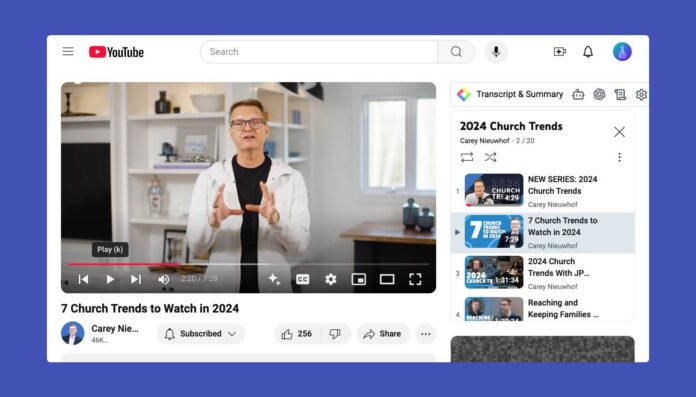
Listen To Carey’s Original Predictions
5 Predictions for 2025
This discussion on trends for the church has been fruitful, leading me to think through what the implications are going forward into the next year. Here are 5 current threads I’m thinking through these last months of the year. I’d love to know your thoughts on them.
1. Hybrid Spiritual Communities Will Dominate:
Churches will blend digital and physical experiences seamlessly, creating hybrid spiritual communities that cater to members’ varied preferences. Expect an expansion of interactive digital platforms where sermons, discussions, and discipleship groups happen simultaneously in person and online.
2. Personalized Faith Journeys with AI:
AI tools will advance to help pastors and ministry leaders create more tailored spiritual growth plans for congregants. These plans will adapt in real-time based on engagement data, ensuring each individual feels supported and challenged at the right levels.
3. AI-Driven Ethics Training for Church Leaders:
To address growing concerns, specialized AI ethics training will become a standard part of leadership development. This training will equip pastors to navigate AI-related ethical dilemmas with confidence and integrity.
4. Enhanced Focus on Digital Spiritual Mentorship:
Churches will prioritize building digital mentorship programs that pair experienced members with newer or younger believers. This mentorship will occur through dedicated apps and platforms, making spiritual guidance accessible anytime. This doesn’t need to mean new-fangled apps and services. It could start with texting groups, etc. The point is technology will increasingly be leaned upon for strengthening the communications and relationships needed for real authentic conversations and mentorship activities.
5. AI Accelerates Content Production and Relationship-Centric Ministry Gains Impact:
AI will further streamline content creation, reducing the relevance of purely knowledge-based activities. As automated content production becomes the norm, the emphasis will shift towards relationship-centric ministry programs. These programs will gain increasing importance, leveraging both in-person connections and asynchronous, live virtually-mediated methods to deepen community bonds and foster genuine engagement.

More Questions For You
- What are you seeing in your neck of the woods?
- Have you taken proactive steps to get training on AI through resources like ChatGPTforChurches.com?
- What obstacles, concerns, or fears do you have regarding AI when used for ministry work?
- Have you actually tried any AI tools yet? Or are your opinions informed by 2nd hand information?
- Would you be interested in seeing how other churches are actually using AI today?


“AI will further streamline content creation, reducing the relevance of purely knowledge-based activities. As automated content production becomes the norm, the emphasis will shift towards relationship-centric ministry programs.”
I hope you are right that the emphasis shifts towards relationship-centric ministry programs. One of my concerns is that as AI makes content generation faster and easier, that more churches will just produce more content, because church culture in America tends to believe discipleship is mostly a knowledge/education issue.