

Episode Summary:
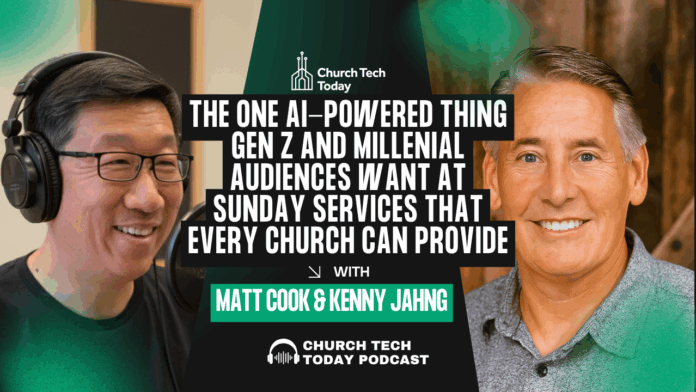
Join Kenny Jahng, host of the Church Tech Today podcast, as he welcomes Matt Cook, CEO of Aberdeen Broadcast Services, to unpack how artificial intelligence is revolutionizing accessibility in the church. This episode spotlights how AI-powered translation, captioning, and voice dubbing are opening doors for churches to connect with multilingual, hearing-impaired, and younger generations. Matt shares practical strategies and real-world stories, making this a must-listen for any ministry leader considering new ways to foster belonging and reach more people—right in their local context. Tune in to discover tools, mindsets, and first steps to make your church services more engaging and inclusive.
In This Episode, You’ll Learn:
How AI-driven captioning and translation are making church services instantly accessible to diverse language groups and the hearing-impaired
Why closed captions benefit not just those with hearing needs, but also younger generations (Gen Z, millennials) who now expect this as part of digital and in-person experiences
What the latest stats reveal about video caption usage in church and secular settings, and how this influences church attendance and engagement
Steps to set up live AI captioning and translation—even for smaller churches with limited budgets or tech experience
Creative ways churches are leveraging translation beyond Sunday services, including special events and outreach initiatives
How AI-powered voice dubbing can help ESL (English-as-a-Second-Language) attendees fully participate in worship and teaching
Key considerations for regional dialects and translation accuracy when using modern AI tools
Key Quotes:
“70% of Gen Z and 53% of millennials are using closed captions on a regular basis, so why wouldn’t you offer it as a church?” — Matt Cook
“It’s not just an accessibility issue. This is about engagement—helping every person better absorb and remember the message.” — Kenny Jahng
“The decision is the hardest part. Once you do it, you realize the benefits of captioning and translation across the board.” — Matt Cook
“As easy as it is to do today, it seems kind of crazy that you wouldn’t at least do the English side of things first.” — Matt Cook
Links & Resources Mentioned:
Aberdeen Broadcast Services: https://aberdeen.io
Contact: 949-858-4463
Email: sales@aberdeen.io
Referenced survey (Preply): https://preply.com/en/blog/captions-subtitles-statistics/
About the Church Tech Today Podcast:
The Church Tech Today Podcast helps pastors, church staff, and ministry leaders navigate the intersection of faith and technology with confidence. Hosted by Kenny Jahng and brought to you by www.AIforChurchLeaders.com.
EPISODE TRANSCRIPT
Kenny Jahng [00:00:03]:
Hey, friends, it’s that time again. Kenny Jahng here with the Church Tech podcast and on ChurchTech Today. We basically are nerding out in this season exploring all the different use cases of AI. AI has been such a tremendous blessing for church leaders that are diving into it. And today is going to be very practical, I think, and eye opening to a lot of pastors and leaders that are listening in today. I’ve got Matt Cook on the line here, CEO of Aberdeen Broadcast Services. Matt, welcome to the show. How are you doing?
Matt Cook [00:00:38]:
I’m great, thank you, Kenny. Thanks for having me today.
Kenny Jahng [00:00:41]:
Before we dive right in, can you just share with us for people who may not know Aberdeen, what does Aberdeen do for churches today? And just a sentence or two about what is your role in the history of Aberdeen?
Matt Cook [00:00:54]:
Absolutely. Well, we are 25th year of doing business and we started off as a closed captioning company, so access in that sense, but really for broadcast. So we’ve been in the broadcast world for TV and all kinds of other broadcasts as we go today. But really what we’re moving into is more of the AI realm with the accessibility which now has allowed us to do closed captioning more quickly as well as more affordably in many cases, along with translations and voice dubs. Now, what we’re offering to churches, so we’re seeing a lot of churches, churches add this to their services where they’re able to access languages that they weren’t able to before. It was just cost prohibitive.
Kenny Jahng [00:01:37]:
Yes. I love it. I love it. I want to zoom out a little bit because you have experience in the tech world for decades here, and pastors are constantly being told about, like, here’s the new technology, here’s the latest thing. But a lot of pastors listening, they basically wonder like, is this going to actually help me grow the church and strengthen my community, or is just a shiny object? Is it the latest gadget from where you sit, leading a tech company that serves churches all over the place at scale? What do you think the biggest opportunity is here right now with AI in general? Right. AI is the talk of the town.
Matt Cook [00:02:16]:
Yeah.
Kenny Jahng [00:02:16]:
What’s your take on it? Where is AI opening up opportunities for ministry right now in general?
Matt Cook [00:02:22]:
Yeah, it’s a great question. And I try to put myself in the role of a pastor to say, what would it be like if I were running the church? And one of the things that I think is the biggest thing is to make use of their entire library of content that they have today. So if you can make use of your Content, pull it all into a central system, maybe your own LLM, you want to control everything yourself. You now can be able to break this content up, make little clips, do things in warp speed compared to what you’re able to do. And as well as consolidate it, make it, you can just use it in so many different ways. And then that does kind of tie back into even our services because now you can take all your sermons and you can, you can put them in as many languages as you want in a super cost effective way to reach different, different segment groups around the, around the world or within your own congregation. So there’s a lot of, lot of super exciting ways. I mean, some of the simple ones you look at are, you know, you can help prep for your sermons, you can help get ideas.
Matt Cook [00:03:16]:
That’s, that’s the, that’s the low hanging fruit of AI today. But you want to start using it for really diving into, you know, really analyzing all of the sermons that you’ve done. And what am I saying? How am I saying it? What could I say better? Those are, those are super exciting.
Kenny Jahng [00:03:32]:
I love it. Now, you mentioned translation. I think a lot of people think about AI translation as the, one of the first tip of the sword areas where AI might be able to help. But especially in terms of the services, I think there’s an overlooked issue that you probably can speak into and that most pastors probably don’t realize. How many people are just sitting there in front of them on a Sunday after Sunday basis that are just struggling to fully engage with the service? Right. It’s not on a language translation basis, but even in the native language that you’re speaking and preaching on a regular basis on Sunday. Do you have any stats or insights in terms of just how big is this issue in terms of being able to hear and understand and actually receive the communication that you’re trying to broadcast from the stage? And why does that matter to every church out here? Right. Because I think one of the things, Matt, I’m realizing as we explore all these AI tools is translation might be that shiny object, but AI can help on the audio side in so many other ways that probably could impact a larger segment of every single church’s population immediately.
Kenny Jahng [00:04:44]:
Right?
Matt Cook [00:04:45]:
100%. 100%. And we’ve obviously been on the captioning side for 25 years and we’ve done captioning for churches for 25 years with our live writers, ones that have had the resources to be able to do that and they’ve, we’ve got tons of stories about people that, you know, the sermon they get to, they literally get to so to speak here but they read the sermon for the first time and it opens their eyes where they were sitting there, so to speak in the, in the dark or in the, in the silent. But from a standpoint today, from where we were 25 years ago to today, it’s amazing that there’s about 50% of the population uses captions on a regular basis for their consuming video. So if you realize that number it just seems, it seems ridiculous that you wouldn’t add captions to your church service and to do that. And I’ve got a couple surveys that we’ve referenced in the past but preply is one that did a survey, they say about 70% of Gen Z and 53% of millennials are using closed captions on a regular basis. So when you’re realiz that’s a younger group now and that’s where a lot of churches are looking to say how do I get the young people involved? How do we keep the next generation going? Captions are a piece that they’re doing even another study by Stage Techs it talks about 31% of people would be more likely to go to live events church if captions were provided and even a higher number like 45% of 18 to 25 year olds said that they’d be more likely to go from the study. So you start to read these studies and again it’s a couple studies studies but I think you’re really starting to see that these, that captioning and then that’s just in your native language now you can add the English as a or the second language pieces where people partly know English or don’t know at all.
Matt Cook [00:06:33]:
And then you get to those numbers and you’re realizing that you’re right. People probably sitting in the back pews just kind of being there trying to absorb as much as what they can, maybe getting a few words here or there. But we’ve got plenty of stories about people that are from the same family. A lot of times you might have a grandfather, a grandmother or even a mom or dad or you know, somebody that’s there that you know the kids are coming and they brought their parents who are, you know, they’re immigrants and come over and they’re, they don’t even know the language and now they’re able to, to get the message when you’re adding the additional languages to the, to the service that the fact that you’re.
Kenny Jahng [00:07:10]:
Talking about that trend of you know, we’re watching Netflix with captions on by default, right? We’re, we’re watching social media with a. The audio off and captions are on and YouTube and all these platforms have made that available for free by default. So it just has been normalized. When do you think that shift has actually been made? You know, we know Gen Alpha, Gen Z, even millennials are preferring that. Is it the millennial generation that actually saw that cultural shift of looking for captions in terms of, as part of the experience and not just because they’re hard of hearing or. It’s, it’s not an accessibility issue, right?
Matt Cook [00:07:52]:
Yeah, I wouldn’t, I would say yes and no. It’s one of these things where if it once, once you start to turn the captions on, on, on TV or your social media, whatever, you realize you’re like, wow, I got stuff I didn’t get. So you realize it’s a benefit. It, it really is. It’s. It’s something like, wow, I was missing something. Oh, I heard what they said now and I would have missed it. So yes and no.
Matt Cook [00:08:13]:
It’s one where it’s become available because Netflix, everybody else has captions and Netflix, Netflix spends millions and millions of dollars on their captioning for all of their content and so do lots of other sites now. So, you know, it’s free to people. But it still is a costly back end type of thing to make it really done really well, especially when you’re talking in post produced content. But the idea that it has become part of the, the norm, I think it’s a multiple thing, that it’s one because it’s become available and then people realized how much it benefits them. So is there some of that accessibility in there when it’s a benefit? Yeah, I think so.
Kenny Jahng [00:08:50]:
That’s awesome. And I think the other mindset shift, I would say most leaders, when I talk to them about captioning type of and translation tools is they think about it first with all their produced content that they’ve published already. Right. Their sermon archive and all the things that they have on their hard drive. But applying it to live environments I think is where it really shines that we now have the ability to make that affordable to pretty much every church out there to be able to provide captions on your live environments, not just post production. And maybe you can speak into that. Just how hard is it to start to adopt that if you are looking at figuring out how to actually bring that into your live environments?
Matt Cook [00:09:35]:
Yeah, it’s actually really quite easy to do it’s the decision that’s the hard part. It’s a decision to say, yes, I want to do this, yes, we’re going to start this. It’s another thing, so to speak. But once you do it, you realize the benefits across the board. And I think that’s one of the things we’ve talked about too, is because you have the ability with our service to be able to add captions to a screen in your service, to all your screens if you want to, or you can allow it just to happen on the personal device where the people that are using it are using their personal device to do that, that. But the idea, if you put it on a screen or multiple screens, you’re going to realize the benefit even more to do it. And I think it’s those kinds of decisions by the pastoral staff, the leaders, to say, wow, we’re willing to do this. And of course there’s going to be a couple people are going to say, oh, it’s distracting.
Matt Cook [00:10:22]:
So not to have that one or two people that say it is, but to have the hundreds others that are looking at it and saying, wow, this is a benefit to me. I got words, I got the, I got something. I, I lost track of, you know, paying attention for a second. Now I look back and see it. You know, as much as we don’t want to admit that we all do at times, and to be able to do that, to me is, is really that. So how easy is it? It’s as simple as really for us for calling Aberdeen saying, well, we can do a 10 minute setup with you. Most of the time. Churches have the equipment already.
Matt Cook [00:10:53]:
They’re able to send us an audio feed. We put it through our system and then we publish it back to basically a webpage. Call it a little web app. You don’t need to download anything. Somebody comes into a CH service and basically there’s a QR code that the church has set up. They put it on the pamphlet, they put it on a sign out front of church, they put it up on the big screen. Scan here for, you know, English captions, for, you know, languages, whether you’re doing Mandarin, Farsi, Spanish, Portuguese, Korean, whatever you might want to do. You get to add the voice dubs now too.
Matt Cook [00:11:24]:
So it’s not just seeing captions or subtitles as you would like to reference maybe, but you’re able to put an earbud in and listen in your native language. So you can come to church and you can put an earbud in and listen and in, in Any language that we want to set up. We got about 60 languages for voice dubs. And you know, they’re, they’re very, very good too, because I’m sure we jump into that just, hey, how good is it? And it’s gotten really good today. So the ability to do that. That’s part of the reason we’ve held off for 25 years, up until the last year or so of looking at doing this. We’ve been testing AI for, gosh, way back 2010-12 when Dragon naturally Speaking came out. Yes, when, you know, we, We’ve been using AI on the transcription ASR portion of it since 2018 for some of our post work.
Matt Cook [00:12:12]:
And it has just made leaps and bounds improvement. So easy to set up a simple call and some, you know, simple stream to get to us. It’s easy for the church to use to adopt, but it’s really then putting the signs out there for the church just to get people to be aware of what it is. If they put it on the screen and they want to do an overlay, it makes it obvious.
Kenny Jahng [00:12:32]:
That’s awesome. Yeah. I was just, I was meeting with the head of Exponential Espanol recently and he was sharing with me the stats of how, how large of explosion that just the Spanish language is in our metro, our major metropolitan areas across the country. And that now, you know, if you’re in most regions of the country, in these urban areas especially, and the suburbs surrounding them, that you are now able to access a completely different demographic segment in your own zip code, but just by adding translation services. From what you’ve seen, what’s one creative approach that’s working well to reach and engage ESL communities in church life? Like, have you seen anything that’s creative or interesting or something that’s just not the expected thing? Expected ways that churches are operating.
Matt Cook [00:13:28]:
Yeah, beyond what we’re talking about here. I mean, obviously once you do this, you’ve. You’ve kind of committed to it. So that’s a big part of it. I go to Saddleback Church, so obviously a pretty big church out here in Southern California, and they do four or five different languages for their different services, but they’ve also taken it now to their other campuses. So. So expanding beyond that, they do it for celebrate recovery. So you’ve got your other events.
Matt Cook [00:13:52]:
So it starts to be beyond just the normal service that you’re doing. You know, you’re able to do more and more. I think what, what we’ve seen, even with tv, is some of the TV ministries that have added a language over time, they realize they start to build up and nothing happens right away. So I think that’s the big thing too. Clearly you might get a great story week number one. Somebody might come, you know, jumping up and down in tears that you’ve. Which those are amazing, right? But now it’s that continual service that you provide to now people are really part of the community. They get involved and they’re able to say, wow, I can be part of something I wasn’t able to be part of before.
Matt Cook [00:14:27]:
So I think the idea of, of doing that is really, I think it’s that long term commitment to it. As you start to grow your audience in that maybe other language, you’re going to continue to add more and more pieces to it. You’re going to end up having people that are part of it. You’re going to, you know, maybe publish things in other languages. You might have things along those ways. So it’s just, it’s pretty amazing to see again, go back to the TV ministries to realize some of these TV ministries have grown, you know, thousands, tens of thousands audiences because they just started and they thought they’d try it and all of a sudden, wow, it kind of took off for them. And they’ve got a huge population that follow them in Latin America for Spanish, you know, in particular, I love that.
Kenny Jahng [00:15:11]:
Now when I’m speaking to conference goers, when I’m presenting and I’m demonstrating some of this AI translation stuff, one of the Q and A type of questions that typically come up consistently, and I’m sure you’ve heard it, is the pastors and the leaders I’m meeting that are saying that, look, Spanish is in Spanish is in Spanish. There’s different dialects, there’s different countries that speak Spanish, for example. And translation can really depend on the region and the context. And we’ve seen, I think anyone that’s used Google Translate over the years just seen how rough that can be. Can you just speak into like, how accurate is translation today and how long is it going to be before it’s really indistinguishable from a human to human live translation?
Matt Cook [00:16:01]:
Yeah, well, it’s getting pretty close today in some of the stuff we’re doing. And I can tell you we’ve got 30 some churches we’ve already signed up and many of them are doing Spanish already. But first of all, we’ve tested it first ourselves to make sure we have a level of saying what’s good enough to be able to put our name on it. We’ve done professional translation, professional voiceover dubs for four years with our post produced broadcast work. So the level that we’ve typically come to expect in a post produced thing is, is that perfect level. What do you do with live? We do live with translators, with individuals, and we’ve been doing that for a while too. So trying to get the right version of Spanish is, yes, an important feature. We have some different options within our software to do somewhat different versions.
Matt Cook [00:16:49]:
But typically, you know, you have a generalized Latin American approach to Spanish for the US And I can give you an example of one of our, one of our post translators. We had them listen to one of our demo that we did, or live, we’re doing a live demo. And they listened and they, they, they kept their, their headphones on and you could just see their eyes going. And they took the headphones off and they said, wow. Wow. They, they could not believe that it was AI, a generated voice. They, their comments were that it was as good or better than the human interpreters that they had seen. So I can’t promise that every time AI and different people, different things.
Matt Cook [00:17:35]:
But what I can tell you is that if you look at it logically, I’m an engineer, so I’m like, okay, we’ve been doing this testing for a while. One of the things we’ve tested was the speech recognition. So the ASR is the first piece just with English. And we did some benchmarking and we’re looking at some of the single speaker, no background noise. You’re getting 98, 99% accuracy, contextual accuracy, standpoint. So you miss a comma, you miss an S or an ed. Those are not typically big deals. You’re not missing words and AI picks up the words exceptionally well.
Matt Cook [00:18:10]:
So if you’re starting with an English transcript that is that good, you’re now able to translate to a different language that much better. Add AI into the translation process as well. The translations are way better than what they were two or three years ago. And now you’ve got voice dubs that are indistinguishable from the human. And you’ve got all this inflection and everything else now where you’ve got live voice dubs able to mimic sports broadcasts, where you’ve got people doing soccer and it’s goal and the additional language is goal and Golosso and you know, so it’s, it’s pretty crazy how fast AI is changing and that exponential growth and what we’re seeing and how it’s being applied to, you know, the Translations to the voice dubs to those types of things where it’s becoming exceptionally good right now. Different languages, the more obscure languages are not quite there yet. Spanish, Spanish is very, very good.
Kenny Jahng [00:19:06]:
It’s exciting to hear all of that. Now, a lot of pastors might assume this is only for the big churches with the big budgets and like Saddleback you’re talking about, or North Point or Life Church, like all the big media teams of the big budgets. How small of a church can actually use these AI powered systems to translate and to provide captions in a meaningful way? And what do you think the typical decision tree is? Is it for a church that may not have that many ESL families in their midst, you know, is it still worth it for the Gen Z and the millennials that are looking for captions or you know, the hearing impaired who, you know, that really do rely on that? What does that decision tree look like? At what point do you say as a church we should really seriously look into this, take the risk of trying it out. And yeah, I think that first question I think is really important is how small of a church can actually use these AI translation and captioning services?
Matt Cook [00:20:08]:
Yeah, good question. Well, we have the broad range from small to large. So we’ve got 100 person church that’s doing it. So that’s pretty small. You’re able to do it. They had a deaf person that they wanted to service and when they were just looking to do English in this case. So I think it costs them about $38 a week for the hour and a half service that we’re doing with them. And the cool or exciting godly part about the whole thing is they were doing it for a few weeks and the deaf person they were serving brought another friend or two to church that it did.
Matt Cook [00:20:45]:
And you’re like, didn’t even know, you know, and I mean, yeah, you’re going to say, oh, it was one or two people. Okay, well then add the other languages, add other things. It’s that part that it is, it’s kind of there but you, you’re not, it’s kind of, I guess, hidden, so to speak. And then you realize obviously the Bible calls us to service everyone as a, as a pastoral team, you know, to things like that. And especially that somebody that might not be able to hear. Right. That, that, that’s got to be one of the most calling things to be able to do. And for as easy as it is to do today, again, to me it seems kind of, kind of crazy that you wouldn’t at least do the English side of things, then depending upon your congregation, like you said, in the.
Matt Cook [00:21:24]:
The urban areas, Southern California, some of these other big cities, there is a large percentage of, you know, additional languages to reach. And Spanish, obviously, being number one where you’re able to add that on. And. And you realize, wow, I’ve got people that are really using it. You know, again, a number of stories about how that’s just life changing for people.
Kenny Jahng [00:21:46]:
For a pastor that’s listening right now and who thinks, oh, this sounds powerful, but it could be a little overwhelming. Not all pastors are tech savvy, et cetera. What’s the simplest first step that they can take in beginning to experiment with captions and translation of the church?
Matt Cook [00:22:02]:
Yeah, I think first of all, we can do a proof of concept, a demo for them to be able to show them to see what it sounds like.
Kenny Jahng [00:22:10]:
What does that look like? Walk us through that. Yeah.
Matt Cook [00:22:12]:
Basically they say, hey, call us up. We do a free month. Part of even here, we’d say we offer a free month of service. Call us up and say we’d like to test it out. Probably what we’re going to do is we’ll show them a demo. We’ll grab. Most everybody’s got one of their videos on YouTube, so we’ll just grab a YouTube video, we’ll play it out as if it were live, and we’ll show them their service in English, in Spanish, in whatever language that they’d want to see. So it’s there for them to be able to see and to see how easy it is to do in person.
Matt Cook [00:22:45]:
So that’s the first step. And they can look and say, okay, that’s good. If they’ve got somebody on their staff that speaks a different language, they can have them test it out, which is a lot of people, you know, will want to do. They want to see. Let me have my person confirm that it’s good enough, and they’ll do that, and then we can set it up with them.
Kenny Jahng [00:23:01]:
And so even for that, they don’t need to install software. You could just grab one of their video sermons and act as if that’s being broadcast live or that’s in the room live. And then they can see it for their own personal context, their own sermon. Right. It’s not someone else’s sermon.
Matt Cook [00:23:16]:
That’s right. We’ll match the voice, and then we’ll put up a QR code in our demo. So we’re not in person. We’re doing a zoom like this with them. We’ll put a QR code up on the screen and say, okay, imagine you’re sitting in service watching yourself and here’s the QR code. Scan the QR code they pull up on their phone or their mobile device and they’ll listen and watch on their phone to see what it’s like to be in person. That simple.
Kenny Jahng [00:23:39]:
I love it. I love it. Okay, well, as we close out this discussion, map for the pastor listening today, who’s inspired, who wants to learn how they can actually test it out or put it into action, Maybe they’re ready to leap in. Because I think the case is made that captioning. You know, here’s the other thing. I would love if there was any studies to show that when you put up captions, I’m going to remember the sermon even better, even if it’s in my own native language and it’s not translating right. Because we know all the stats where like you preach on Sunday, by Monday, certain percentage, forget it by Tuesday, even more by Wednesday, you know, you don’t remember the majority of the sermon. Right.
Kenny Jahng [00:24:16]:
And so putting caption on there would even just help the absorption of the message. If someone’s willing to really dive in right now, what’s the best way that they can connect with you and the team at Aberdeen to explore this? Because I think this is exciting. Every church should explore this option for them.
Matt Cook [00:24:34]:
Yeah, absolutely. You can go to our website. That’s easiest. If people want to go there and keep it simple, they can go to our website, which is Aberdeen IO A B E R D E E N I O. You can give us a call. We pick up the phone here. We’ve got a whole team of people. So 949-858-4463.
Matt Cook [00:24:52]:
So those are probably the best ways to be able to do it. They could send us an email, too. Send us an email at salesberdineio so any one of those ways. But if you go to our website, you’re able to see some of the examples that we put on there. We have streaming capability, too, so we can add it to streams. We’re talking a little bit about in person here today, but you’re able to add these languages to stream, so we kind of have you covered when you’re looking to add both English captions or multiple languages in subtitles or voice dubs.
Kenny Jahng [00:25:24]:
I love that. Yeah. As a church line pastor, I think that’s so important to be able to figure out how to provide that accessibility for those audiences out. Well, thank you for sitting us with us and just explaining some of the nuances of this somewhat new field. Even though you guys have been around for decades for many, many pastors listening in today, that’s new to us. And I just love how accessible you are and how easy going and, and you’re always up for answering any questions, right? And so the posture that you have in supporting the church has been just quite amazing. And for everybody else, thank you for listening in on this episode. The Church Tech Today podcast is here for you.
Kenny Jahng [00:26:06]:
This topic as well as others come to fruition because of the feedback that you are providing. So send me an email@kennyurchtechtoday.com and let me know what you thought about this episode. What else should we get Matt to come back on and explore even further? We’ve got an expert here in our midst to be able to answer any questions and serve you even further in this whole area that I think most churches are not even, you’re not even scratching the tip of the iceberg. And so let us know what you’d love to know further. In this realm of captioning and translation and accessibility, I think Matt can come back on and share with us even further. And remember, smash that like button, share this episode with another leader so that they could actually use digital wisely and share the gospel widely. I’m Kenny Jiang. Thank you so much for listening and we’ll catch you here on the next video.