


|
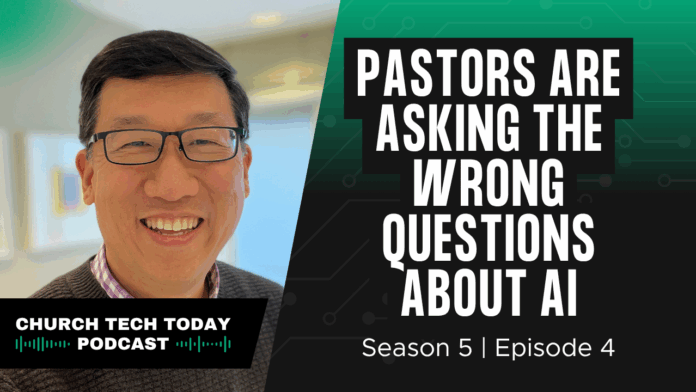
TL;DR The real question isn’t whether AI replaces the Holy Spirit, but whether it helps pastors cooperate more closely with Him. 1. Every new tech (roads, microphones, radio) raised fears—AI is no different. 2. Discernment matters: use AI to serve ministry, not replace spiritual work. 3. AI already aids Bible translation and outreach worldwide. 4. Pastors should guide conversations on AI with wisdom, not fear. |
Episode Summary:
In this episode, Kenny Jahng, editor in chief of Church Tech Today explores a thought-provoking question circulating in ministry circles: Should artificial intelligence take on roles that were traditionally seen as the work of the Holy Spirit?
Kenny revisits historical shifts in church technology—from microphones to Bible translation and radio—addressing modern fears and discernments around AI in the church.
Tune in to hear how ministry leaders can ask better questions, engage new tools faithfully, and create more space for spiritual fruit, rather than just fearing innovation.
This discussion provides practical reflection points to help pastors and church staff lead their communities into the digital age with wisdom and boldness.
In This Episode, You’ll Learn:
How to assess if your use of AI is complementing or competing with the Holy Spirit’s work
Historical examples of technology in the church—from microphones to Roman roads—that parallel today’s AI debates
Why initial fears about new tech aren’t necessarily wrong, but shouldn’t be the final word
How AI is currently being used in Bible translation and gospel outreach around the world
The importance of reframing the question from “Is AI replacing the Spirit?” to “Does this help me cooperate more closely with the Spirit?”
Practical criteria to ensure technology serves ministry without compromising gospel values
Steps for church leaders to become facilitators of responsible AI conversations in their own communities
Key Quotes:
“It isn’t that first immediate reaction of hesitation to AI is wrong. I do think it reminds us that not everything new is necessarily good.” — Kenny Jahng
“The upside is that technology and AI can create conditions where the fruit [of the Spirit] can actually flourish more fully. And that’s good news.” — Kenny Jahng
“God’s spirit is not threatened by AI tools. Because, the mission isn’t confined by the methods of the past.” — Kenny Jahng
“Your call today is not to become an AI expert. Your call today is to become the conversation facilitator about AI in whatever environment and community that you live in.” — Kenny Jahng
Links & Resources Mentioned:
Missional.AI (conference/community, referenced)
Wycliffe.org (Bible translation ministry)
SeedCompany.com (Bible translation ministry)
AI for Church Leaders & Pastors Facebook Group (community for pastors and staff)
About the Church Tech Today Podcast:
The Church Tech Today Podcast helps pastors, church staff, and ministry leaders navigate the intersection of faith and technology with confidence. Hosted by Kenny Jahng and brought to you by www.FrontDoor.church.
EPISODE TRANSCRIPT
Kenny Jahng [00:00:00]:
Well, it’s that time again. Kenny Jang here with the Church Tech Today podcast. And today, we’re gonna be talking more AI. And today, I wanted to start a thoughtful conversation with you. Hopefully, you will respond, comment. Let me know what you think about this. I recently saw on social media this comment, a feedback that said, hey. If what you’re about to use AI for would have been accomplished by the Holy Spirit’s gift or fruit one hundred years ago, stop what you’re doing.
Kenny Jahng [00:00:27]:
You need to rethink your use of AI. Now at first glance, I think there’s something good in that caution. Right? It’s pointing back to our our need and reliance on God, not just human tools, and we all need that reminder. But if we slow down and walk through it carefully, I think there’s a deeper and maybe a better way to approach this. Right? So first, let’s recognize something here that I think we all should really say. It’s that reactions like this are normal. They’re expected. It happens almost every time something new or disruptive arrives.
Kenny Jahng [00:00:57]:
Like, when a new tool or technology shows up, and we don’t have the language for it. We don’t have the categories. We don’t have the frameworks to understand maybe exactly where it fits in, what box to put it in. I think it’s human nature to feel unsettled. So I think it’s okay, to wonder if we’re crossing a line here. That caution is healthy. To fear what we don’t understand yet, that’s normal. Right? That first reaction of hesitation isn’t wrong.
Kenny Jahng [00:01:21]:
I think it’s protective, and it reminds us that not everything new is necessarily good. Hey. But at the same time, I think history shows us that if we stop there, we miss out. Right? So let’s look back at church history. If we look at, the Christian history, new innovations have often raised the same questions. But looking back now, we pretty much see clearly and we pretty much all agree that the early fears weren’t always the final word. And if we stopped there at our fears, where would we be today? So I wanted to walk through some examples that came to mind that might shed some light on this. So the first one I think is from a technology, a tool perspective is the microphone.
Kenny Jahng [00:02:07]:
Right? A hundred years ago, pastors preached without sound systems. They were in the public square. They depended on natural voices. They they, you know, use their own voice without amplification. But today, microphones are everywhere. Right? They amplify our voices so everyone in the room can hear clearly. But the microphone, I wouldn’t say replaces the spirit’s gift of preaching. Would you? I actually would say the microphone serves the gift of preaching.
Kenny Jahng [00:02:38]:
It expands the reach of it. So I don’t know if the microphone in its original fears, should have been stopped. Or Or think about even, like, Bible translation. Hopefully, maybe this is something no one can argue against. Right? So early translators spent years working hand by hand, copying, composing, revising, translating scripture, word by word, right, in every single heart language. We have thousands of heart languages throughout the world. If you look at the good work of, SIL and Wycliffe and Seed Company, all all these great ministries, the early translators did tons of work manually. But today, a lot of this work, AI can assist in this early stages, and they’re being used by these organizations.
Kenny Jahng [00:03:28]:
In fact, I just came back from Missional AI, a great conference and community. That translation is at at the heart of a lot of the people in the room. And AI is great at suggestion drafts and checking consistency. Now it doesn’t remove the need for spiritual discernment, theological grounding, human wisdom, all that stuff. But can AI simply help faithful people work more efficiently toward the same god called sacred end? Absolutely. Right? AI in translation, I think, is something that is not only a plus, but it’s almost something like we must lean forward into that so that we must fulfill the great commission. Then there’s the example everyone uses. Right? The printing press, Gutenberg.
Kenny Jahng [00:04:14]:
When it first arrived, many Christians were concerned. Right? Should scripture, which is sacred, be printed so widely? Would it be misunderstood? Would it be misused? I I think those concerns are valid at the time, preprinting press and postprinting press. But yet today, we see, the printing press is one of the greatest catalyst. We credit the printing press for gospel growth across history, across the decades. Right? This is one of the biggest inventions of technology innovation that really helped the gospel at the end of the day. I don’t think you could argue against the work of the Holy Spirit because it’s in printed type versus, oral or in person. Right? Think about then Christian radio. Right? When radio, originally emerged, there are people that were aware that broadcasting sermons, would turn holy preaching into mere entertainment.
Kenny Jahng [00:05:06]:
And what do we have today? I think God has used Christian radio to reach countless people, including many that have maybe never ever stepped inside a church. There are, organizations using Christian radio to broadcast into countries where Christians are persecuted, where it’s not safe to either actually gather, but they’re able to receive radio in their home or in groups, etcetera, surreptitiously under, even even though while they’re being persecuted externally. How can you argue against that? Is the Holy Spirit not working in those regions of the world? And then look. Let’s even go further back. Look at the Roman roads, the Roman roads that were made in Paul’s day. They were built for the Roman Empire, for military might. They were used by society, right, for different purposes. But Paul used them to travel, you know, further, faster, plant more churches than he ever could have done on foot without them.
Kenny Jahng [00:06:07]:
Is the holy spirit not at work with the technology of roads, during the Roman ages? I I just don’t know if you can rule out using the roads because the holy spirit was active before the roads versus post. Again and again, we see the same story. Right? I think at the end of the day, God’s spirit, is not threatened by new tools. It’s not surprised by new tools. The mission isn’t confined by the methods of the past. Right? It it adapts, it advances, it expands, it’s agile without ever compromising the gospel itself. Right? So I think, yes, we need to hold the gospel in one hand tightly, and not be compromising. But the methods and the means and the tools that we bring into the mix of gospel advancements, is a different question, which brings me back to that original comment.
Kenny Jahng [00:06:58]:
Right? And so if AI is doing something the spirit did a hundred years ago, stop. I don’t know. I don’t understand. I well, I do understand the heart behind the caution, but I think there’s a better, more faithful question that we can ask. So maybe we should be asking a different question. Right? So not is it replacing the spirit, which I see time and time again in all the groups that I’m speaking to and teaching, etcetera, these days. But maybe the better question is, is this helping me cooperate more closely with the spirit? Is this helping me cooperate more closely with the spirit? Is this tool helping me walk more faithfully? Is it freeing up more space for love, joy, peace, patient, kindness, goodness, faithfulness, gentleness, self control? That’s the last one. To flourish in my ministry, in my life.
Kenny Jahng [00:07:47]:
Right? Technology, even something, as powerful as AI. Look. You can never, never, produce the fruit of the spirit by technology alone, but God can. And technology can create conditions where the fruit can flourish more fully. And so I always say, look. There think of the Toyota five wise. Why why do you think that? Why do you think that? Why do you think that? Right? And at the end of the day, I think the question comes down to and this this becomes a choose your own adventure once you actually answer this question. Do you believe there can be divinity in the digital? Do you think God can do anything with digital innovation, technology, bits and bytes, zeros and ones.
Kenny Jahng [00:08:32]:
If you say no, then it’s man versus machine. It’s a whole different narrative. If we say yes, then it’s not about the tool. It’s about the heart using the tool, and it’s whether we are stewarding new opportunities that we have with these technologies, with humility, with discernment, with the deep reliance on the spirit, just like every generation before us has been called to do. Right? So today, I’m not inviting us to fear innovation, but to engage it prayerfully. Not not to assume the worst, but maybe it’s just to ask different questions, better questions. How can we be faithful with what’s in front of us? Trusting that the spirit is still leading, the spirit is still empowering, the still, the spirit is still building his church. I think that’s the better or different question we have to ask today in the age of AI.
Kenny Jahng [00:09:29]:
What do you think? Thanks for being a part of this conversation. I think these are the types of discussions that sharpen us, that root us, that prepare us to serve in this ever changing world with the velocity of innovation that’s happening right now. And so I’d love to hear your thoughts. Drop a comment. Come into our AI for church leaders and pastors Facebook group and talk about that there. I’m gonna start a thread in there. But I’d love to hear what you’re thinking. And more importantly, could you start this conversation in your own spheres of influence? I’ve been saying this a lot recently.
Kenny Jahng [00:10:02]:
Your call today is not to become an AI expert. Your call today is to become the conversation facilitator about AI in whatever environment and community that you live in. So Kenny Jang here for Church Tech Today. Loving this journey that we’re going together on on AI, and I’ll see you here next time on the Church Tech Today podcast.