

|
TL;DR AI tools like Tapos can unlock hidden church wisdom, turning sermon archives into searchable discipleship resources that equip believers. 1. Tapos makes sermons and resources shareable and accessible. 2. The SEND framework helps churches onboard AI wisely. 3. Safeguard theology by curating trusted sources. 4. Embracing AI ensures the church stays relevant in digital discipleship. |
Episode Summary:
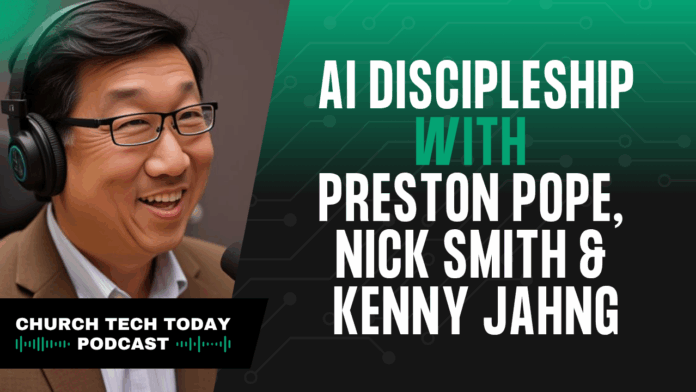
In this episode, Kenny Jahng sits down with Preston Pope and Nick Smith, co-founders of Tapos.app, to explore how churches can harness AI to make discipleship resources more accessible and impactful.
The discussion dives deep into practical ways Tapos uncovers and leverages buried church wisdom for ongoing ministry—a solution born straight from the real challenges pastors face.
Discover an actionable framework for discipleship, innovative use-cases, and the tech that’s helping ministry leaders extend the reach of their sermons, build stronger discipleship pathways, and more.
Whether you’re AI-curious or wary, this conversation offers clarity and next steps for integrating digital tools with wisdom and discernment.
In This Episode, You’ll Learn:
How Tapos.app transforms sermon archives and church resources into searchable, sharable discipleship tools
The real-world origin story that inspired Preston and Nick to build tech for ministry, not just the marketplace
The 4-step SEND discipleship framework for onboarding AI in church life, from seeding your content to engaging and nurturing your congregation
How to safeguard theological alignment by curating trusted sources alongside your own materials
Different ways churches are using AI today
Why embracing, rather than avoiding, new technology is critical for church growth and ongoing relevance
First steps for pastors and ministry leaders exploring AI without risking mission drift or overwhelming their team
Key Quotes:
“The wisdom of the church is buried…AI is really the only way to make that accessible and discoverable in a practical way.” — Preston Pope
“Tapos is a very safe first step into the AI world. It takes all of your sermons, all of your content, anything that you’ve created, and makes them searchable, shareable, and unforgettable.” — Nick Smith
“We can either embrace AI for the light or abandon it to the darkness. That’s the challenge for the church ahead of us.” — Preston Pope
“It’s good to be hesitant…but the Church has adopted every new technology eventually, and we’ve seen the gospel grow. AI is just another tool.” — Nick Smith
Links & Resources Mentioned:
Tapos.app
The Bible Project
GotQuestions.org
ChurchTechToday.com
Email for Tapos: hello@tapos.app
Email for the podcast: kenny@bigclickadmin
About the Church Tech Today Podcast:
The Church Tech Today Podcast helps pastors, church staff, and ministry leaders navigate the intersection of faith and technology with confidence. Hosted by Kenny Jahng and brought to you by www.FrontDoor.church.
EPISODE TRANSCRIPT
Kenny Jahng [00:00:02]:
Well, it’s that time again, folks. My name is Kenny Jahng. We are here with the Church Tech Today podcast. We are going down even further in the sphere of AI and discipleship. This is one of the sweet spots I think that AI has that is often overlooked. We constantly are looking at AI for novelty and content Preston, but in the actual ministry of discipleship, there’s a very big, big case for using and applying AI tools together. And for that purposes, I’ve invited two friends here, cofounders of a tool called Tapos. App.
Kenny Jahng [00:00:39]:
Welcome to the show, Preston and Nick. How are you guys doing?
Preston Pope [00:00:42]:
Hey, Kenny. Thanks for having us.
Kenny Jahng [00:00:44]:
Hey. How are you
Nick Smith [00:00:45]:
doing, Nick?
Kenny Jahng [00:00:45]:
Quickly, for everybody here, before we dive right in, could you just give us, like, one sentence or two of, like, who you are and what’s your role at Tapos?
Preston Pope [00:00:56]:
Yeah. Absolutely. So, so I started Tapos about a year and a half ago. So I’m the the initial founder and basically Nick lead lead dev, doing most of the the nerdy behind the scenes things.
Kenny Jahng [00:01:07]:
Awesome.
Nick Smith [00:01:08]:
Yeah. I’m Nick. I’m the pretty face in front of Tapos. Preston the brain. So
Preston Pope [00:01:13]:
going.
Nick Smith [00:01:13]:
You just serving. Yeah.
Kenny Jahng [00:01:16]:
So what does your company do for churches? Right? So Tapos.app, it’s, it’s a SaaS product. It’s online. It’s a tool that pastors and church staff leaders should should investigate. What does it actually do?
Nick Smith [00:01:31]:
Yeah. It makes discipleship easier in the AI world. It takes your sermons and your content, and, you’re able to ask Preston, you’re able to search, and, it provides answers from your content and your trusted sources.
Kenny Jahng [00:01:47]:
Yeah. And one of
Preston Pope [00:01:48]:
the is the easy one stop shop for AI for churches.
Kenny Jahng [00:01:52]:
Yeah. And so what I love about your journey and as I’ve gotten to know you guys is that it is not just, hey, business people trying to find a market, but, it’s coming out of real practitioner usage. Right, Nick? You’re a pastor, and you’re seeing the actual fruits of how we can use AI and even the places that the AI tools are not probably the best place to do. Can you just share a little bit of the origin story about this product and platform? Like, what actually sparked the idea? I love hearing these origin stories of the AI tools that we have today.
Preston Pope [00:02:26]:
Yeah. Absolutely. So I’ll tell kinda mine and then Nick, you know, you can tell kind of your your your intro into it as well. So the, it’s probably about a year and a half ago, and I was in a bible study and we’re sitting around and the pastor had said something a couple weeks ago. There was it was the perfect thing that we needed to disciple in that moment. And you were trying to talk with this guy and encourage him like, hey, man, the pastor said this. And so literally eight of us were like pulling up YouTube or panning through or trying to find, scrolling through. Maybe it was the week before, maybe it was the week after.
Preston Pope [00:02:54]:
After about ten minutes, we we just gave up. We couldn’t find it. And I realized the tragic truth that the wisdom of the church is buried. It is just in these archives that are nondiscoverable, inaccessible, and not able to be utilized in a practical way. And so, I was Kenny challenged in the moment. I was like, the guys were like, Preston, don’t you build apps for a living? Like, can’t you can’t you find a solution for this? And so that was kind of the the the inspiration. I’m like, alright. I really think we got to find a way to make the wisdom of the church accessible and discoverable.
Preston Pope [00:03:23]:
And AI is really the only way to do that in a meaningful way.
Nick Smith [00:03:29]:
Yeah. My my intro to it was Preston calls me, and he’s like, Nick, dude, I have this great idea. What if all your servants could be searchable? And I’m going, oh, please, god. No. What what heretical thing have I said? Or or what dry humor is somebody not gonna understand, when I preach reference reference Yeah. How many of your office yeah. How many office office references are just, like, just overdone? I mean, the the show is fifteen years old, 20 years old now. But, so he asked me that question.
Nick Smith [00:04:02]:
There’s a little bit of fear. He told me to to get on it, encouraged me, so I did. And then about a month after that, my dad called me and he says, hey, Nick. I’m actually retiring at the end of this year. And that’s when it really hit me of going Kenny years of my dad’s servants are just buried, and I rely on him so much for advice. When he’s done, how do I access this? How do like, how can I continue to ask him questions when he leaves this world? And so, I uploaded all his stuff, and and now I don’t even have to talk to my dad. I have his wisdom. I have his sermons.
Nick Smith [00:04:38]:
I don’t even
Preston Pope [00:04:39]:
need him. Is that the driving?
Nick Smith [00:04:40]:
That’s another joke. Sorry. Hello?
Kenny Jahng [00:04:42]:
Yeah. So, so this journey, I think, has been interesting to unfold, especially looking at even other, AI apps out there for the church and seeing the evolution. Right? Like, it’s one of those things. When I was, part of a venture catalyst firm where we had multiple companies in the portfolio, we saw how the initial impetus for starting the company sometimes, changes over time because of interactions with actual users and seeing how the communities actually use the product, which many times are even more robust or dynamic than we imagined as startup founders, etcetera. Currently, when you’re talking to pastors and churches that are putting Tapos into action, what would you what would they say is the problem that they’re addressing on their side? Like, what do they think that they’re solving?
Preston Pope [00:05:34]:
Like, it’s a Yeah.
Nick Smith [00:05:35]:
It’s, it’s twofold. The first one, like, we’ve been talking about, their wisdom is buried, and it’s not being used. It seems like the Sunday message ends Sunday afternoon when everyone breaks for lunch. And it’s what what did the pastor say? And it it maybe last an hour. And so discipleship is just, falling short there. And so the first problem is making your sermons extend beyond the pulpit, not just, till that following Saturday, but, I mean, weeks, months, years past. And then the second problem is just time and bandwidth on every pastor. It seems like, discipleship and ministry all gets bottlenecked, on one guy.
Nick Smith [00:06:19]:
And so being able to, make pastor’s times more efficient and then even to start equipping others to begin using this to create study guides and those things that will help their congregation, into deeper design.
Kenny Jahng [00:06:36]:
I love it. So, why don’t we zoom back out for a little bit because not everyone knows Tapos. How does it actually work? Can you just give a very simple twenty twenty thousand foot view of what what does a pastor do when they’re actually setting up Tapos and using Tapos? Basically, they one of the steps is they can actually upload all of their own sermons. Right?
Preston Pope [00:06:58]:
Mhmm. Yeah. So so we’ve actually developed a framework, to to to walk pastors through this. What does it look like to actually equip your congregation with AI? And so we call it the Kenny framework. So there’s four steps of that. The first one is seed, and that’s where you you upload and curate your your library content. That’s your sermons, that’s your podcast, everything you have there. You seed it, you stylize it, you you categorize it and tag it.
Preston Pope [00:07:22]:
The next one is to engage. And this is the most important one. You’ve got to equip your congregation with that. You know, put the chatbot on your website, send out the links to the actual library page where they can interact with it, utilize our API if you really have a really tech savvy team, and also use it to generate resources that you can share out automatically with your team on a weekly basis. The third step is nurture, and that’s when you actually take those insights. So as people are interacting with the content on your on your library, you can actually see the anonymized insights from that and use that to drive action steps. And if you can effectively do those three, that’s what true we believe truly leads to to discipleship in the AI age, is to help you equip, you know, seed, engage, nurture, and then all that can at the end of the day lead to discipleship.
Kenny Jahng [00:08:04]:
Oh, I love that framework. And so this is a process that your tool supports throughout the entire process, like or is it just solving one little piece of that?
Preston Pope [00:08:13]:
Our when you log in, our admin portal that you will log in to has four sections, seed, engage, nurture, disciple, and it walks you through the the substeps within that to seed with structure, to seed with style, to seed with selection, and so on and so forth, walking through all the different ways that you can go from from having no experience with AI to having a fully AI equipped congregation that’s not replacing the Preston, but supplementing and pointing everything Nick to gospel centric truth.
Kenny Jahng [00:08:42]:
I love it. Okay. And so it’s not just like, hey. Let’s just copy paste the sermon into ChatChippity and then see what happens. You actually have this whole process that actually gives that guardrails. One of the things I love about your platform also is that it’s not just your own, trusted sources. Right? Like, it’s not all your own manuscripts from your sermons and bible study lessons that you’ve written and but you have the ability to do more than that in terms of the trusted sources. Right? Because I think one of the biggest concerns, we’re seeing it in our AI Nick, state of the AI of the church survey that the number one issue that pastors have with AI is theological alignment.
Kenny Jahng [00:09:24]:
They’re very there’s a big concern. That’s the number one issue, pastors have in our national survey. How does that get addressed, and what how do you do that beyond just your sermons?
Nick Smith [00:09:35]:
Yeah. So it’s, you can see with just your sermons. That’s step one. But then step two is you actually go and choose your trusted sources and who you are pouring into you. And so, for me personally, I, have the Bible project as one of my trusted sources. I have got questions, my dad’s sermons. And so when I go and do research, ask a question, it’s actually pulling from each one of those trusted sources and answering. And so I I’ve as I serve in prep, I’ve already been using those Pope, but it required me to go to their site, go do deep study, go find the answers that I’m looking for, and Tapos reverses all of that.
Nick Smith [00:10:11]:
It brings all of that to me, and then actually sources it out so that I can actually go do a deeper study.
Kenny Jahng [00:10:18]:
Yeah. That that I think is one of the best parts of Tapos in particular.
Preston Pope [00:10:22]:
And one of the biggest things too is, you know, there’s a lot of tools out there that are they’re hyper focused on equipping the Preston, and I love that. And I think that’s that’s a very needed skill set. That’s not truly where our heart and desire is. Our we love the Preston, and we have really cool tools that that help equip the pastor just like Nick has talked about. But everything that Nick just described there is fully accessible as well to the incongruent. And so you can come you go to your church’s website and if they’ve embedded that widget, all the wisdom not only of that their library, but also the trusted sources that they’ve chosen to say, hey, these are all in theological alignment with us are now a corpus of of knowledge that can be accessed. It’s really important for, like, small churches who maybe maybe they’re just getting started. They’ve got maybe five months worth of sermons.
Preston Pope [00:11:02]:
They haven’t gone through a Roman series. So if I’m asking about Romans 12, it’s not gonna have an answer for me. And so we can go through and and actually say, hey. Bring in Bible project. Bring in these other trusted sources that can help supplement the library of wisdom that we’re exposing to help disciple our congregation.
Kenny Jahng [00:11:18]:
Yeah. That’s amazing to me. And and I guess not to get into the weeds, one of the things I love, a superpower is that, if you wanted when you’re picking and seeding, as you say, the sources, even for your own church, You could even just put in a YouTube playlist link, I think, and then it does like, it many churches, the pastor has been preaching for ten years, twenty years, thirty years, some forty years or more, and you have hundreds of sermons, on YouTube. And the idea of getting someone to copy paste every single one one by one is just so tedious, but you have a you have a facility that does it all in bulk. Right? Like, just can you just share that for a second? Because I just wanna show how easy you’ve made it in terms of the user experience to get get on board and get going.
Preston Pope [00:12:06]:
Absolutely. The the goal was to make this to not add work to youth
Nick Smith [00:12:10]:
and church staff,
Preston Pope [00:12:11]:
but to to take work away and to free them up to actually do hands on ministry. And so we’ve made that as easy as possible. All you have to do is copy the YouTube link. We give a a demo of exactly how to do that. Copy the playlist link, and we will auto pull from that multiple times a day, bring it through, process all the insights from every single new sermon that is there, and save it to your library of wisdom. And the beauty of it is we have that stored. And so if for something something ever happened to YouTube or something happened to your Facebook live stream, you know, that’s still stored. All those wisdom and insight is still preserved.
Preston Pope [00:12:39]:
You can obviously delete it in the future if you would like, but we have those insights saved for you. You can also upload just a PDF or upload the actual audio or video files if that’s your preferred method. But by far, if you’re already on YouTube, just link your playlist, and we will auto pull from that.
Kenny Jahng [00:12:54]:
Awesome. So, can you give us maybe one or two real world ways that churches are actually using your tool that are not like, in like, it’s not the standard thing that we all dream of when we’re thinking of an AI tool. Like, what’s one or two ways that might surprise us or spark new ideas for, like, oh, we might be able to use AI in a a way that’s different than I thought of just minutes ago before starting this interview and podcast. Maybe if you have one each, like, can you share like, what’s a real world way that the church is using it that’s surprising or different?
Nick Smith [00:13:31]:
Yeah. So our church currently uses it. When I when I get my sermon up on time, like, not Sunday morning when I’m prepared ahead, We take my sermon notes. It hasn’t been breached yet. It’s just a PDF file. And we actually generate children’s ministry ideas. And so for, our five and unders class, it gives us three different craft ideas, tells us what materials we need, what steps to take, and then how it connects to the Sunday sermon. And so the reason we do that is we’re really geared towards, all sections of our church learning the same thing that week.
Nick Smith [00:14:11]:
It starts to facilitate conversations with you and your kids on the drive home. And so, yeah. And then Preston?
Preston Pope [00:14:18]:
Yeah. So one of the things that that we’ve we’ve seen people do as well, which is, you can tell we’re both parents, is generating bible studies. So we have about a 25 default generate resources that you can generate either from your entire library on a specific topic or from specific pieces of material. But, kids’ bedtime stories is one that we’ve we’ve had it generated. So it’s a fun activity where we say, hey, what’s your favorite color? What, what what’s what animal are you thinking of right now? And we have it generate a a gospel centric, you know, bedtime story that I can read over the kids, that that’s grounded and rooted in the the wisdom of the church. And and one other example that I’ll share because it’s a little different here in scope is we have some organizations, some churches that have a counseling, center as a part of their organization. And so they have a bunch of material there that that’s centered around counseling or specific, you know, elements of discipleship. And so they’ve created a subaccount within their umbrella church Tapos list account.
Preston Pope [00:15:11]:
They’ve created a subaccount that they can seed with just the material for that and provide as a separate resource that they have insights and visibility into, but can be used as a resource specifically tailored to that specific ministry within their organization.
Kenny Jahng [00:15:24]:
Wow. I love that. Can we talk about some of your your core customers, the the ones that are fully aligned and understand that they know how to steward AI? What’s something that they’re doing differently when they approach AI? Like, how are they thinking it different than, the typical pastor now that’s still in the early stages of adoption? You know? Are there any tips or approaches that you’ve seen that are actually meaningful that changes the game for a pastor when they’re thinking about it differently?
Nick Smith [00:16:02]:
Yeah. I think the first step is I I’ll just talk personally. When I actually did just a a quick history lesson of the church and technology and going, man, it it’s actually good to be hesitant. I’m not gonna tell you not to be. You should be weighing the pros and cons, and you should know the pitfalls. That it is just wise for pastors to do that. However, we have adopted every new technology eventually, and we’ve seen gospel actually grow from there. We’ve we’ve seen the gospel used through television, radio, through the printing press, through the Internet, through or anything, really.
Nick Smith [00:16:41]:
And so the the shift that needed to happen for me was just going, AI is just another tool. That’s all it is. And if I can get good at this tool, look how much better, and more efficient and how much time I’m saving by by letting it do this so that I can actually go and talk to these people here at this constant show.
Preston Pope [00:17:05]:
That’s the way the way I’d like to phrase it in the past is we can either embrace AI for the light or we can abandon it to the darkness. And that’s the challenge for the church that’s ahead of us. You know, what what are we going to do? We have to have an answer to AI. It’s one of those polarizing Tapos. And so, you know, are we going to embrace it or are we going to to reject it and and let the world Kenny of run with it and do with it what it will? And then one of the more more kind of practical example that I’ve seen, you know, kind of the super users of of this use, is they’ll use it for some of the correspondence as well. So some of their, like, weekly correspondence with their staff or as people are, you know, you know, prayer requests coming in, they can use it to help, hey, I’m gonna type out a response, kind of supplement this with insights from our sermon library. And so it’s not writing the email for them, but it’s it’s taking the the core heart behind what they’re trying to do and supplementing and showing them and saying, hey. At minute thirty five in the sermon from ten years ago, you had this quote and this is gonna share here.
Preston Pope [00:17:58]:
So we’re gonna embed that link there to that so they can actually share the insights from the decades worth of holy spirit inspired wisdom that’s now accessible to be be used even in something as mundane as as replying to an email.
Kenny Jahng [00:18:10]:
Wow. That part is I think is great. Like, we know that, I think one of Google’s original mission statements is really to make the world’s knowledge accessible in an instance. And yet that’s not really the case. Right? And we’re hunting and pecking on Google, and tools like this is actually doing that, on a very practical basis. Well, thank you so much for being with us today. Now one of the things that I think is just, you know, what I love about our communities, we have, thousands of growth minded pastors that are following along and even contributing their best practices, what they’re seeing working, etcetera. Can you give us, like, a sixty seconds, pitch? Or what would you say if we had a room full of pastors, all the people that are listening in today? What would you say to them about AI discipleship and actually about trying out Tapos for themselves? What what’s what do you have to offer them today?
Nick Smith [00:19:11]:
Yeah. Specifically about Tapos. If you are tired of just prepping sermon after sermon after sermon every Sunday, And then not seeing that sermon actually go the bandwidth or, like, the the actual potential it has, to create disciples, if you’re tired of that. And if if you’re overwhelmed with going that I need to generate new and new things, which I’m there. I’m tired. If you’re there, there is a tool called Tapos that takes all of your sermons, all of your content, all of your podcasts, anything that you’ve created, and it makes them searchable, it makes them shareable, and it makes them unforgettable. It’s actually taking your holy spirit inspired wisdom, giving it to your people to begin equipping them, to actually be doing ministry. Tapos is a very safe first step into the AI world.
Kenny Jahng [00:20:05]:
I love it. Great. Now if, if you’re looking forward in the next chapter of, you know, technology development and even the church world, I would ask each one of you, your answer to this question. What are you most excited about next? Either for your product or the church tech space in general, what is getting you most excited about what’s next? What’s up ahead?
Preston Pope [00:20:31]:
I think for me, one of the things that excites me most is the interconnectivity that we’re starting to see in the church tech space, but also just in the kingdom as a whole. As we work towards each other as you know, there’s a lots of tools running in parallel. Can we lock arms and start to build things that are interconnected, that could help serve the church more holistically than we could do individually?
Nick Smith [00:20:53]:
This is how you know Preston and I spend a little much too too much time together. I had the exact same. It was
Preston Pope [00:20:59]:
Oh, you
Nick Smith [00:21:00]:
conversations yeah. Well, the conversations I’ve had with people who are working alongside, I’m just I’ve been so blessed just to see God working, other people filled with the spirits. Other people would love God wanting to to further this.
Kenny Jahng [00:21:15]:
Awesome. If someone’s interested after hearing this about Tapos, like, where should they go next? What what is the call to action for everybody here today?
Preston Pope [00:21:24]:
Yeah. You can follow us, find our website. It’s tapos.app, t a p 0 s A p p. You can also email us at hello@tapos.app, and book a demo. The the links on our website, we’d love to chat whether it’s checking out Tapos or just questions about AI in general, we are, we are here to help.
Kenny Jahng [00:21:40]:
Awesome. We’re gonna end with a a fun little section that we do with some of our guests here. It’s called our lightning round of questions. It’s, fast, furious, and fun. So, I’m gonna put you on your toes here, and ask you a couple Preston. Right? And so maybe we start with Preston and Nick, you’re on bat after, and we’ll go back and forth. So the first question is, what is your favorite app on your phone or a piece of tech right now that you can’t live without? What are you obsessed with? Preston, you go first.
Preston Pope [00:22:08]:
Superhuman AI powered emails. It is fantastic. Game changer.
Kenny Jahng [00:22:12]:
I’ve heard about that platform. So curious about it. Nick, what about you?
Nick Smith [00:22:16]:
Once you have GVT. As I make coffee, I I tell it all of my to do list, and it reminds me during the day.
Kenny Jahng [00:22:23]:
Yes. I love it. Okay. What’s something about your job that would surprise people?
Preston Pope [00:22:32]:
Half my day, I end up spending, I had calf urine covering my my leg yesterday because I was carrying a a baby calf to go take care of it. So I live I live on a ranch. So that is a a little bit of a dichotomy with the, the AI world that I live in.
Kenny Jahng [00:22:48]:
Yeah. I will say that sometimes you have a Zoom call and then there’s literally cows in the background, and it’s not just a wallpaper for fun. You can
Preston Pope [00:22:55]:
smell me through the Zoom call.
Kenny Jahng [00:22:56]:
That’s a very different experience, when we’re talking online. Nick, what about you?
Nick Smith [00:23:03]:
I don’t know. I’m talking to pastors. Everyone already knows, what pastors do. I don’t spend all my day in prayer. I don’t have the Babylon memorized, Bible Belt.
Preston Pope [00:23:16]:
You You haven’t seen it for years. Yeah.
Nick Smith [00:23:19]:
I haven’t seen it. Yeah. Yeah. I’m I’m not even gonna yeah.
Kenny Jahng [00:23:23]:
Okay. We’ll go on to the next one. So what’s one church trend that you think is overhyped or done?
Preston Pope [00:23:33]:
Oh, the the heavy marketing, kinda gets cringey at times for me for I think it’s important. I think there’s the space for it, but I think it can get cringey at times.
Kenny Jahng [00:23:43]:
What about you, Nick? What’s one church trend you think is overhyped or done?
Nick Smith [00:23:49]:
I’m gonna be a little bit bold here. I see a very big movement towards very small church. 50 people or less. So so big churches, I think, we’ll we’ll see what happens. Nice. There’s a need for them, but I I do see a a movement happening.
Kenny Jahng [00:24:07]:
Okay. Here’s a religious question. Apple or Android?
Preston Pope [00:24:14]:
Apple. Unfortunately, I I I shifted about ten years ago. I was forced to buy my old company to to go Apple, and, I I’m happy to say I did it.
Kenny Jahng [00:24:23]:
What about you, Nick?
Nick Smith [00:24:25]:
Yeah. Apple.
Kenny Jahng [00:24:26]:
Okay. Awesome. Yeah. Heart of the family. And then going back to church trends, what’s one church trends more pastors need to pay attention to today besides AI?
Preston Pope [00:24:42]:
Nick, go ahead if you got it. I don’t have one. I’m sorry. I had something prepared.
Nick Smith [00:24:50]:
I it’s gonna be the same answer as I had on the previous one, micro church. Meeting getting more intentional, meeting in living rooms a little bit, being real, doing life together. Smith, I would Nick.
Preston Pope [00:25:03]:
Yeah. One I would say is maybe personalization. And, you know, what does it look like to be more personalized in the the AI age, but specifically for within the kind of spiritual growth and discipleship.
Kenny Jahng [00:25:14]:
Awesome. And then we’re gonna leave this with the question we always ask is fill in the blank. The future of church tech is blank. The future of church tech is? Personal. K. Nick?
Nick Smith [00:25:33]:
Discipleship. It has to be.
Kenny Jahng [00:25:35]:
Okay.
Nick Smith [00:25:36]:
It has to be.
Kenny Jahng [00:25:37]:
Yeah. Exponential. Their last theme this past year was a 80 degrees back to discipleship. And so I think that’s a very good one to end on on with. Well, thank you so much for, being with us today. We’ll have to have you back and share more of your journey and then maybe even talking through specific use cases of what you can do. Because I think Tapos versus some other AI apps out there is a lot more extensible and flexible and that you actually can do many more things that most people don’t even think about. And I am excited about the future ahead for you guys.
Kenny Jahng [00:26:10]:
Thank you to our listeners for tuning in today to the churchtechtoday,uh,.compodcast. If this conversation sparked some ideas for your church, can you make sure to subscribe so you don’t miss future episodes? But be sure to share this with another pastor, another teammate, someone else that needs to hear it because we all need more conversations about AI in this age. And it’s a great excuse to actually have maybe a lunch and learn or, do it as part of a staff meeting, have an have an assignment to listen to this together, and then start those discussions. If you’ve got any questions, any feedback, or have any suggested topics of people that you want us to talk to and tackle next, email me directly, Kenny Jang. My email address is kenny@ChurchTechToday.com. I’d love to hear from you. Till next time. Remember, don’t just build with tech, lead with it.
Kenny Jahng [00:27:02]:
Okay. Thank you, guys.
Preston Pope [00:27:06]:
Thank you. Yeah. That was great.
Nick Smith [00:27:08]:
These are hard questions, Kenny.
Preston Pope [00:27:10]:
Yeah.
Kenny Jahng [00:27:12]:
It was good. Okay. Awesome.
Preston Pope [00:27:15]:
We owe you feedback on your video. So we both watched it. We’re we’re chatting on it probably this afternoon. So we’ll get you some some feedback. So
Kenny Jahng [00:27:24]:
Okay. Awesome.
Nick Smith [00:27:26]:
Yeah. See you next week.
Kenny Jahng [00:27:28]:
See you. Yes. See you next week.
Preston Pope [00:27:30]:
Yeah. You probably haven’t seen the new admin portal. I mean, no one has because I