

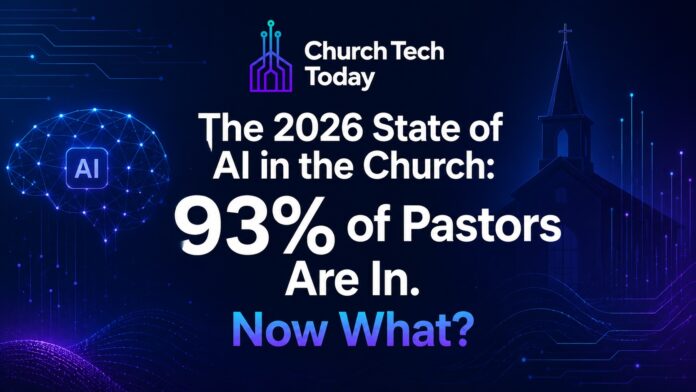
The debate is over.
The third annual State of AI in the Church Survey, conducted by AIforChurchLeaders.com, ChurchTechToday.com, and Exponential AI NEXT, surveyed hundreds of pastors and church leaders in the annual landmark study.
The results are unambiguous: AI has moved from novelty to normal, inside the American church.
93.5% of church leaders are now actively engaging with or exploring AI in ministry.
Only 2.4% say they are avoiding it entirely. (That number was at 13% against AI use for church work just two years ago.)
This is an quickly evolving leadership story.
The Numbers That Will Stop Your Scroll
Before diving into the full picture, these headline figures deserve their own moment:
43% of church leaders now use AI every single day. That is nearly double the rate reported in 2024.
78% use AI weekly or daily, up from 61% in 2025 and 43% in 2024.
64% of preaching leaders have used AI as part of sermon preparation. That figure has held steady from 2025, suggesting it has reached a durable plateau rather than a passing trend.
Only 9% of churches have a formal AI policy in place. Yet daily use is at an all-time high.
That last gap, between adoption and governance, is the most important story in this entire report.
The AI Question Has Changed
Kenny Jahng, Founder of AI for Church Leaders & Pastors, the largest online community for pastors navigating AI with over 8,100 members and growing, put it plainly.
“Two years ago, the question pastors were asking was, ‘Should I even be using this?’ That question is gone. The new question is, ‘How do we use this well?’ And that is a much harder question to answer.”
~Kenny Jahng
Jahng, who also serves as Director of Exponential AI NEXT and editor-in-chief of ChurchTechToday.com, has been tracking these trends since the first survey in 2024. He sees the 2026 data as a watershed moment. We have crossed the threshold. AI is no longer something church leaders are considering. It is something they are doing, every day, in their sermon prep, their emails, their graphics, their discipleship content. The church has arrived at AI. The real work now is building the wisdom to match the speed.”

How Churches Are Actually Using AI In Church Work
Text content creation leads the way at 36%, followed closely by research at 22% and image and graphics generation at 21%. Administrative work accounts for 13% of primary use.
The most common AI-assisted activities in the last quarter include writing or editing emails and newsletters (16%), designing graphics (15%), creating Bible study materials or devotionals (13%), generating small group discussion questions (13%), and transcribing or summarizing sermons (13%).
In other words: pastors are using AI for the tasks that have historically consumed the most time with the least strategic return.
On tools, ChatGPT remains dominant at 84%. But the rising story is Google Gemini, which jumped from 9% in 2024 to 38% in 2026, and Claude (Anthropic), now at 21% after barely registering in previous years.
The Sermon Prep Plateau
One of the more nuanced findings: AI use in sermon preparation has stabilized at roughly two-thirds of preaching leaders for two consecutive years. In 2024, only 43% of preachers had used AI for sermon prep. By 2025, that number jumped to 64%. In 2026, it held at 64%.
The survey authors describe this as a “stable adoption plateau,” suggesting the practice has moved from experiment to standard workflow for most preachers who are going to use it at all.
Agentic AI and the Next Frontier for Pastors and Staff
Perhaps the most forward-looking finding: 40% of church leaders identified AI automations as the emerging capability they most want to explore, far ahead of any other category including sermon transcription (21%), AI chatbots for websites and discipleship (9%), and real-time translation for multilingual services (7%).
29% report already experimenting with agentic AI tools, and 14.5% have used custom GPTs or Claude Projects for ministry work.
13.3% have completed at least one AI-built app or automation for their ministry. Another 4.3% have a project in progress.
“Agentic AI is the next wave. We are moving from ‘AI helps me write things’ to ‘AI does things on my behalf.’ That shift has massive implications for how small and mid-sized churches can scale ministry without scaling staff.”
~Kenny Jahng
The Concerns Are Real and Getting More Precise Regarding AI for Churches
The 2026 survey documents something important: more AI use has not reduced ethical concern. It has sharpened it.
75% of respondents cited theological misalignment as a top ethical concern, making it the most widely shared concern in the entire study. Church leaders are acutely aware that AI systems trained on theologically diverse datasets can produce content that sounds authoritative while being doctrinally problematic.
67% cited the replacement of human interaction as a top concern. 49% flagged privacy and data security. And 42.5% are focused on authenticity and transparency, specifically the question of whether congregations have a right to know when AI helped write their pastor’s sermon or their church newsletter.
64% are very concerned about AI-generated theological content that is inaccurate. 60% are very concerned about AI voice cloning scams targeting their congregation. And 30% have already encountered AI-generated misinformation or scams affecting their people.
The AI Governance Gap Is the Real Crisis For Churches
Despite all the adoption, fewer than one in ten churches has a formal AI policy. More specifically:
- 9% have a formal policy in place
- 9% are currently developing one
- 29% plan to create one but haven’t started
- 28% have no policy and no plans to create one
- 46% have not disclosed AI use to their congregation in any form
Churches are using AI at scale, daily, for their most sacred tasks, without written guidelines, without congregational transparency, and often without any formal conversation about ethics or boundaries.
“We would never let a pastor add a new ministry program without any accountability structure around it, But right now, many churches are letting AI reshape their content, their communications, and their care pathways with zero policy in place. That gap has to close. THIS is not a technology problem. It is a governance and leadership problem.”
~Kenny Jahng
What Leaders Actually Want Regarding AI For Churches
When asked what resources would help their teams adopt AI more effectively, respondents were clear and practical:
- 65% want basics of AI workshops and presentations
- 61% want tutorials for specific tools
- 59% want ministry-specific use case examples
- 47% want ethical guidance for AI in ministry
- 39% want pre-built prompts and templates
85.8% say they are already investing or plan to invest in AI education. The appetite is there. The resources are not keeping pace.
The budget reality is sobering: 46% expect to spend less than $100 on AI education this year. Only 4% are budgeting more than $2,500.
Who Took the Survey
The 509-response sample spans denominations broadly: 27% non-denominational, 12% Southern Baptist, 10% Methodist, with Wesleyan, Nazarene, Pentecostal, and Evangelical traditions well represented.
39% of respondents are Lead or Senior Pastors. 68% serve in full-time ministry positions. The majority lead congregations under 500 people, confirming that AI adoption is not limited to large, well-resourced churches.
Generationally, 48% are Gen X, 26% are Millennials, and 21% are Baby Boomers, with a small but present Gen Z cohort. Daily AI use is now widespread across every generational and church-size category.
The Framing That Matters For What’s Next
The 2026 survey closes with a framing the whole church technology space would do well to internalize:
The new central question is whether the church can build the wisdom, governance, and relational integrity to use AI well.
“The church has always been called to be wise as serpents and harmless as doves. AI doesn’t change that calling. It tests it. The churches that will lead well in the next decade are the ones building discernment alongside capability. You can’t have one without the other.”
~Kenny Jahng
Key Takeaways at a Glance
Adoption is near-universal. 93.5% of church leaders are engaging with or exploring AI. The holdouts are a shrinking minority.
Daily use has exploded. 43% use AI every day, nearly double the 2024 rate.
The tools are diversifying. ChatGPT leads at 84%, but Gemini (38%) and Claude (21%) are now mainstream in ministry contexts.
Automation is the next frontier. 40% of leaders want to explore AI automations. Agentic use is already underway.
Ethical concerns have sharpened, not softened. Theological accuracy, human connection, and authenticity top the list.
The governance gap is the defining challenge. Only 9% have a formal AI policy. Nearly half have said nothing to their congregations.
Training demand is high, budgets are low. Leaders want practical, ministry-specific education. Most are working with under $100.
Kenny Jahng is the Founder of AI for Church Leaders & Pastors, Director of Exponential AI NEXT, and Editor-in-Chief of ChurchTechToday.com. Kenny leads a community of over 8,100 church leaders in the largest online community focused on the practical and theological integration of AI in ministry.