


| TL;DR: Church leaders have mixed feelings about artificial intelligence—while many understand it and see potential, a large share remain cautious or uncomfortable about using it in ministry. 1. About 63% of leaders say they are fairly to somewhat knowledgeable about AI—but only ~9% say they are very knowledgeable. 2. 62% say they rarely or never use AI in ministry; only ~19% use it weekly or daily. 3. 54% are quite to extremely concerned about ethical issues with AI in ministry; 43% say they feel uncomfortable or anxious about using AI in their church. |
A new survey from Gloo aims to uncover how church leaders view artificial intelligence and its role in the church. The results reveal divisions in opinion, showing the need for more discussion.
A recent survey from faith-based technology company Gloo, in partnership with organizations like Barna Group and Biola’s Ed Stetzer, polled over 1,500 church leaders and members to uncover sentiments on artificial intelligence and its use in ministry.
The results reveal a split among leaders – while most understand AI generally, many express ethical concerns and discomfort with fully embracing it in their churches.
Key Survey Findings
Here are some top findings from the survey:
- 63% of leaders say they’re fairly to somewhat knowledgeable about AI, but only 9% consider themselves very knowledgeable. 28% say they know little to nothing about AI.
- 62% say they rarely or never directly use AI in their ministry work. 19% report occasional use, 19% weekly/daily use.
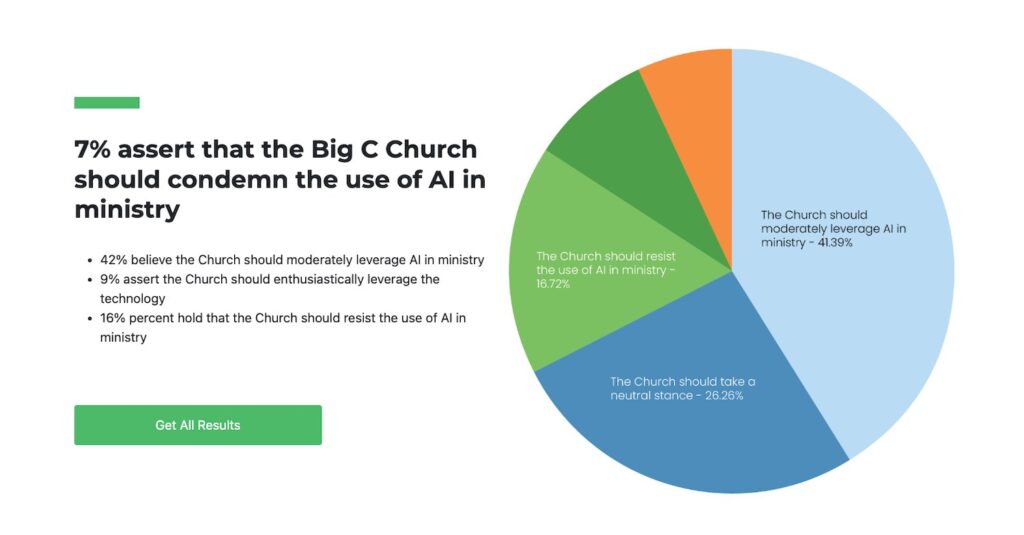
- 7% believe the Church should condemn AI use.
- 54% are quite to extremely concerned about ethical issues with AI and the church. 40% have slight to moderate concerns, 6% have no concerns.
- 43% are uncomfortable/anxious about using AI in their specific church. 27% are positive/excited, 30% neutral.
- 41% think the Church should moderately leverage AI. 26% are neutral. 17% say the Church should resist/condemn AI use.
Understanding and Use of AI Varies
The survey results reveal church leaders have a decent general understanding of artificial intelligence. Almost two-thirds say they are fairly or somewhat knowledgeable. However, less than 10% consider themselves very knowledgeable. Over a quarter admit to knowing little or nothing substantial about AI.
This shows many leaders still need more education on AI’s capabilities and limitations before fully implementing it. As Kansas City pastor Randy Frazee stated, church leaders are often behind the innovation curve and need to get up to speed.
Currently, most pastors and ministry staff are not utilizing AI directly in their roles. About 60% say they rarely or never use AI tools in their work. Only 19% use AI on at least a weekly basis.
This aligns with the finding that most leaders need more training before effectively leveraging AI technology. As adoption increases down the road, leaders must ensure ethical use.
Concerns Exist Around Ethics, Implications
A majority of church leaders express notable concern about the ethical implications of utilizing artificial intelligence in ministry. Over half are quite to extremely concerned about moral issues related to AI and the church.
AI experts both within and outside the church are similarly cautious, noting the technology’s potential benefits as well as risks. Ongoing discussion around AI ethics and establishing guardrails will be critical.
There is also discomfort among many leaders regarding AI’s emergence and its role in both society generally and their specific churches. 43% feel uncomfortable or anxious about using AI in their own ministry context.
30% hold a neutral opinion, while only 27% are positive or excited. As Ed Stetzer commented, this shows opinions vary widely on if/how AI should integrate with faith-based organizations.
Opinions Split on AI’s Church Role
Looking beyond individual churches, leaders also diverged on whether AI should have a place in the broader Church.
41% think the Church should moderately utilize AI in ministry. However, 17% say the Church should resist or condemn its use. 26% held a neutral opinion.
9% are very enthusiastic, saying the Church should take full advantage of AI technology in advancing its mission and work.
With sentiments across the spectrum, it is a prime opportunity for denominations, networks, seminaries and other institutions to guide an open discussion around if, when and how AI could assist ministry.
More Discourse Needed
Overall the survey makes clear church leaders need more education, discussion and reflection on AI’s implications for ministry. While opinions vary at this stage, increased understanding over time can lead to ethical integration where appropriate.
Gloo’s Steve Millette concluded the data should compel engagement, not retreat from AI, while Savannah Kimberlin of Barna Group said the time is right for thoughtful conversations.
With AI already transforming society, and ethical risks requiring vigilance, the church cannot ignore – but rather help guide – its emergence. Ongoing discourse and criticial analysis centered on moral questions will allow leaders to make informed decisions.
The church often brings a countercultural perspective, challenging prevailing views. This wisdom and grounding in historic beliefs can contribute to AI being harnessed for societal good.
But first, leaders must grapple with AI themselves – its values, limits, proper use cases. Gloo’s survey provides an initial snapshot of where opinions stand today among pastors and ministry staff. It likely signals the start, not end, of an important dialogue that will continue shaping AI’s evolution.