

The second annual State of AI in the Church survey reveals a sharp uptick in AI adoption among church leaders, with 91% now supporting its use in ministry work. That’s up from 87% in 2024, according to the 2025 national study conducted by ChurchTechToday.com and Exponential AI NEXT.
The survey collected responses from 594 church leaders across denominations, church sizes, and geographic regions—meeting the threshold for statistical confidence at the 95% level.
Frequency has nearly doubled in a year
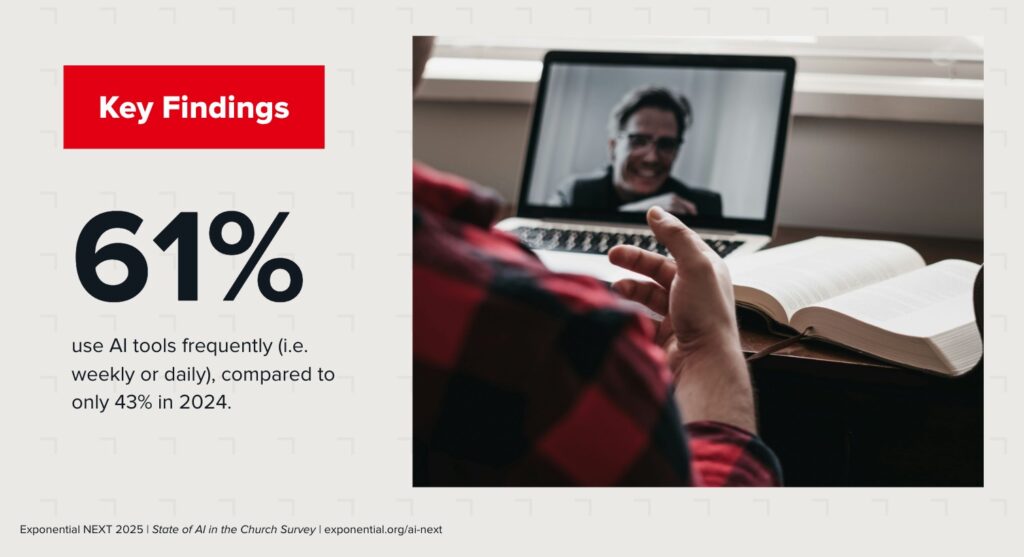
Perhaps the most striking shift from last year: 61% of respondents now use AI tools on a weekly or daily basis. In 2024, that number sat at 43%. Daily users alone account for 25% of the sample, while another 36% report weekly usage.
The data suggests AI has moved past the curiosity phase for many ministry leaders. Forty-six percent describe themselves as “optimistic and learning,” actively exploring how AI can benefit their work. Another 15% have fully embraced the technology, integrating it across multiple areas of ministry.
Only 9% of respondents remain fully opposed to AI in church contexts—down from 13% the previous year.
Content creation leads use cases
When asked about primary applications, 36% of leaders pointed to content creation. Research came in second at 26%, followed by administrative tasks at 16% and image generation at 10%.
ChatGPT dominates the tool landscape at 26% usage, with Grammarly (11%), Microsoft Co-Pilot (9%), Google Gemini (8%), and Canva Magic Studio (8%) rounding out the top five.
Sermon preparation sees dramatic growth
Among church leaders who prepare or write sermons, 64% now use AI somewhere in their process. That figure jumped 21 percentage points from 43% in 2024.
The survey didn’t specify exactly how pastors incorporate AI into sermon work, though the broader findings on content creation and research suggest these tools assist with everything from biblical research to crafting illustrations to editing final drafts. Finding the balance between AI efficiency and maintaining authentic spiritual insight will likely become a recurring conversation as adoption continues.
Where leaders see the biggest potential
Respondents ranked sermon preparation (23%), communications (20%), administration (14%), and counseling/pastoral care (14%) as the areas where AI could create the most disruption.
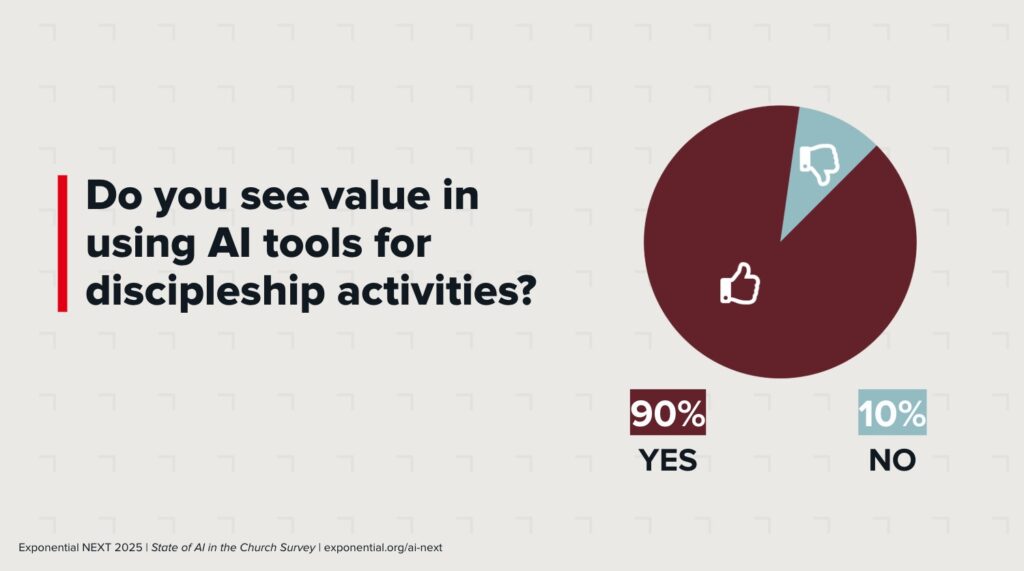
Traditional ministry functions like discipleship (13%) and worship (7%) ranked lower, possibly reflecting hesitation about AI’s role in relational and spiritual contexts. Still, 90% said they see value in using AI tools for discipleship activities.
When asked whether AI would affect their church’s effectiveness, 82% predicted it would make their ministry more effective. Fourteen percent anticipated no tangible impact, while just 4% expected AI to reduce effectiveness.
Concerns center on theology and human connection
The enthusiasm comes with caution. Theological misalignment topped the list of concerns at 29%, reflecting anxiety about misinformation and whether AI-generated content aligns with a church’s doctrinal positions.
Close behind, 23% worried about AI replacing or diminishing personal, spiritual guidance and the quality of human relationships within their congregations. Privacy and data security registered at 20%, while transparency and accountability concerns came in at 15%.
When asked about the single greatest threat AI poses to their congregation, 41% pointed to misinformation. Overdependence on technology followed at 35%.
The policy gap
Despite widespread adoption, formal governance lags far behind. Only 6% of ministries have AI policies in place. Seventy-three percent have no policy at all, while 19% are developing or considering one.
This gap creates real exposure. Without guidelines, staff members make individual decisions about which tools to use, what data to input, and how to disclose AI involvement in their work.
The survey found strong appetite for closing this gap: 87% of respondents said they’re willing to invest in AI education and training for themselves and their staff. When asked what resources would help, leaders requested tutorials for specific AI tools (22%), ministry-specific use case examples (21%), introductory training on AI basics (19%), and ethical guidance for AI use (18%).
Who responded
The respondent pool skewed toward senior leadership, with 39% identifying as lead or senior pastors. Executive pastors and directors made up 11%, and teaching or associate pastors accounted for 10%.
Non-denominational and independent churches represented 21% of responses, followed by Southern Baptist (9%), Methodist (8%), Nazarene (7%), and Wesleyan (7%) congregations.
Church size varied considerably: 30% came from congregations under 100 in weekly attendance, 24% from churches of 100-249, and 14% each from the 250-499 and 1,000-4,999 ranges.
Generation X leaders (ages 44-59) made up the largest cohort at 43%, followed by Millennials at 26% and Baby Boomers at 26%.
What comes next
The trajectory points toward continued acceleration. Resistance has dropped while usage has climbed across nearly every metric tracked between 2024 and 2025.
Church leaders weighing their own approach will need to address several practical questions: Which tasks genuinely benefit from AI assistance? How do you verify theological accuracy in AI-generated content? What safeguards protect congregant data? When should AI involvement be disclosed?
The full 2025 State of AI in the Church Report is available for download at exponential.org/AI2025.